
Yogurt and chhana making
Buying raw milk at Tk 45-55 a litre and turning it into curd and chhana. Yield per litre and spoilage decide whether it makes money.
- Last reviewed: 19 September 2026
- Version 1

Yogurt and chhana making
- Starting capital
- ৳80,000 – ৳4,50,000 Editorial estimate
- Manpower
- 1 – 5 people
- First sale
- 14 – 45 days Official source
- Break-even
- 4 – 9 months Editorial estimate
- Kind of work
- Workshop · Medium difficulty
About the business
Buying raw milk, boiling it down and setting it as curd, and cutting chhana for sweets — the two jobs usually run in the same kitchen. The work looks simple, but profit is decided in two places: how much curd one litre of milk actually becomes, and how much of it is thrown away. The milk price is known. On 1 July 2026 farmers in Shahjadpur, Sirajganj said Milk Vita collects at Tk 45-47 a litre and the open market pays up to Tk 55. The selling price is known too: Milk Vita's own price list puts one litre of sweet curd at Tk 210, sour curd at Tk 175 and a kilo of chhana sandesh at Tk 550, while a sara of Bogura curd sold for Tk 280-300 before the January 2025 VAT rise added another Tk 30-40. What nobody writes down is the number in between — kilos of curd per litre of milk, and what sugar, clay pots and gas add to each kilo. Curd lasts two or three days. Without a chiller, or through a power cut, the whole batch goes, and the loss is worst in hot weather; sending it to another city means ice or a cold vehicle, which is how Bogura curd reaches Dhaka by courier every day. The rules have tightened as well: under the 2026 food safety regulations a dairy producer must register with the Bangladesh Food Safety Authority for Tk 1,000, valid three years. The shops that survive are the ones that record milk in, curd out and curd wasted.
Unit economics
| Item | Range | Evidence | Suggest a correction |
|---|---|---|---|
| Monthly working capital | ৳75,000 – ৳3,00,000 | Editorial estimate | |
| Selling price | ৳175 – ৳340 / kg | Official source | |
| Variable cost | ৳58 – ৳69 / kg | Editorial estimate | |
| Gross margin | 61% – 83% | Editorial estimate | |
| Time to first revenue | 14 – 45 days | Official source | |
| Break-even time | 4 – 9 months | Editorial estimate | |
| Cash cycle | 2 – 30 days | Editorial estimate | |
| Waste / loss | 3% – 10% | Editorial estimate | |
| Daily capacity | 50 – 200 | Editorial estimate |
What you need to start
- A large boiling pan, a stove, strainers and chhana vessels, scales, and a fridge or chiller. A 12 kg LPG cylinder is Tk 1,585 (BERC, 2 September 2026).Equipment
- Bangladesh Food Safety Authority registration, compulsory for dairy producers under the Food Safety (Registration and Licensing) Regulations 2026: Tk 1,000 new, Tk 500 renewal, valid three years; licensing for establishments Tk 1,000-5,000.Licence
- Trade licence from the city corporation or municipality: form Tk 10, licence book Tk 50, standard tax Tk 30, stamp Tk 150-300, licence fee Tk 100-60,000 by trade type. Issued in 3-5 working days.Licence
- Knowing how long to boil the milk, how much starter curd to add and at what temperature to set it. Get these wrong and the batch is ruined.Skill
- A potter for clay saras, pots and cups. If the pots do not arrive on time the curd cannot be set at all.Supplier
- Daily raw milk from a farm, a grazing herd or a dairy cooperative. In Shahjadpur in July 2026 Milk Vita was collecting at Tk 45-47 a litre and the open market paid up to Tk 55.Supplier
- A separate kitchen with water supply and drainage. BFSA inspects the premises during registration.Workspace
How the work is done
- 1First fix where the milk comes from: a farm, a grazing herd or a cooperative. Write down the rate, the daily quantity and the delivery time.
- 2Measure for yourself how many kilos of curd one litre of milk gives. A week of writing down milk in and curd out is enough to get the number.
- 3Take the trade licence from the city corporation or municipality, with dairy products named as the trade.
- 4Register with the Bangladesh Food Safety Authority: fee Tk 1,000, valid three years, with a physical inspection of the kitchen.
- 5Set up the boiling pan, the stove, clay saras and cups, and a fridge or chiller. Without cooling, curd does not last beyond about three days.
- 6Start with small batches of 20-30 saras a day. Only scale up after seeing how much sells and how much comes back.
- 7Record three numbers every day: litres of milk in, kilos of curd out, kilos thrown away. The third number is the one that tells you whether you made money.
- 8Arrange regular supply to nearby sweet shops, hotels and caterers, but cap the credit before you start.
- 9To ship to another city, set up courier packing with ice — this is how Bogura curd travels every day.
- 10Learn to cut chhana and make sandesh and rosogolla. When curd sales drop, the same milk can go into chhana products instead.
- 11Line up extra milk and clay pots ahead of Ramadan, Eid and the wedding season, when most of the year's sales happen.
Seasons
- JanHigh
- FebHigh
- MarNormal
- AprHigh
- MayHigh
- JunHigh
- JulNormal
- AugNormal
- SepNormal
- OctNormal
- NovHigh
- DecHigh
Where it works well
- Strong fitBogura · The country's best-known curd district. Whole neighbourhoods in Sherpur and Namajkhali live off it, and curd goes out by courier nationwide every day.
- Strong fitDhaka · The biggest market, with the sweet shops, restaurants and caterers all here, but milk has to be brought in from outside, so the raw material costs more.
- Strong fitPabna · Milk Vita's Baghabarighat dairy plant sits here, with chilling centres at Bhangura and Ishwardi, so raw milk supply runs all year.
- Strong fitSirajganj · Shahjadpur produces about 5 lakh litres of milk a day from roughly 30,000 registered and unregistered farms. Milk is cheapest and easiest to get here.
- PossibleChattogram · A big-city market with many hotels and restaurants; there is a chilling centre at Patiya, but milk supply is thinner than in the north.
- PossibleKushtia · Chilling centres at Kumarkhali and Bheramara and heavy cattle rearing make raw milk easy to source.
- PossibleManikganj · A chilling centre and a location right beside Dhaka, so curd made in the morning reaches the city by midday.
- PossibleRangpur · A Milk Vita chilling centre and many farms nearby make milk cheap, but local purchasing power is lower so prices have to stay down.
- PossibleSatkhira · A chilling centre plus the Assasuni and Tala farming belt, with the Khulna city market close by.
- PossibleTangail · Has a Milk Vita chilling centre and a good road link to Dhaka, so curd can be sent out easily.
Risks and cautions
- HighSpoilage: Curd is a two-to-three-day product. Without a chiller, or through a power cut, the whole day's batch is lost, and in hot weather that happens repeatedly. Curd sent to another city can sour on the road, and then the customer returns it and the money goes back too.
- HighDependency: The whole business rests on raw milk. In July 2026 Shahjadpur farmers said feed and wages had risen while the milk price had not — daily wages went from Tk 400 to Tk 600-650 in five years. If farmers give up their cows, milk prices jump suddenly, and curd prices cannot be raised at the same speed.
- MediumCompliance: A dairy producer needs BFSA registration and a physical kitchen inspection. Operating without it risks a mobile-court fine and closure. Registration runs three years, and forgetting to renew starts the whole process again.
- MediumLate payment: Sweet shops, hotels and caterers take supply daily but pay at month end or later, while milk must be bought in cash every day. Once the outstanding balance grows, there is no money left to buy tomorrow's milk.
- MediumDemand: Sales are not level through the year. Ramadan, Eid and the winter wedding season bring sudden peaks, and the monsoon and mourning months, when functions stop, bring the trough. Set a big batch in a slow week and it is thrown away.
Sources
সিটি কর্পোরেশন থেকে ট্রেড লাইসেন্স প্রাপ্তির ধাপ সমূহ
Collected: 16 Sept 2026Supports: Starting capital · বাংলাদেশ
- Collected: 15 Sept 2026
Supports: Variable cost · ঢাকা মহানগর — সিপাহীবাগ, মিরপুর-৬, মোহাম্মদপুর টাউন হল, নিউমার্কেট, রামপুরা, মহাখালী বাজার
LPG price cut by Tk 13, 12kg cylinder now Tk 1,585 (BERC, কার্যকর ২ সেপ্টেম্বর ২০২৬)
Collected: 2 Sept 2026Supports: Starting capital · বাংলাদেশ
All food businesses now need safety registration
Collected: 22 Jul 2026Supports: Starting capital · বাংলাদেশ
পণ্য তালিকা — মিল্কভিটার ভোক্তা মূল্য (তরল দুধ, মিষ্টি দধি, টক দধি, ছানা, ঘি, বাটার)
Collected: 22 Jun 2025Supports: Selling price · বাংলাদেশ
What changed
No corrections have been published yet.
Questions and answers
No questions yet. Be the first to ask.
Stories about this business
From yogurt as a hobby to 310-330 kg a day, with demand still 50 kg ahead
Some 620-650 litres of milk a day become 310-330 kg of yogurt. Eight lakh taka went into the factory, five lakh into distribution vehicles and six lakh into land, and demand still runs about 50 kg a day ahead of supply.
- Reasons
- Weak demand, Good quality
Similar businesses
 Food processing
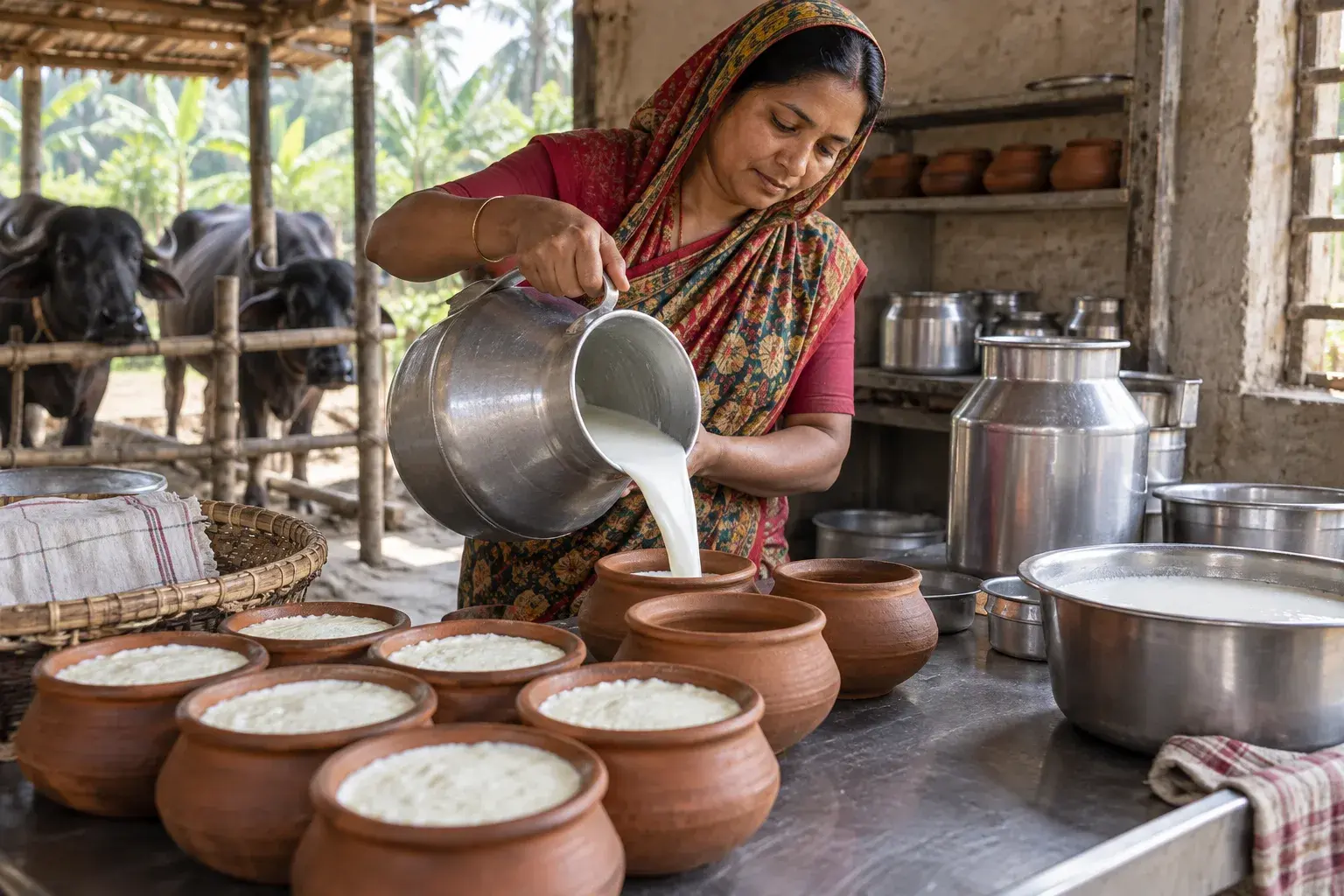
Buffalo curd and dairy
Raw buffalo milk set in clay pots. In Bhola milk costs Tk 150/kg and the curd sells at Tk 200/kg, so about Tk 50 a kg is left, and getting the milk at all is the hardest part.
- Capital
- ৳80k – ৳4 lakh
- People
- 1 – 5
- First income
- 7 – 30 days
 Food processing
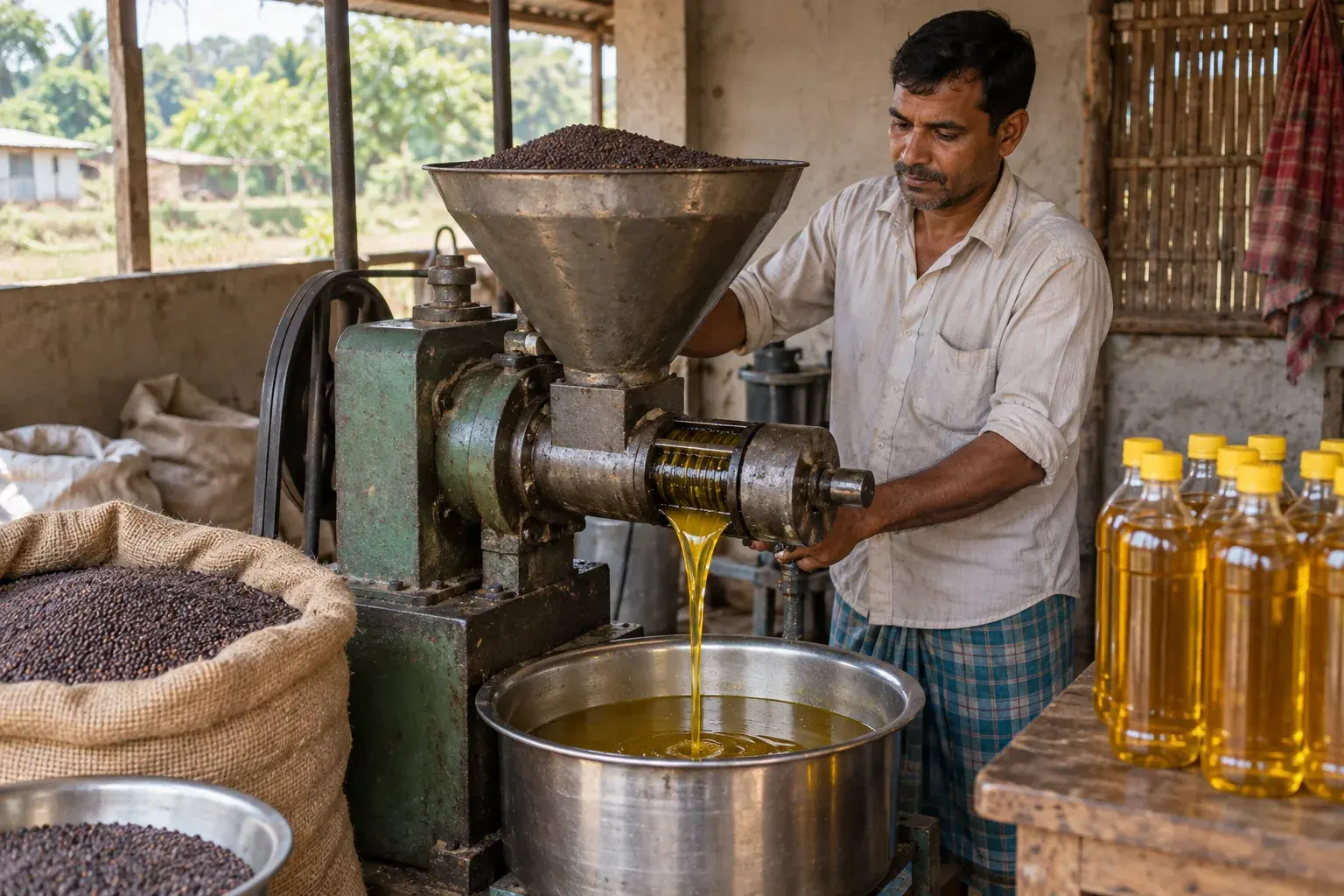
Mustard oil pressing (ghani)
Crushing mustard seed for oil and cake. A maund of seed gives 16-19 litres of oil and 25 kg of cake; net of the cake a litre costs Tk 96-114 to make and sells loose at Tk 200.
- Capital
- ৳80k – ৳5 lakh
- People
- 1 – 4
- First income
- 30 – 90 days
 Food processing
Mustard honey bottling
Place bee boxes in winter mustard fields, strain and bottle the honey, sell all year.
- Capital
- ৳1 lakh – ৳2.5 lakh
- People
- 2 – 3
- First income
- 60 – 90 days
 Food processing
Ghee and butter making
Separating milk into butter and ghee, with chhana or yogurt from the skim. One maund (40 kg) of milk gives 1.25 kg of ghee; cost about Tk 2,900 against Tk 3,040-3,260 of sales - a 5 to 11 percent margin.
- Capital
- ৳60k – ৳4 lakh
- People
- 2 – 6
- First income
- 15 – 60 days