
Chira (flattened rice) mill
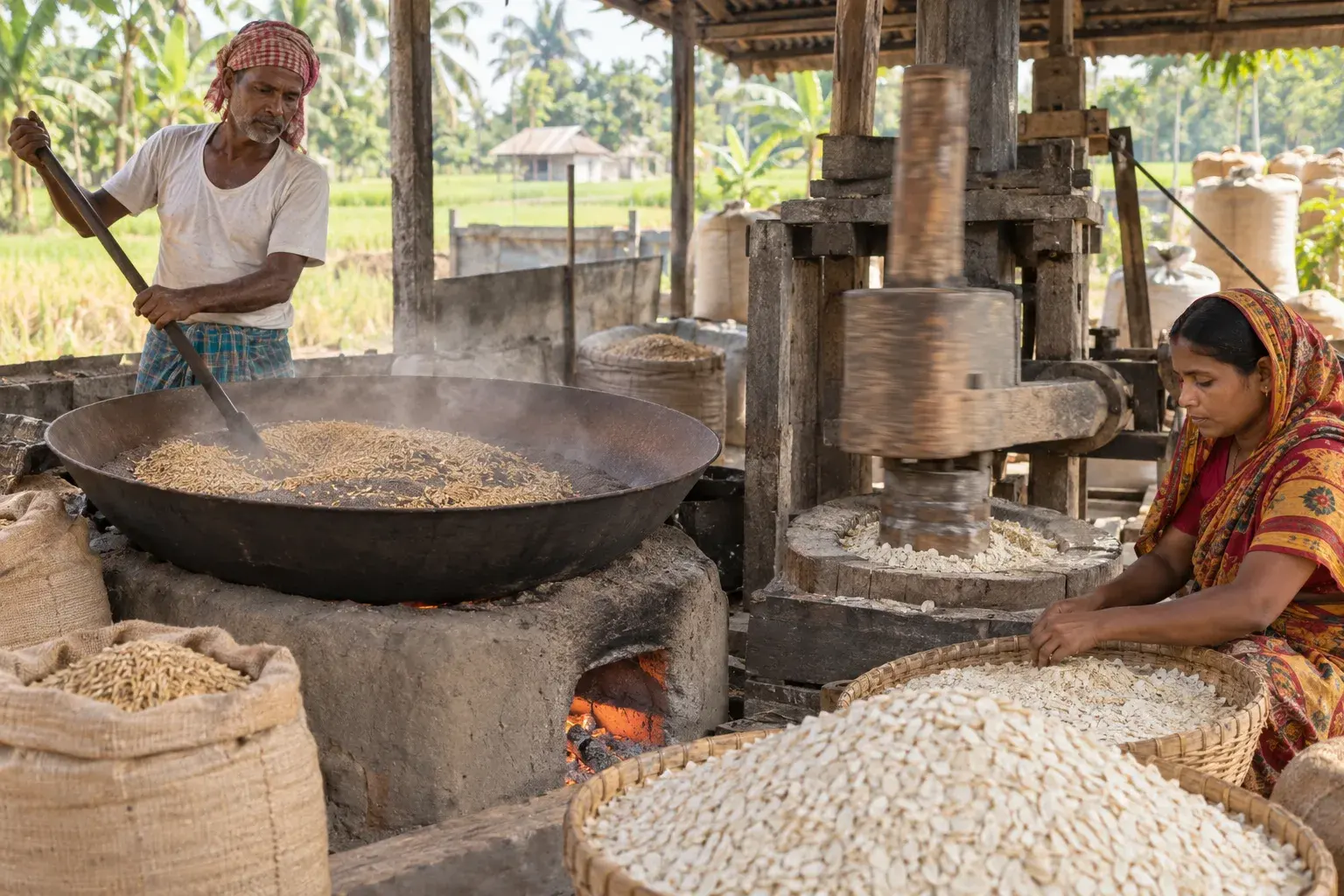
Roasting paddy in hot sand and flattening it into chira. A village mill charges about Tk 8 a kg to flatten a farmer's own paddy, while chira retails at Tk 70-80 a kg.
- Last reviewed: 19 September 2026
- Version 1
Chira (flattened rice) mill
- Starting capital
- ৳60,000 – ৳5,00,000 Editorial estimate
- Manpower
- 2 – 5 people
- First sale
- 30 – 90 days Editorial estimate
- Break-even
- 3 – 7 months Editorial estimate
- Kind of work
- Workshop · Medium difficulty
About the business
A chira mill turns paddy into flattened rice. Sand is heated in a big pan over a furnace, paddy is poured into the hot sand, and as soon as it starts to pop the whole lot goes into a sieve and the sand is shaken out. The paddy then goes through a round machine and comes out as chira, and a final sieving clears the husk. There are two kinds of mill and the arithmetic is different for each. The village mill flattens the farmer's own paddy for a fee by the kilo - at Asaduzzaman's mill at Dugdugi haat in Ghoraghat, Dinajpur the rate was Tk 8 a kg, so five kilos of paddy cost the farmer Tk 40. That mill runs two days a week, on haat days, and is busiest in the Aman and Boro paddy seasons. The other kind buys paddy, makes chira and sends it to the wholesale market. Chira was retailing at Tk 70-72 a kg at Karwan Bazar in Dhaka, while Kaliakoir's famous 'Dhanir chira' in Gazipur sells at Tk 400-500. The advantage of chira is that it does not spoil, and demand comes from three directions: iftar in Ramadan, flood relief, and everyday breakfast. During the 2024 floods chira and muri were selling at Karwan Bazar before the trucks could be unloaded and the price rose Tk 4-5 a kg in a week. The risk is fuel: when the furnace and the machine both stop, so does production.
Unit economics
| Item | Range | Evidence | Suggest a correction |
|---|---|---|---|
| Monthly working capital | ৳30,000 – ৳3,80,000 | Editorial estimate | |
| Selling price | ৳70 – ৳80 / kg | Market quote | |
| Variable cost | ৳52 – ৳63 / kg | Editorial estimate | |
| Gross margin | 10% – 35% | Editorial estimate | |
| Time to first revenue | 30 – 90 days | Editorial estimate | |
| Break-even time | 3 – 7 months | Editorial estimate | |
| Cash cycle | 0 – 1 days | Editorial estimate | |
| Waste / loss | 2% – 5% | Editorial estimate | |
| Daily capacity | 300 – 1,000 | Editorial estimate |
What you need to start
- A furnace and a large pan, sand, a coarse sieve, the round flattening machine, a husk sieve and scales.Equipment
- Trade licence from the union parishad, municipality or city corporation: form Tk 10, licence book Tk 50, standard tax Tk 30, stamp Tk 150-300, licence fee Tk 100-60,000 by trade type, issued in 3-5 working days.Licence
- Bangladesh Food Safety Authority registration, compulsory for packaged food producers under the Food Safety (Registration and Licensing) Regulations 2026: Tk 1,000 new, Tk 500 renewal, valid three years. Whether a mill that only flattens a farmer's own paddy needs it was not confirmed and must be checked with the authority.Licence
- Judging the sand's heat and the moment to lift the paddy. Too long and the chira crumbles; too little and it stays hard.Skill
- A paddy supply. At a village mill the farmer brings his own, but making chira to sell means a relationship with a paddy arot.Supplier
- A roadside shed beside the haat with somewhere for the smoke to go, and a dry corner for sacks of paddy.Workspace
How the work is done
- 1Take a place beside the haat or on the road to it. Farmers will not carry a sack of paddy far.
- 2Fix your running days by the haat days. The Ghoraghat mill runs Friday and Tuesday because those are the haat days.
- 3Take the trade licence from the union parishad or municipality, and get food processing named on it as the trade.
- 4If you will pack and sell under your own name, take Bangladesh Food Safety Authority registration: Tk 1,000 new, Tk 500 renewal, valid three years.
- 5Build the furnace and the big pan and arrange the sand. Heating the sand is the heart of the job.
- 6Install the round flattening machine and the sieve for husk. You also need room to shake the sand out through a jhanjhar.
- 7Keep two workers: one on the furnace handling sand and paddy, one shaking out sand and feeding the machine.
- 8Set the milling charge by the kilo and put it on the board. At Ghoraghat it was Tk 8 a kg.
- 9Prepare separately for the Aman and Boro harvests, when farmers flatten a year's supply at once.
- 10Plan for fried chira before Ramadan: it sold at Tk 120 a kg in the Lalmonirhat iftar market.
- 11Hold stock through the flood season. In the 2024 floods the goods were gone at Karwan Bazar before the trucks were unloaded.
- 12Line up a fuel alternative. Chira and muri production has stopped before because of gas shortages.
Seasons
- JanNormal
- FebHigh
- MarHigh
- AprNormal
- MayNormal
- JunNormal
- JulHigh
- AugHigh
- SepNormal
- OctNormal
- NovHigh
- DecHigh
Where it works well
- Strong fitDhaka · The chira and muri arots at Karwan Bazar are the biggest selling point in the country, and during floods they run out here first.
- Strong fitDinajpur · A working chira mill at Dugdugi haat in Ghoraghat, in a paddy district where the raw material is at hand.
- Strong fitGazipur · Kaliakoir's 'Dhanir chira' sells at Tk 400-500 a kg, so there is a distinct market for a premium chira here.
- PossibleBogura · A centre for both paddy and machinery; mill machines are made here.
- PossibleJoypurhat · A paddy area with many haats, which suits a village custom-milling operation.
- PossibleKurigram · Flood-prone, so demand for dry relief food comes round every year.
- PossibleKushtia · An old paddy and food-processing area.
- PossibleLalmonirhat · Fried chira has steady demand in the town's Ramadan iftar market.
- PossibleMymensingh · A big paddy area with easy road access to the Dhaka market.
- PossibleNaogaon · A paddy district with many rice mills, so paddy comes cheap.
Risks and cautions
- HighDependency: Without fuel the mill does not run. A gas shortage in 2024 disrupted chira and muri production and pushed the price up. A day without furnace fuel or power is a day with no income at all, and if it is a haat day the whole week is gone.
- HighDemand: Demand is seasonal and irregular. Outside Ramadan, the floods and the harvest the mill sits mostly idle - the Ghoraghat mill works all year but only two days a week, on haat days. Ramadan moves eleven days earlier every year, so last year's calendar is no guide.
- MediumWorking capital: Buying paddy to make chira means putting the whole paddy cost in first and getting it back slowly. Working on a milling fee avoids that risk, but then the income is only a few taka a kilo.
- MediumCompliance: Selling packaged under your own name needs Food Safety Authority registration, and mobile courts fine mills for adulteration or unclean premises. Note that muri is on BSTI's mandatory certification list (BDS 1796) while chira is not among those 315 products - so chira needs no CM licence, but adding muri would.
- LowSpoilage: Chira is dry and keeps well, but a wet sack or a damp store gives it an off smell and insects, and then no wholesaler will take it.
Sources
List of 315 Products Brought Under Mandatory Certification Marks Wing
Collected: 16 Sept 2026Supports: Starting capital · বাংলাদেশ
What changed
No corrections have been published yet.
Questions and answers
No questions yet. Be the first to ask.
Stories about this business
Chira at 40-42 taka a kilo, muri next door at 45-50, and the grocers stopped asking
At the Fatulla wholesale market chira moves at 40-42 taka a kg while muri fetches 45-50 wholesale and 50-70 retail. A maund of rice yields 28-30 kg of muri, and with demand shifting the chira mills are going quiet.
- Reasons
- Weak demand
Similar businesses
 Food processing
Ghee and butter making
Separating milk into butter and ghee, with chhana or yogurt from the skim. One maund (40 kg) of milk gives 1.25 kg of ghee; cost about Tk 2,900 against Tk 3,040-3,260 of sales - a 5 to 11 percent margin.
- Capital
- ৳60k – ৳4 lakh
- People
- 2 – 6
- First income
- 15 – 60 days
 Food processing
Tulshimala aromatic rice
Growing and milling Sherpur's GI-registered aromatic paddy. Paddy is Tk 2,200-2,400 a maund and the rice sells online at Tk 145-150 a kilo - no higher than aromatic rice without a GI.
- Capital
- ৳50k – ৳3 lakh
- People
- 1 – 6
- First income
- 120 – 180 days
 Food processing
Solar and rack-dried shutki
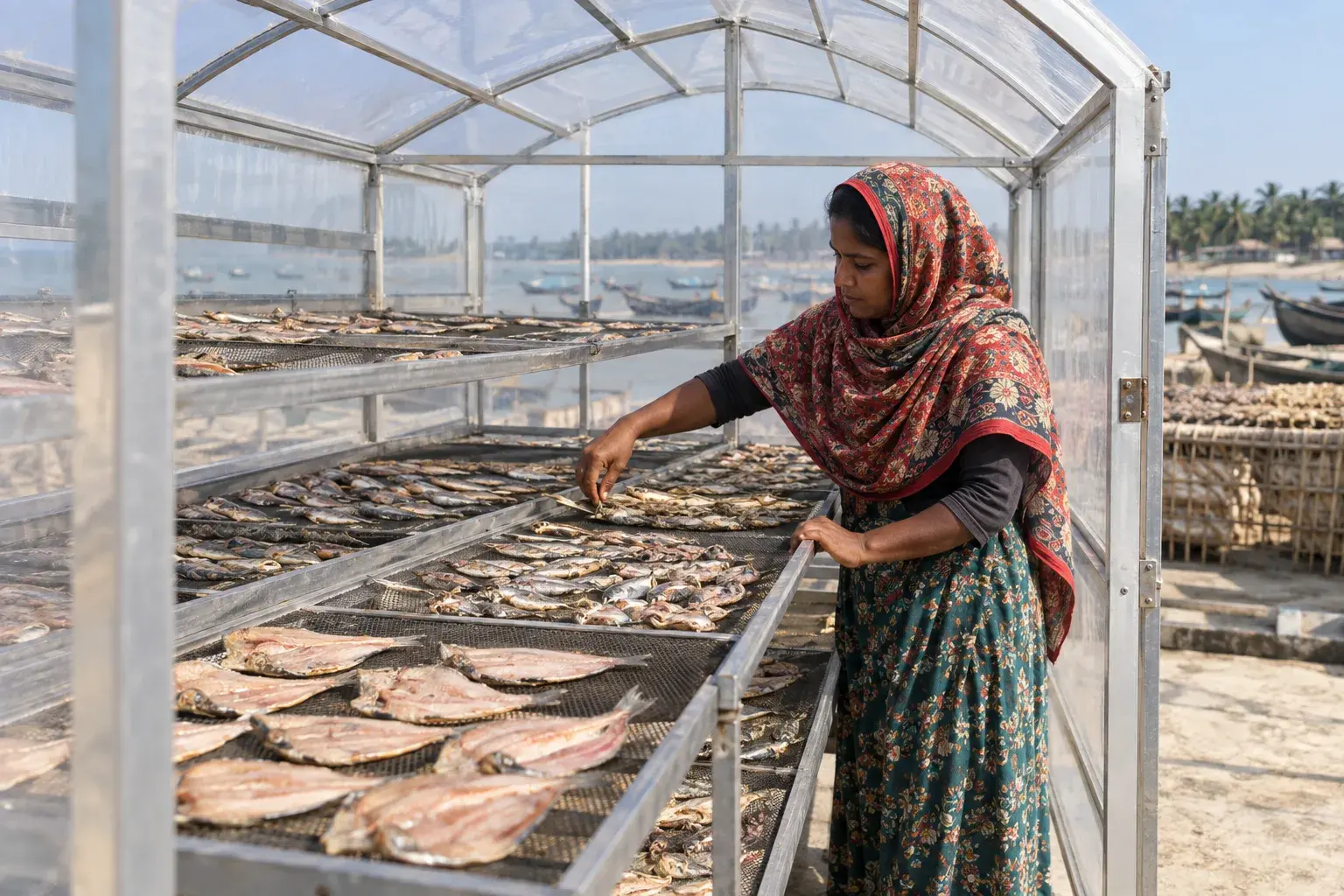
Drying fish on raised racks or inside a solar dryer instead of on the ground, so no insecticide is needed. At Asadganj on 3 June 2026 good churi shutki fetched Tk 2,000-2,500 and loitta Tk 600-1,500 a kg.
- Capital
- ৳50k – ৳6 lakh
- People
- 2 – 20
- First income
- 20 – 60 days
 Food processing
Paneer and chhana making
Milk split into chhana, pressed into paneer. 8-10 kg of milk makes 1 kg of paneer, which sells at Tk 900-1,200 a kg - the whole business is the gap between the two prices.
- Capital
- ৳50k – ৳20 lakh
- People
- 1 – 10
- First income
- 7 – 135 days