
Farm machinery rental
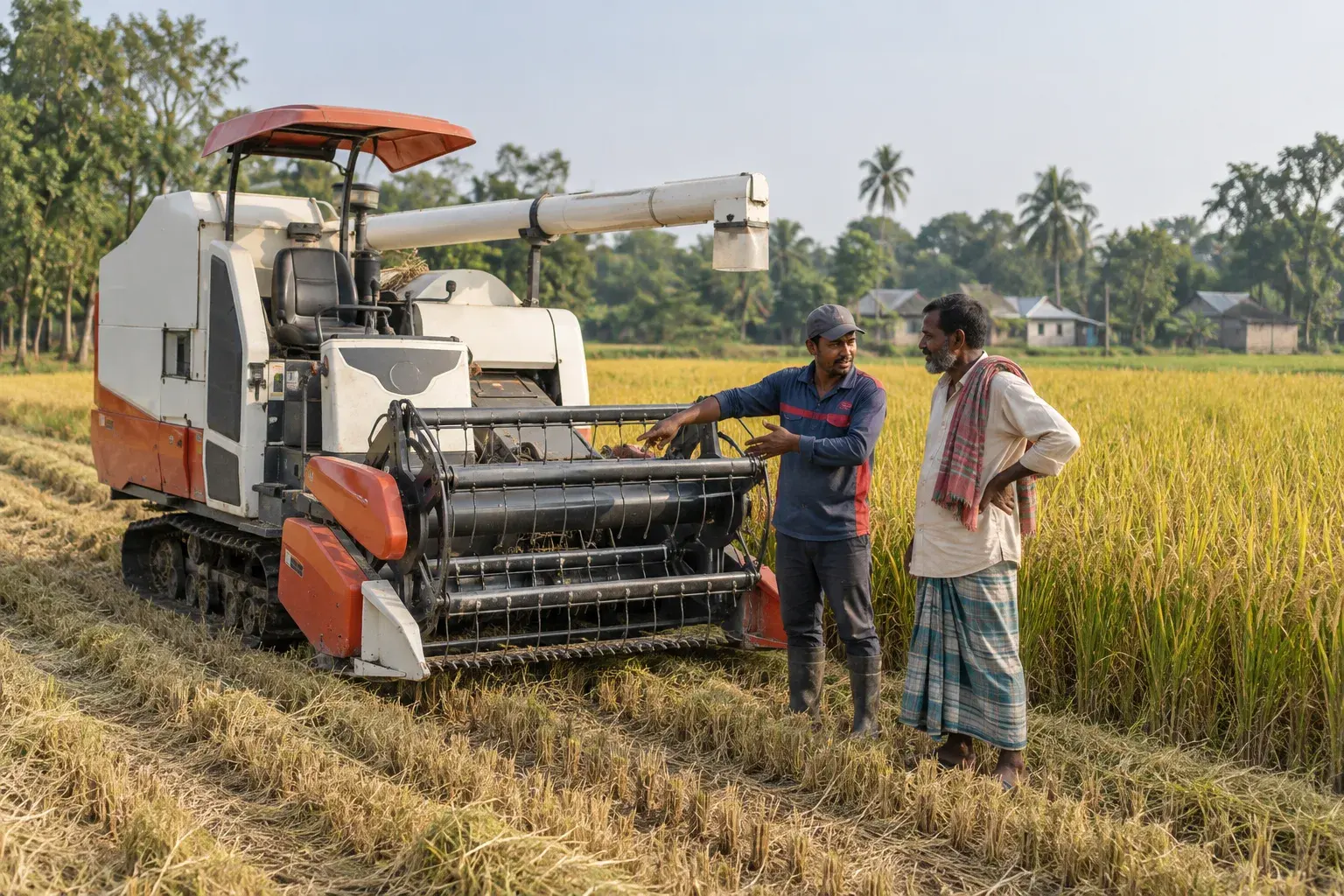
Buying a harvester or reaper and hiring it out to farmers. In May 2026 the fixed rate in Katiadi was Tk 2,500 a bigha; a machine costs Tk 30-40 lakh and the subsidy has been suspended since June 2024.
- Last reviewed: 19 September 2026
- Version 1
Farm machinery rental
- Starting capital
- ৳30,00,000 – ৳40,00,000 Market quote
- Manpower
- 2 – 6 people
- First sale
- 15 – 180 days Editorial estimate
- Break-even
- 18 – 60 months Editorial estimate
- Kind of work
- Mobile service · Hard
About the business
Buying a combine harvester, reaper, rice transplanter or power tiller and hiring it out on farmers' land. The arithmetic of this business is the subsidy. Under the government's farm mechanisation project the state was to pay 50 percent on the plains and up to 70 percent in the haor, against a target of 51,300 machines of twelve types, of which about 40,000 were delivered. But the subsidy has been suspended since June 2024 over irregularity allegations, and machinery sales have fallen 80 to 90 percent. A combine harvester now costs Tk 30-40 lakh; with the subsidy running it would be Tk 15-20 lakh on the plains and Tk 9-12 lakh in the haor. That difference decides whether the business happens at all. As for the rate: in May 2026 the Upazila Agriculture Officer in Katiadi, Kishoreganj fixed a maximum of Tk 2,500 a bigha, and although 27 harvesters were working in the upazila, demand was such that machines had to be brought in from neighbouring districts, because a farm labourer costs Tk 1,300 a day and two maunds of paddy were no longer enough to hire one. A machine cuts about an acre an hour, and about three acres a day in practice. Recovering a Tk 30 lakh machine takes 1,200 bighas of cutting, and the Boro season lasts about a month. The business therefore lives on how much land you can book in one season, and an idle machine is a loss.
Unit economics
| Item | Range | Evidence | Suggest a correction |
|---|---|---|---|
| Monthly working capital | ৳1,00,000 – ৳4,00,000 | Editorial estimate | |
| Selling price | ৳2,500 / unit | Official source | |
| Variable cost | ৳330 – ৳600 / unit | Editorial estimate | |
| Gross margin | 76% – 87% | Editorial estimate | |
| Time to first revenue | 15 – 180 days | Editorial estimate | |
| Break-even time | 18 – 60 months | Editorial estimate | |
| Cash cycle | 0 – 15 days | Editorial estimate | |
| Waste / loss | 10% – 20% | Editorial estimate | |
| Daily capacity | 9 – 24 | Editorial estimate |
What you need to start
- A truck or trolley to move the machine between plots and districts, plus a stock of spare parts for the season.Equipment
- A combine harvester, Tk 30-40 lakh (2025). Reapers, rice transplanters, seeders and power threshers are also covered by the project, but their prices could not be verified here.Equipment
- Trade licence from the union parishad, municipality or city corporation: form Tk 10, licence book Tk 50, standard tax Tk 30, stamp Tk 150-300, licence fee Tk 100-60,000 by trade type.Licence
- Application to the upazila agriculture office for the farm mechanisation subsidy - 50 percent on the plains, up to 70 percent in the haor. The subsidy has been suspended since June 2024 over irregularity allegations, so confirm at the office whether it is running before applying.Licence
- A skilled operator. One machine gave work to six people including the driver. Without a company-trained operator the machine breaks more and leaves paddy in the field.Skill
- A service centre and parts dealer for that brand in your own district, plus a reliable diesel supply.Supplier
- A roofed place to keep the machine out of season. Six months in the open shortens its life fast.Workspace
How the work is done
- 1Count how much paddy land there is in your area and how many machines already work it. An upazila like Katiadi had 27 machines and still could not meet demand, while elsewhere two machines fill the market.
- 2Go to the upazila agriculture office and find out whether the machinery subsidy is running now, and whether your area counts as haor.
- 3If the subsidy is running, apply - 50 percent on the plains, up to 70 percent in the haor. A Tk 30 lakh machine can come to Tk 9 lakh in the haor, and that difference is what makes the business work.
- 4Before choosing a brand, check whether that company has a service centre and spare parts in your district. A breakdown mid-season that takes more than three days to fix costs the season.
- 5Take the trade licence from the union parishad or municipality, and arrange the truck or trolley to move the machine.
- 6Hire a skilled operator and learn to run it yourself. In untrained hands the machine breaks more often and paddy is left in the field.
- 7Book land before the season starts. Write down whose paddy ripens when and plan the days around it - a day idle is more than a thousand taka lost.
- 8Check first whether the upazila agriculture office has fixed the rate. Katiadi capped it at Tk 2,500 a bigha and there were complaints of operators charging more.
- 9Take the money as the cutting is done, especially from sharecroppers. 'After I sell the paddy' can mean the money never comes even when the season ends.
- 10After Boro, take the machine to another district. Paddy ripens earlier in the haor and later in the north, and that gap lets one machine work two or three areas.
- 11At season's end wash the machine, oil it, cover it, and service it before the next season. The biggest bills come from starting a machine that sat for six months.
Seasons
- JanNormal
- FebLow
- MarLow
- AprHigh
- MayHigh
- JunNormal
- JulNormal
- AugLow
- SepLow
- OctNormal
- NovHigh
- DecHigh
Where it works well
- Strong fitKishoreganj · A haor district, so within the 70 percent subsidy. Katiadi upazila had 27 harvesters working and still could not meet demand, and the upazila agriculture officer capped the rate at Tk 2,500 a bigha in May 2026.
- Strong fitNetrokona · Haor country under the 70 percent subsidy, where large contiguous plots let the machine work at its best rate.
- Strong fitSunamganj · The country's largest haor area, inside the 70 percent subsidy band, where Boro ripens early so the season starts here first.
- PossibleBogura · The trading centre of the north, with parts and service centres close at hand.
- PossibleBrahmanbaria · Haor and low-lying land, with the Dhaka-Chattogram highway close so the machine is easy to move.
- PossibleDinajpur · A big paddy district where a shortage of workers and machines in season pushes rates up.
- PossibleGopalganj · Beel and low-lying land, where the rush to cut before the water rises keeps machine demand high.
- PossibleHabiganj · A haor district where fear of early flash floods makes farmers want to cut fast, so machine demand is sharp.
- PossibleJashore · Both paddy and wheat are grown, so the machine can get two runs of work a year.
- PossibleSylhet · Has haor land and remittance money to buy machines, though the plots are scattered.
Risks and cautions
- HighCompliance: The whole arithmetic rests on the subsidy, and it has been suspended since June 2024 over irregularity allegations. Of a 51,300-machine target about 40,000 had been delivered when it stopped, leaving 11,000 undelivered, and machinery sales fell 80 to 90 percent. Without the subsidy a Tk 30-40 lakh machine must be bought outright. The Agriculture Secretary said it would resume once the irregularities are settled but gave no date - check the current position at the upazila agriculture office before committing money.
- HighWorking capital: At Tk 2,500 a bigha it takes about 1,200 bighas of cutting just to recover a Tk 30 lakh machine, or 1,600 bighas for a Tk 40 lakh one - and that is before fuel, the operator's wage and repairs. The Boro cutting window is only a few weeks. Buy on credit and the instalments run twelve months while the income comes in two or three.
- HighDependency: A mid-season breakdown stops the business. Without that brand's service centre in the district, getting a part can take a week, and by then the farmers who booked you have called another machine. Land lost mid-season does not come back.
- MediumLate payment: Farmers say they will pay after selling the paddy, and when the paddy price is low that money sticks. In May 2026 in Katiadi green paddy was Tk 650-700 a maund, and against a production cost of Tk 22,000 a bigha, 25 maunds brought only Tk 17,500 - the farmer was losing Tk 4,000-5,000 a bigha. Collecting rent from a farmer in loss is hard.
- MediumDemand: The demand is real but it bunches into a few weeks. With labour at Tk 1,300 a day and two maunds of paddy no longer enough to hire a worker, everyone wants machines - Katiadi had 27 and still imported more from neighbouring districts. But for the same reason, if everyone buys one, next year's per-bigha rate falls.
Sources
সিটি কর্পোরেশন থেকে ট্রেড লাইসেন্স প্রাপ্তির ধাপ সমূহ
Collected: 16 Sept 2026Supports: Starting capital · বাংলাদেশ
What changed
No corrections have been published yet.
Questions and answers
No questions yet. Be the first to ask.
Similar businesses
 Agriculture & farming
Strawberry farming
A winter crop fruiting in 72-75 days at Tk 400-1,000 a kilo, but about Tk 4 lakh goes into just 30 decimals and the fruit keeps only two or three days.
- Capital
- ৳4 lakh – ৳12 lakh
- People
- 2 – 12
- First income
- 72 – 75 days
 Agriculture & farming
Biofloc fish farming
Dense fish farming in tanks. High output from a small space is possible, but in Thakurgaon one farmer put in Tk 4 lakh and sold only Tk 60,000 of fish.
- Capital
- ৳3 lakh – ৳4 lakh
- People
- 1 – 3
- First income
- 150 – 180 days
 Agriculture & farming
Layer poultry farm for eggs
Feed alone is Tk 7.90-9.30 per egg and full production cost Tk 8.50-10. Through mid-2026 farmers were getting Tk 6-6.80, a loss on every egg.
- Capital
- ৳3 lakh – ৳15 lakh
- People
- 1 – 4
- First income
- 126 – 140 days
 Agriculture & farming
Dairy cattle farm
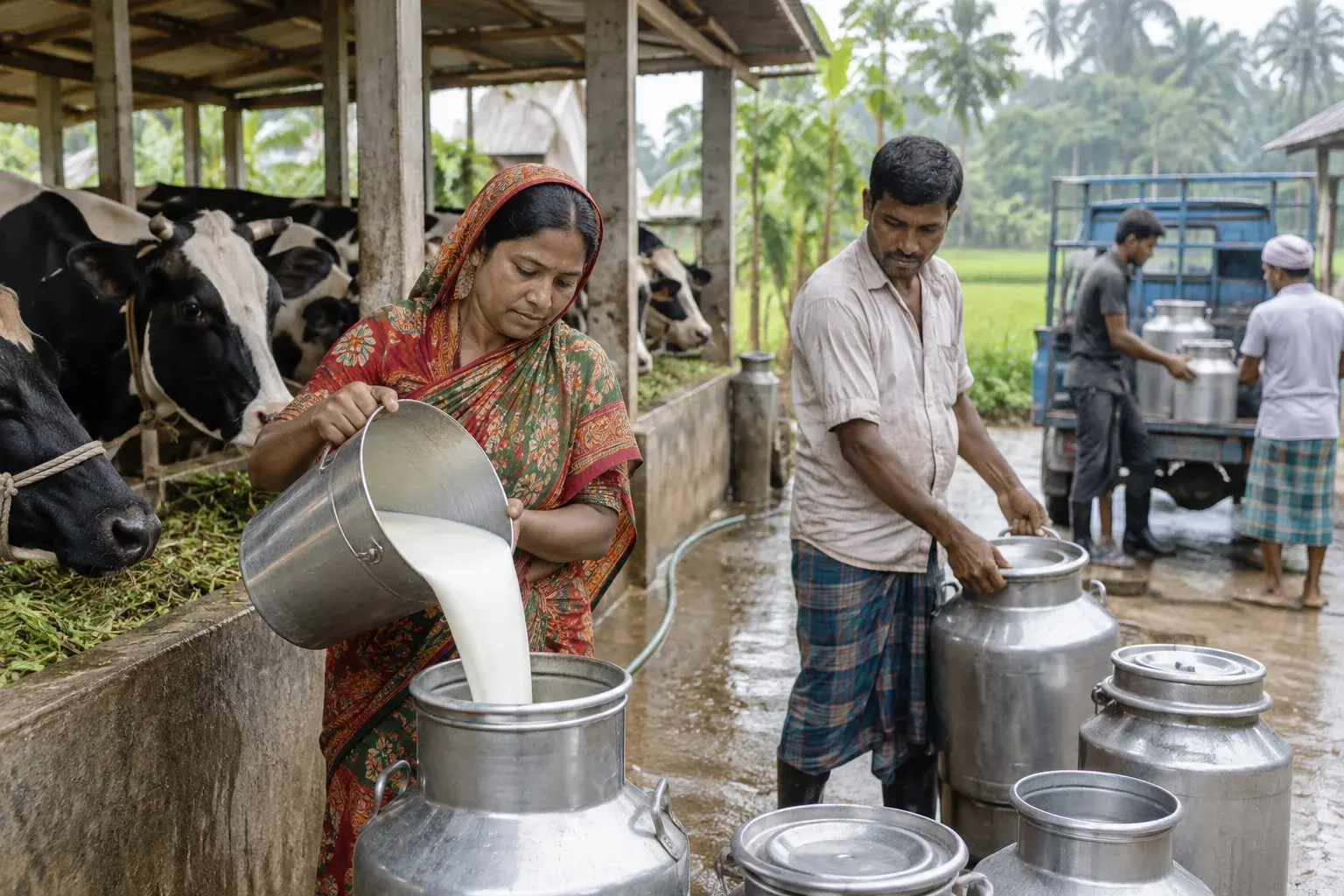
Rearing milch cows and selling milk daily. Milk Vita pays Tk 45-47 a litre and the open market about Tk 55, against a farmer-stated cost of roughly Tk 32.5 a litre. Output halves for three monsoon months.
- Capital
- ৳2.5 lakh – ৳12 lakh
- People
- 1 – 6
- First income
- 7 – 60 days