
Layer poultry farm for eggs
Feed alone is Tk 7.90-9.30 per egg and full production cost Tk 8.50-10. Through mid-2026 farmers were getting Tk 6-6.80, a loss on every egg.
- Last reviewed: 19 September 2026
- Version 1

Layer poultry farm for eggs
- Starting capital
- ৳3,00,000 – ৳15,00,000 Editorial estimate
- Manpower
- 1 – 4 people
- First sale
- 126 – 140 days Editorial estimate
- Break-even
- 10 – 16 months Editorial estimate
- Kind of work
- Farm · Hard
About the business
Keeping layer hens and selling eggs every day. Chicks are bought and fed for 18-20 weeks before the first egg, then lay for around eighteen months, after which the spent birds are sold and the cycle restarts. The whole business rests on one number: what feed costs per egg. A hen in lay eats about 120 grams of feed a day. On 7 September 2026 a 50 kg sack of layer feed cost Tk 2,950-3,100, that is Tk 59-62 per kg, so feed is Tk 7.08-7.44 per bird per day. At 80-90 percent lay that is Tk 7.90-9.30 of feed in every single egg. Add chicks, vaccines and medicine, electricity, labour and mortality and the industry association puts farm-level production cost at about Tk 10 an egg. In July 2026 farmers were selling at about Tk 6 - a loss of Tk 4 an egg and, the association says, around Tk 500 crore a month nationally. In the same period Dhaka retail was Tk 48-50 per hali of four, about Tk 12-12.50 an egg. The gap between the farm gate and the retail counter is the real story of this business: producing eggs is not the hard part, getting paid for them is.
Unit economics
| Item | Range | Evidence | Suggest a correction |
|---|---|---|---|
| Monthly working capital | ৳2,12,000 – ৳2,24,000 | Editorial estimate | |
| Selling price | ৳6 – ৳7 / unit | Disputed | |
| Variable cost | ৳9 – ৳10 / unit | Disputed | |
| Gross margin | -67% – -25% | Disputed | |
| Time to first revenue | 126 – 140 days | Editorial estimate | |
| Break-even time | 10 – 16 months | Editorial estimate | |
| Cash cycle | 7 – 20 days | Editorial estimate | |
| Waste / loss | 4% – 10% | Editorial estimate | |
| Daily capacity | 750 – 900 | Editorial estimate |
What you need to start
- Cages or litter, feeders, a water line or drinkers, lights and fans, a generator or IPS, and egg trays.Equipment
- Layer feed: Tk 2,950-3,100 per 50 kg sack on 7 September 2026, that is Tk 59-62 per kg, and 70-80 percent of total cost.Starting stock
- Trade licence from the union parishad, municipality or city corporation: form Tk 10, licence book Tk 50, standard tax Tk 30, stamp Tk 150-300, licence fee Tk 100-60,000 by trade type, issued in 3-5 working days.Licence
- Farm registration with the upazila livestock office under the Department of Livestock Services. Registered farms appear on the lists for vaccination, advice and government support. The exact fee and validity could not be verified here.Licence
- Keeping to the vaccination schedule, recognising disease early, and keeping daily records of feed, eggs and mortality. Without the third, the first two do not help.Skill
- A hatchery or chick dealer, a feed dealer, and a livestock officer or veterinary medicine shop; all three are needed continuously.Supplier
- A shed, cage or deep-litter, with through ventilation, away from housing and other farms, with separate disposal for litter and dead birds.Workspace
How the work is done
- 1Pick a dry, airy site away from the house. Another poultry farm next door sharply raises the risk of disease spreading.
- 2Go to the upazila livestock office for farm registration and the vaccination schedule, and take a trade licence from the union parishad or municipality.
- 3Build the shed, deciding cage or floor first. Cages need less space and keep eggs cleaner, but cost more up front.
- 4Fix your chick supplier and confirm price and delivery date in writing. A sudden jump in chick prices changes the arithmetic of the whole cycle.
- 5Fix a feed dealer and record the price per sack. On 7 September 2026 layer feed was Tk 2,950-3,100 a sack, and dealers charge more per sack on credit.
- 6Pin the vaccination schedule on the wall and never let it slip a day. One disease outbreak can take half the flock, and the feed bill does not stop.
- 7Write down three numbers every day: kilos of feed used, eggs collected, birds dead. Without those three there is no way to know whether the farm is making money.
- 8Decide the buyer before the first egg: aratdar, middleman, or direct to shops and hotels. Direct pays more but the daily delivery is your problem.
- 9Do not hoard eggs. When the market dips the temptation is to hold, but eggs spoil and lose weight; waiting out the price is not the farmer's game.
- 10After about eighteen months of lay production falls off. Plan the sale of the spent flock and the intake of new chicks before you get there.
- 11Work out cost per egg every month: total cost divided by total eggs. The day that number rises above your selling price, every egg is losing money.
Seasons
- JanHigh
- FebNormal
- MarLow
- AprNormal
- MayNormal
- JunNormal
- JulLow
- AugNormal
- SepNormal
- OctNormal
- NovHigh
- DecHigh
Where it works well
- Strong fitChattogram · Big-city demand with many hotels and bakeries, and feed raw material lands at the port so feed is relatively close.
- Strong fitCumilla · On the Dhaka-Chattogram highway, so eggs can reach either big-city market the same day.
- Strong fitGazipur · A large poultry belt next to Dhaka with feed dealers, hatcheries and egg arats close by, and eggs reach the Dhaka market quickly.
- Strong fitKishoreganj · A big farming and trading cluster around Bhairab, served by both river and road.
- Strong fitNarsingdi · An established farming area beside the Dhaka-Sylhet highway, so sending eggs to Dhaka is easy.
- PossibleBogura · The trading centre of the north with maize and feed supply nearby, but transport to the Dhaka market costs more.
- PossibleFeni · A highway-side area of small and medium farms feeding the Chattogram and Cumilla arats.
- PossibleJashore · An older farm and hatchery area that can serve the Khulna division market.
- PossibleRajshahi · A maize-growing area so feed raw material is close, but local purchasing power is lower.
- PossibleTangail · On the Dhaka-north highway with cheaper land and workable access to the Dhaka market.
- Weak fitRangamati · Scattered settlement and hill transport push costs up before the feed sack even arrives.
Risks and cautions
- HighDemand: The farmer does not set the egg price and it swings violently. In July 2026 farmers were getting about Tk 6 against a Tk 10 cost, which the industry association put at around Tk 500 crore of losses a month nationally. In August retail jumped from Tk 120 to Tk 165-180 a dozen inside one week while the farm-gate price stayed near Tk 6. The upswing is captured by the hands in between, not the farm.
- HighWorking capital: The feed bill never pauses. A 1,000-bird farm eats 120 kg a day, over Tk 7,000 a day and over two lakh a month, whether the eggs sell or not. When prices fall farmers borrow to keep feeding, and that borrowing is what closes the farm in the next cycle.
- HighDependency: Seventy to eighty percent of cost sits in one input, feed, and its price is set by the feed companies. On 7 September 2026 a rise of Tk 2-3 per kg added Tk 100-150 to every sack. The cause was maize going from Tk 29-30 to Tk 49 a kg, and the farmer has no influence over that.
- HighSpoilage: Once disease is in the shed a large share of the flock can die within days, and the feed for those birds is already paid for. A power cut that stops the fans in hot weather does the same. Eggs themselves do not keep for more than a few days.
- MediumLate payment: Aratdars and middlemen take the eggs and pay later. When the feed bill is weekly and the egg payment is fortnightly, the farmer borrows to bridge the gap.
Sources
সিটি কর্পোরেশন থেকে ট্রেড লাইসেন্স প্রাপ্তির ধাপ সমূহ
Collected: 16 Sept 2026Supports: Starting capital · বাংলাদেশ
- Collected: 15 Sept 2026
Supports: Selling price · ঢাকা মহানগর — সিপাহীবাগ, মিরপুর-৬, মোহাম্মদপুর টাউন হল, নিউমার্কেট, রামপুরা, মহাখালী বাজার
What changed
No corrections have been published yet.
Questions and answers
No questions yet. Be the first to ask.
Stories about this business
Bird flu killed 100 hens, the farm closed, and he now cuts earth for a living
A 300-bird layer farm gave 290 eggs a day at 10 taka each, about 2,900 taka of daily income. Bird flu killed 100 hens; he sold the remaining 200 and closed, putting the loss at about a lakh taka.
- Reasons
- Other, Working capital
Similar businesses
 Agriculture & farming
Biofloc fish farming
Dense fish farming in tanks. High output from a small space is possible, but in Thakurgaon one farmer put in Tk 4 lakh and sold only Tk 60,000 of fish.
- Capital
- ৳3 lakh – ৳4 lakh
- People
- 1 – 3
- First income
- 150 – 180 days
 Agriculture & farming
Dairy cattle farm
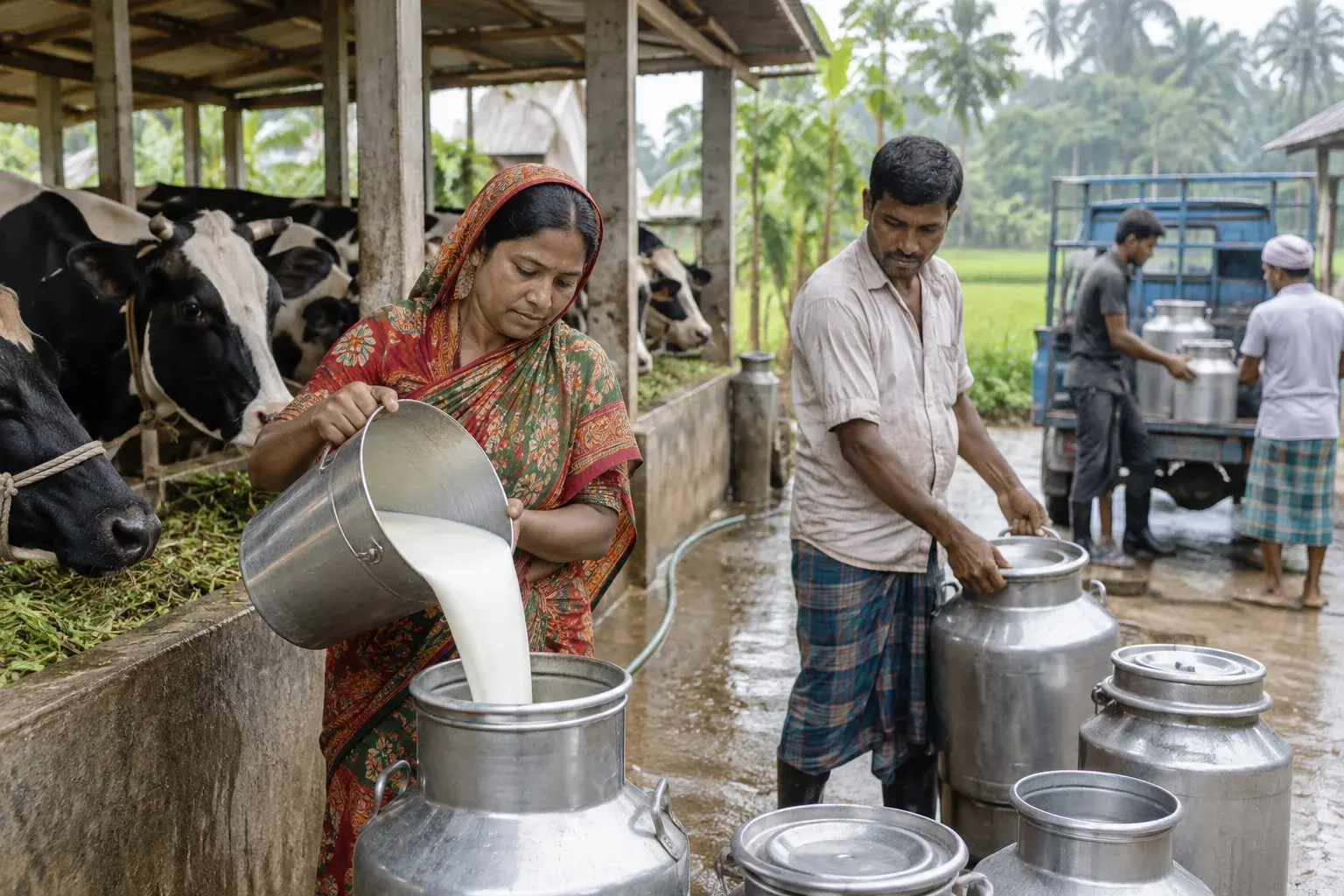
Rearing milch cows and selling milk daily. Milk Vita pays Tk 45-47 a litre and the open market about Tk 55, against a farmer-stated cost of roughly Tk 32.5 a litre. Output halves for three monsoon months.
- Capital
- ৳2.5 lakh – ৳12 lakh
- People
- 1 – 6
- First income
- 7 – 60 days
 Agriculture & farming
Strawberry farming
A winter crop fruiting in 72-75 days at Tk 400-1,000 a kilo, but about Tk 4 lakh goes into just 30 decimals and the fruit keeps only two or three days.
- Capital
- ৳4 lakh – ৳12 lakh
- People
- 2 – 12
- First income
- 72 – 75 days
 Agriculture & farming
Fish nursery and fry
Nursing hatchery spawn into fingerlings and selling them to fish farmers. On a government farm's 2026 targets, spawn runs about Tk 1,900 a kg and fingerlings about Tk 250 a kg.
- Capital
- ৳2 lakh – ৳22 lakh
- People
- 2 – 12
- First income
- 60 – 365 days