
Maize farming
Feed mills buy every kilo, so the buyer is fixed in advance. One bigha costs Tk 12,000-14,000 and yields 30-36 maunds, worth Tk 750-800 a maund wet and Tk 1,040-1,060 dried.
- Last reviewed: 19 September 2026
- Version 1
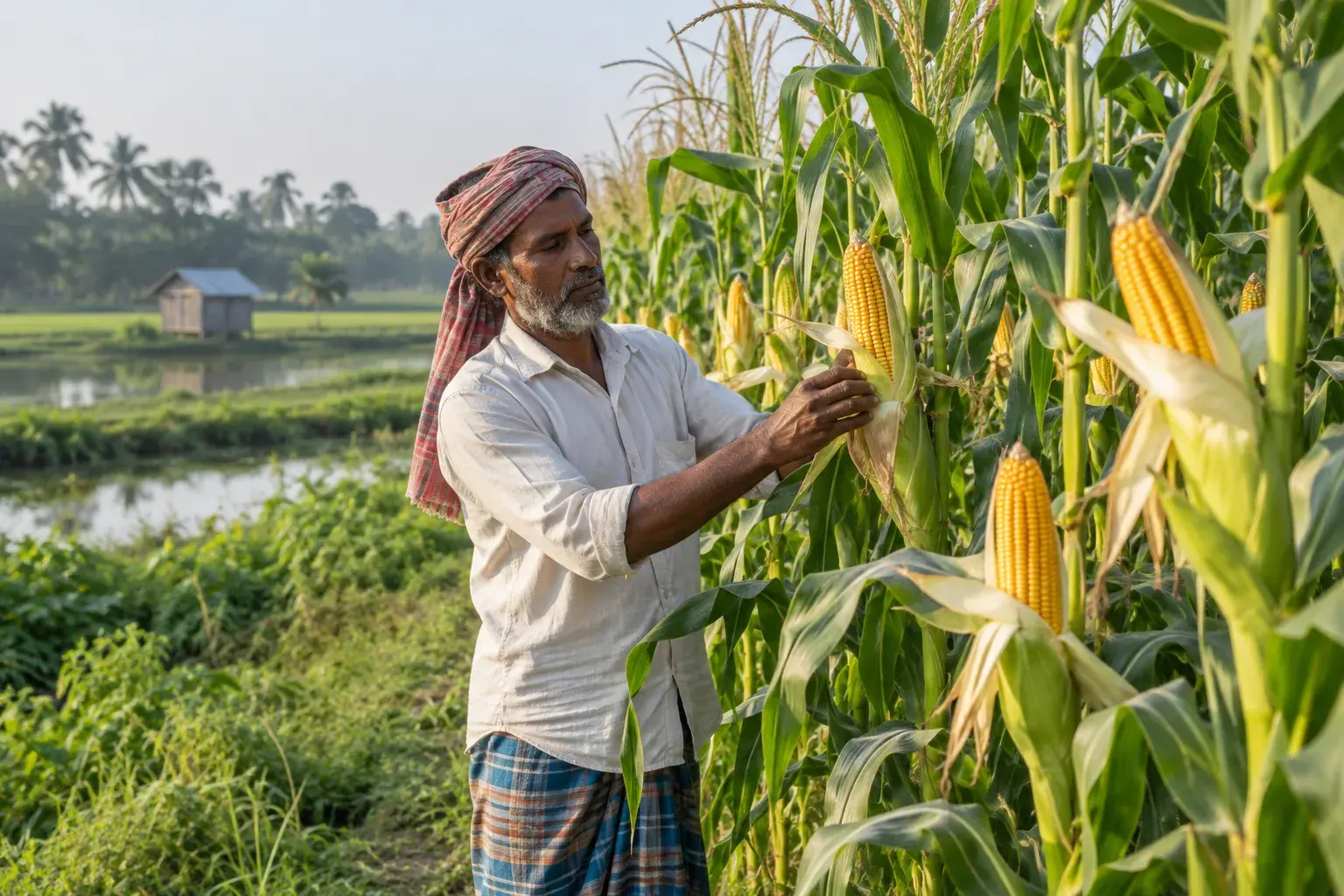
Maize farming
- Starting capital
- ৳12,000 – ৳42,000 Practitioner verified
- Manpower
- 1 – 4 people
- First sale
- 120 – 160 days Editorial estimate
- Break-even
- 5 – 6 months Editorial estimate
- Kind of work
- Farm · Easy
About the business
The great advantage of maize is one a vegetable grower never has: the buyer is already fixed. Poultry, fish and cattle feed mills take every kilo, because maize is roughly 60 percent of a feed formulation. Nothing has to be thrown away the way brinjal or tomato does when the market turns. BSS reported the Lalmonirhat arithmetic on 10 May 2026: about Tk 12,000-14,000 of cost on one bigha, 30 to 36 maunds in a good harvest, and Tk 16,000-18,000 left after costs. There are two prices - Tk 750-800 a maund for wet maize straight off the field and Tk 1,040-1,060 dried - and that gap is the whole game. A farmer with a drying yard and enough cash to wait gets about three hundred taka more a maund; one who has to sell on threshing day does not. Jamilur Rahman, a wholesaler at Chilmari in Kurigram, was buying at Tk 27-28 a kg from farmers in 2025 and selling to feed mills at Tk 29 - the middleman's own margin is only a taka or two, but he can pay cash. The risk is entirely in the price. Feed mills also buy imported maize, so when the world price falls the local one follows; in 2025 northern farmers were losing money as costs rose and prices fell. Maize does not perish, so dried properly it can be held until the price lifts, and in this business the biggest decision about profit and loss is when to sell.
Unit economics
| Item | Range | Evidence | Suggest a correction |
|---|---|---|---|
| Monthly working capital | ৳3,000 – ৳10,500 | Editorial estimate | |
| Selling price | ৳750 – ৳1,060 / unit | Practitioner verified | |
| Variable cost | ৳333 – ৳467 / unit | Editorial estimate | |
| Gross margin | 38% – 69% | Editorial estimate | |
| Time to first revenue | 120 – 160 days | Editorial estimate | |
| Break-even time | 5 – 6 months | Editorial estimate | |
| Cash cycle | 0 – 7 days | Editorial estimate | |
| Waste / loss | 4% – 10% | Editorial estimate | |
| Daily capacity | 0.1 – 0.3 | Editorial estimate |
What you need to start
- An irrigation pump or arrangement, a thresher or sheller (usually hired), tarpaulin or a drying floor, and sacks.Equipment
- Hybrid maize seed, urea, TSP and MOP, pesticide and irrigation. Lalmonirhat farmers put all of it together at Tk 12,000-14,000 a bigha.Starting stock
- Trade licence from the union parishad or municipality: form Tk 10, licence book Tk 50, standard tax Tk 30, non-judicial stamp Tk 150-300, licence fee Tk 100-60,000 by trade type. Not needed to sell your own crop, needed if you buy and sell or run a depot.Licence
- Judging the drying. Under-dried maize gets rejected or discounted by the mill; leave it too long and the weight drops.Skill
- An authorised seed and fertiliser dealer, a pump owner, a thresher owner, and the feed mill's buying agent or a maize wholesaler.Supplier
- Cultivable land - one bigha (33 decimals) is enough to start, and the sandy soil of a char will do - plus open space to dry the maize and a dry room to hold it.Workspace
How the work is done
- 1Pick the land. Maize is a rabi crop, sown in November-December and harvested in April-May. It does well on the sandy soil of the chars, so it grows where paddy will not.
- 2Go to the upazila agriculture office. The Department of Agricultural Extension advises on seed, fertiliser and technique and runs incentive schemes, and they know which variety yields here.
- 3Do the per-bigha sum first. Lalmonirhat farmers put it at Tk 12,000-14,000 a bigha. If the land is rented, add the rent on top of that.
- 4Buy seed from a government or authorised dealer and keep the receipt. Hybrid maize seed is expensive, so a fake batch wipes out a whole season's spending.
- 5Get irrigation and fertiliser timing right. Whether the field gives 30 maunds or 36 rests on those two.
- 6Decide before threshing whether you sell wet or dry. Wet off the field is Tk 750-800 a maund and dried is Tk 1,040-1,060 - a gap of about three hundred taka a maund.
- 7Arrange a drying space - a yard, a concrete floor or a school ground. Line up people who can lift the crop when rain comes, because wet maize goes mouldy and feed mills will not take it.
- 8Get in touch with the local feed mill or its buying agent. Mills prefer local maize over imports, so once they know you they come looking in season.
- 9Know both the wholesaler's rate and the mill's before selling. In 2025 the Chilmari wholesaler bought at Tk 27-28 a kg and sold to the mill at Tk 29; knowing the gap makes the bargaining easier.
- 10Do not sell it all at once. Maize does not perish, and dried well and kept free of insects it holds for months, so this crop gives you the option of waiting out a low price.
Seasons
- JanNormal
- FebNormal
- MarNormal
- AprHigh
- MayHigh
- JunHigh
- JulLow
- AugLow
- SepLow
- OctLow
- NovHigh
- DecHigh
Where it works well
- Strong fitDinajpur · A major northern maize district with established depots and wholesale markets, so rates are known and buyers easy to find.
- Strong fitKurigram · Wholesalers at Chilmari buy straight from the field and send it on to the feed companies without storing, which makes this the easiest place to sell for cash.
- Strong fitLalmonirhat · 30,885 hectares under maize this year, with 30-36 maunds a bigha leaving Tk 16,000-18,000 after costs, bought by poultry, fish and cattle feed makers.
- Strong fitNilphamari · Farmers switch to maize when paddy prices fall, and feed company buying agents come to the district's maize markets.
- Strong fitRangpur · Maize depots and transport concentrated around the divisional town, with cultivation reaching onto char and sandy land.
- PossibleChuadanga · A south-western maize district, closer to the feed mills of Dhaka and Narayanganj.
- PossibleGaibandha · Record maize area on the Brahmaputra chars, where the sandy soil takes maize though it will not take paddy.
- PossibleJamalpur · Maize on the Jamuna chars, with relatively easy access to the Dhaka feed mills.
- PossibleJhenaidah · Interest in maize is rising in upazilas like Kotchandpur on the back of good prices.
- PossiblePanchagarh · A northern border district with rising maize area, though the big feed mills are far and freight costs more.
- PossibleThakurgaon · Good maize area with a strong seed and fertiliser dealer network, and wholesalers who buy at the field.
Risks and cautions
- HighDemand: The price moves with the world market, because feed mills import as well as buy local. In June 2024 the farm-to-mill-gate rate fell from Tk 32-38 a kg to Tk 24-28 within two months, a drop of about 40 percent. In 2025 costs rose while prices fell and farmers in Lalmonirhat, Kurigram, Rangpur and Dinajpur lost money. Nobody can say what the price will be when the crop comes in.
- HighWorking capital: Tk 12,000-14,000 a bigha goes out on seed, fertiliser and irrigation and comes back only after harvest, four or five months later. Without cash in hand the crop has to go wet on threshing day at Tk 750-800 a maund when dried it would have fetched Tk 1,040-1,060. Many farmers lose about three hundred taka a maund purely for want of the ability to wait.
- MediumDependency: The buyer is certain but the buyers are few. A handful of companies dominate the feed, day-old chick and egg markets - six or seven big ones, according to the president of the Bangladesh Poultry Association. They set the rate; the farmer can take it or not.
- MediumSpoilage: Maize itself does not rot, but wet it goes mouldy and then the mill either refuses it or cuts the price. A nor'wester or unseasonal rain in April or May can ruin a standing or drying crop in a day.
- MediumOther: Maize area is rising fast as farmers move off wheat, reaching 672,000 hectares in FY2024-25. More area means the crop lands together in the season and the rate sags. The year everyone jumps in on a good margin is the year the price goes.
Sources
সিটি কর্পোরেশন থেকে ট্রেড লাইসেন্স প্রাপ্তির ধাপ সমূহ
Collected: 16 Sept 2026Supports: Starting capital · বাংলাদেশ
What changed
No corrections have been published yet.
Questions and answers
No questions yet. Be the first to ask.
Stories about this business
Two storms in one day and night, and the maize is flat on the ground
A squall with hail on Saturday morning and a second in the middle of that night laid the maize flat in Thakurgaon; the farmer says the season's capital went with it.
- Reasons
- Other, Working capital
Similar businesses
 Agriculture & farming
Date palm sap and gur
Tapping date palms in winter and boiling the sap into gur. In the 2025-26 season granulated gur ran Tk 350-400 a kg and patali Tk 450-600, but the work lasts only three or four months a year and the gachhi who can climb are disappearing.
- Capital
- ৳10k – ৳60k
- People
- 1 – 4
- First income
- 20 – 35 days
 Agriculture & farming
Fodder grass cultivation
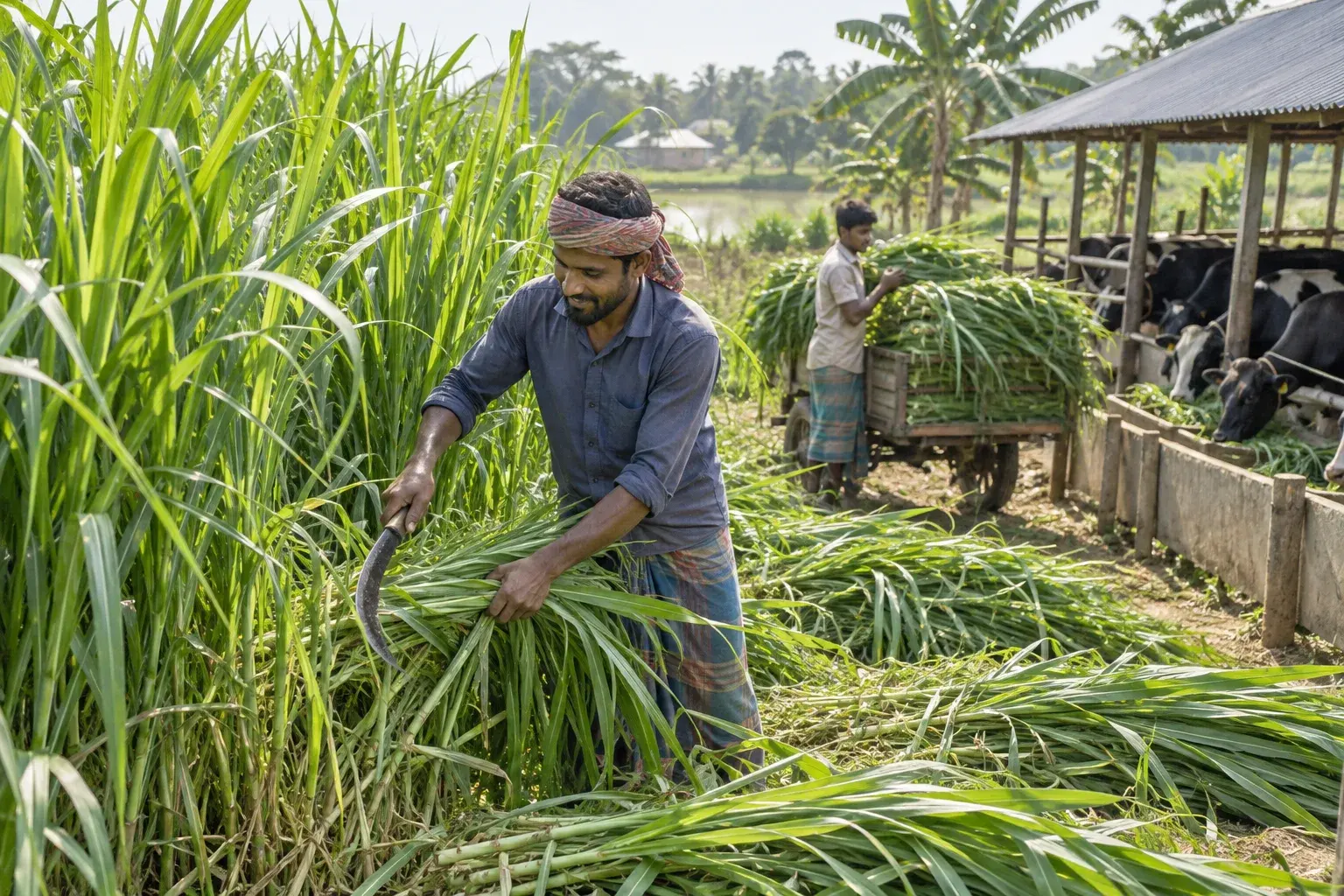
Growing napier fodder for cattle farms. One planting yields for four to five years with four to six cuts a year, and surplus grass off one bigha brings Tk 30,000-35,000 extra a year.
- Capital
- ৳10k – ৳50k
- People
- 1 – 3
- First income
- 50 – 70 days
 Agriculture & farming
Bamboo cultivation
Planting bamboo clumps and cutting culms year after year. Nothing can be cut for the first 3-4 years after planting; after that a culm fetches Tk 100-250 in the village and Tk 125-350 wholesale at the market.
- Capital
- ৳15k – ৳3 lakh
- People
- 1 – 4
- First income
- 1,095 – 2,920 days
 Agriculture & farming
Medicinal plant farming
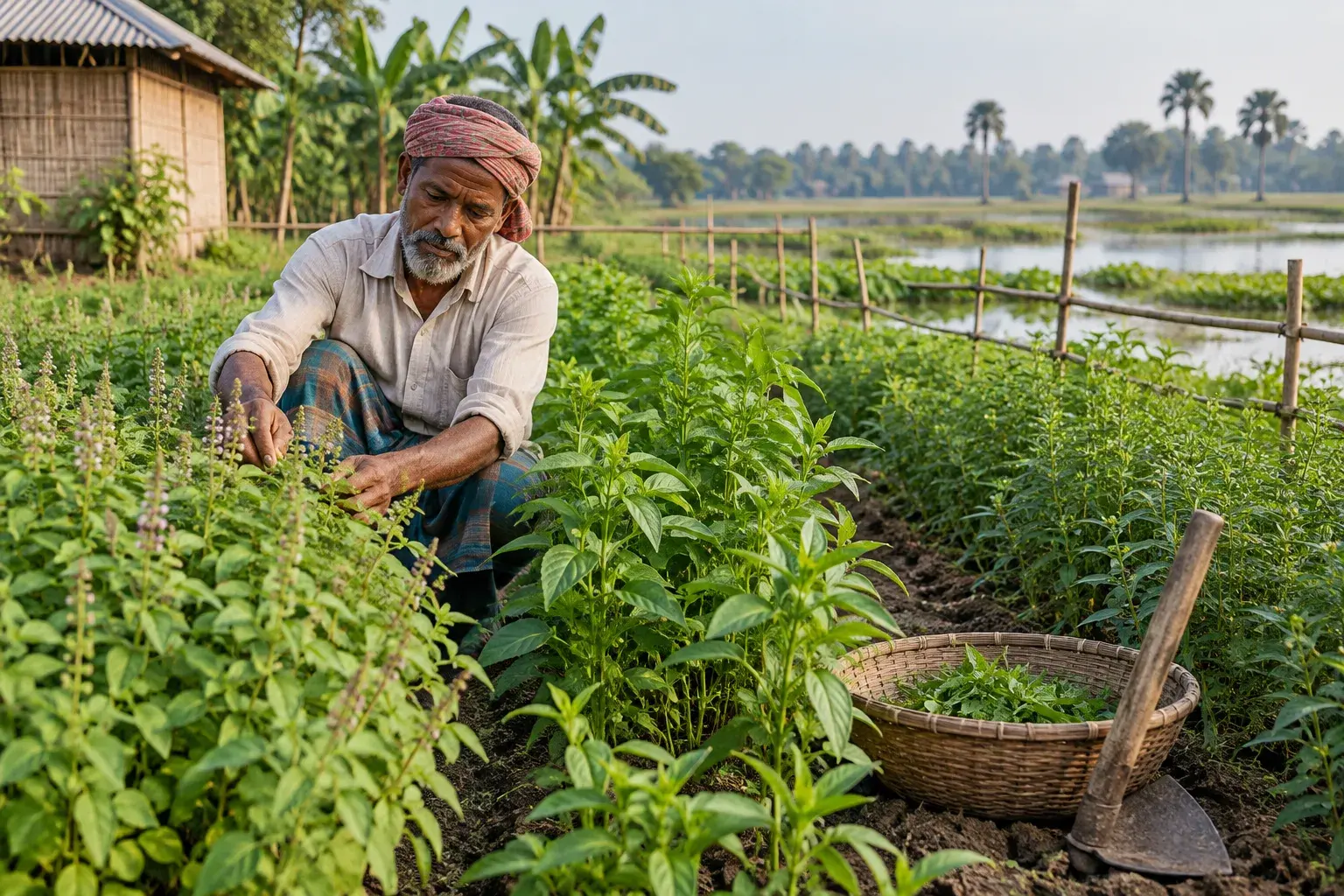
Growing basok, kalomegh, tulsi and arjun. The buyers are medicine companies, so the price is set by contract or tender: a bigha of kalomegh costs Tk 15,000, yields 20-22 maunds and sells at Tk 2,400 a maund.
- Capital
- ৳15k – ৳1 lakh
- People
- 1 – 5
- First income
- 90 – 365 days