
Plastic scrap collection and recycling
Buying, sorting and reselling discarded plastic. The margin is Tk 2-20 a kg, and Dhaka scrap shops pay about Tk 22 a kg at the door.
- Last reviewed: 19 September 2026
- Version 1

Plastic scrap collection and recycling
- Starting capital
- ৳80,000 – ৳6,00,000 Editorial estimate
- Manpower
- 2 – 8 people
- First sale
- 15 – 45 days Editorial estimate
- Break-even
- 5 – 13 months Editorial estimate
- Kind of work
- Workshop · Medium difficulty
About the business
Buying discarded plastic, sorting it by type, cleaning it and selling it on to a grinding factory. Waste pickers, waste-van workers and municipal crews bring sacks in the morning; the shop weighs them and pays cash on the spot. Prothom Alo reported on 18 May 2026 that Dhaka waste-van workers are paid Tk 22 per kg for recyclables and that a single van yields about 10 kg of saleable scrap a day. A survey of scrap and processing shops in Natore found collection shops buying PET bottles at Tk 10-12 and selling at Tk 12-16 a kg, and hard plastic bought at Tk 20-30 and sold at Tk 30-50; that survey dates from 2019-20 and is old. So the margin is two to twenty taka a kilo: the money is in volume, not in price. Nobody fixes the rate and there is no guaranteed buyer, so prices move week to week and the load goes to whoever bids highest that day. The work is dirty and needs floor space, because a truckload only builds up over a week. On 13 August 2026 the government gazetted Extended Producer Responsibility guidelines for plastic waste, requiring large producers and brand owners to collect 15 percent and recycle 7.5 percent of what they sell in the first two years, rising to 30 and 15 percent. Demand for collected plastic should rise over the coming years, and the scrap shop is the first hand that material passes through.
Unit economics
| Item | Range | Evidence | Suggest a correction |
|---|---|---|---|
| Monthly working capital | ৳60,000 – ৳1,80,000 | Editorial estimate | |
| Selling price | ৳7 – ৳50 / kg | Market quote | |
| Variable cost | ৳5 – ৳30 / kg | Market quote | |
| Gross margin | 17% – 40% | Editorial estimate | |
| Time to first revenue | 15 – 45 days | Editorial estimate | |
| Break-even time | 5 – 13 months | Editorial estimate | |
| Cash cycle | 7 – 30 days | Editorial estimate | |
| Waste / loss | 15% – 20% | Editorial estimate | |
| Daily capacity | 140 – 200 | Editorial estimate |
What you need to start
- Digital scale, sacks and baling gear, a handcart or van. To shred you also need a shredder, washing tanks and drying space; machine prices could not be verified here.Equipment
- A stock of sorted plastic, at least one truckload, otherwise there is nothing to ship.Starting stock
- Environmental clearance from the Department of Environment. A shredding or melting unit needs one; the fee is set by the size of the investment, but the exact figure for this trade could not be verified here.Licence
- Trade licence from the city corporation or municipality: form Tk 10, licence book Tk 50, standard tax Tk 30, stamp Tk 150-300, licence fee Tk 100-60,000 by trade type. Issued in 3-5 working days.Licence
- Identifying plastic grades by touch, by burning and by smell. Old traders in Islambagh and Posta judge pellet quality by feel, by biting and by burning it; that recognition is the real capital.Skill
- Waste pickers, waste-van workers, city corporation crews, and nearby hotels, shops and offices. All of them are paid in cash, daily.Supplier
- A yard with truck access, open drying space and a roof. In Natore collection shops averaged 3,777 sq ft and processing shops 13,513 sq ft; small Dhaka shops run 200-2,000 sq ft.Workspace
How the work is done
- 1Fix the buyer before the shop. Find out which grinding factory or big dealer will take your material and at what rate.
- 2Find a yard with truck access, open space to dry material and a roof. A truck only fills after a week of collection, so space is the real cost.
- 3Take the trade licence from the city corporation or municipality, with scrap dealing or recycling named as the trade.
- 4Ask the Department of Environment whether your operation needs environmental clearance. Buying and reselling is treated differently from running a shredder.
- 5Line up your suppliers: waste pickers, waste-van crews, municipal workers and nearby shops and hotels. They are paid in cash, every day.
- 6Buy a good digital scale. The whole margin is in the weight, and weight is what people argue about.
- 7Learn and teach sorting: water bottles, oil bottles, hard plastic, thin polythene, cable. The better the sorting, the higher the rate.
- 8Strip caps and labels from bottles, then wash and dry. Wet or dirty material is bought at a lower rate or sent back.
- 9Write down every purchase and sale: from whom, how many kilos, at what rate. Prices move weekly and without a book you never see the loss.
- 10Ship when the truck is full, and do not send the next load before you are paid for the last one. One unpaid consignment can end this business.
- 11Large companies now have to report collection under the EPR rules. Find out whether you can get onto their list of collection partners.
Seasons
- JanNormal
- FebNormal
- MarNormal
- AprNormal
- MayNormal
- JunNormal
- JulNormal
- AugNormal
- SepNormal
- OctNormal
- NovNormal
- DecNormal
Where it works well
- Strong fitChattogram · A large city's waste plus the port: flake exports ship out of Chattogram.
- Strong fitDhaka · Two hundred to two hundred fifty plastic pellet shops around Islambagh, Posta and Chandnighat; nearly all the country's scrap ends up here.
- Strong fitGazipur · A factory belt, so industrial plastic waste comes in steadily and is cleaner than household waste.
- Strong fitNarayanganj · Next to Dhaka, with many small factories and dense settlement: plenty of waste and buyers close by.
- PossibleCumilla · On the Dhaka-Chattogram highway, so loads can go to factories in either direction.
- PossibleKhulna · A divisional city's waste and transport links towards the port.
- PossibleNatore · The district has 42 collection shops and 11 processing shops; shredded plastic is sent to Islambagh in Dhaka.
- PossibleRajshahi · Enough city waste, but few processing units, so material must be sent to Dhaka and freight eats the margin.
Risks and cautions
- HighOther: Nobody fixes the price and there is no guaranteed buyer. Shop owners in the Natore survey said plainly that these goods have no set rate and no fixed buyer or seller, and that prices swing with the weather and the market. The rate you bought at may be gone by the time the truck is full, and two or three taka a kilo lost over one week of stock wipes out a margin that was only Tk 2-20 to begin with.
- HighWorking capital: Stock is bought daily in cash and the money only returns when a truckload sells, so six or seven days of takings sit on the floor. When the cash runs out the suppliers go to the next yard the very next morning, and they do not come back easily.
- HighDependency: There are only a handful of outlets. In 2021 the country had around 300 plastic recycling factories, of which 80-plus exported flakes. The one or two near you are your only buyers, and if they cut the rate or stop taking material there is no alternative. Those same factories have been asking to import raw material; if imports open, the local scrap price falls.
- MediumCompliance: Scrap yards usually sit inside residential areas, and neighbours complain about dust, smell and fire risk. Without a trade licence, or running a machine without environmental clearance, the yard can be sealed, and the stock inside is locked in with it.
- MediumDemand: The EPR guidelines of 13 August 2026 require large companies to collect 15 percent and recycle 7.5 percent of the plastic they put on the market in the first two years, rising to 30 and 15 percent. That should lift demand. But the obligation sits with the companies, and if they build their own collection chains the small scrap shop can be cut out of the middle.
Sources
সিটি কর্পোরেশন থেকে ট্রেড লাইসেন্স প্রাপ্তির ধাপ সমূহ
Collected: 16 Sept 2026Supports: Starting capital, Time to first revenue · বাংলাদেশ
What changed
No corrections have been published yet.
Questions and answers
No questions yet. Be the first to ask.
Stories about this business
A 1.5 lakh taka machine turning thrown-away plastic into 10-15 tonnes of flake a month
Started in 2006 with a 1.5 lakh taka scrapping machine, this unit now makes 10-15 tonnes of plastic flake a month, employs 20 people and earns its owner 1 to 1.5 lakh taka a month by his own account.
- Capital
- ৳1.5 lakh
- Reasons
- Strong network, Weak demand
Similar businesses
 Light manufacturing & workshop
Signboard and banner making
Printing PVC banners, panaflex and stickers on a digital printer and building LED signboards. Published Dhaka rates run Tk 18 a square foot for a PVC banner, Tk 380 for a panaflex sign and Tk 1,470 for an LED sign; the real capital is the printer, at Tk 340,000 to Tk 1,250,000.
- Capital
- ৳72k – ৳12.5 lakh
- People
- 1 – 8
- First income
- 10 – 45 days
 Light manufacturing & workshop
Handloom and jamdani weaving
Hand-woven sarees on a wooden loom. Sarees sell from Tk 1,500 to Tk 300,000 while a weaver earns about Tk 4,590 a month, because the margin stays with the mahajan.
- Capital
- ৳60k – ৳4 lakh
- People
- 2 – 10
- First income
- 7 – 180 days
 Light manufacturing & workshop
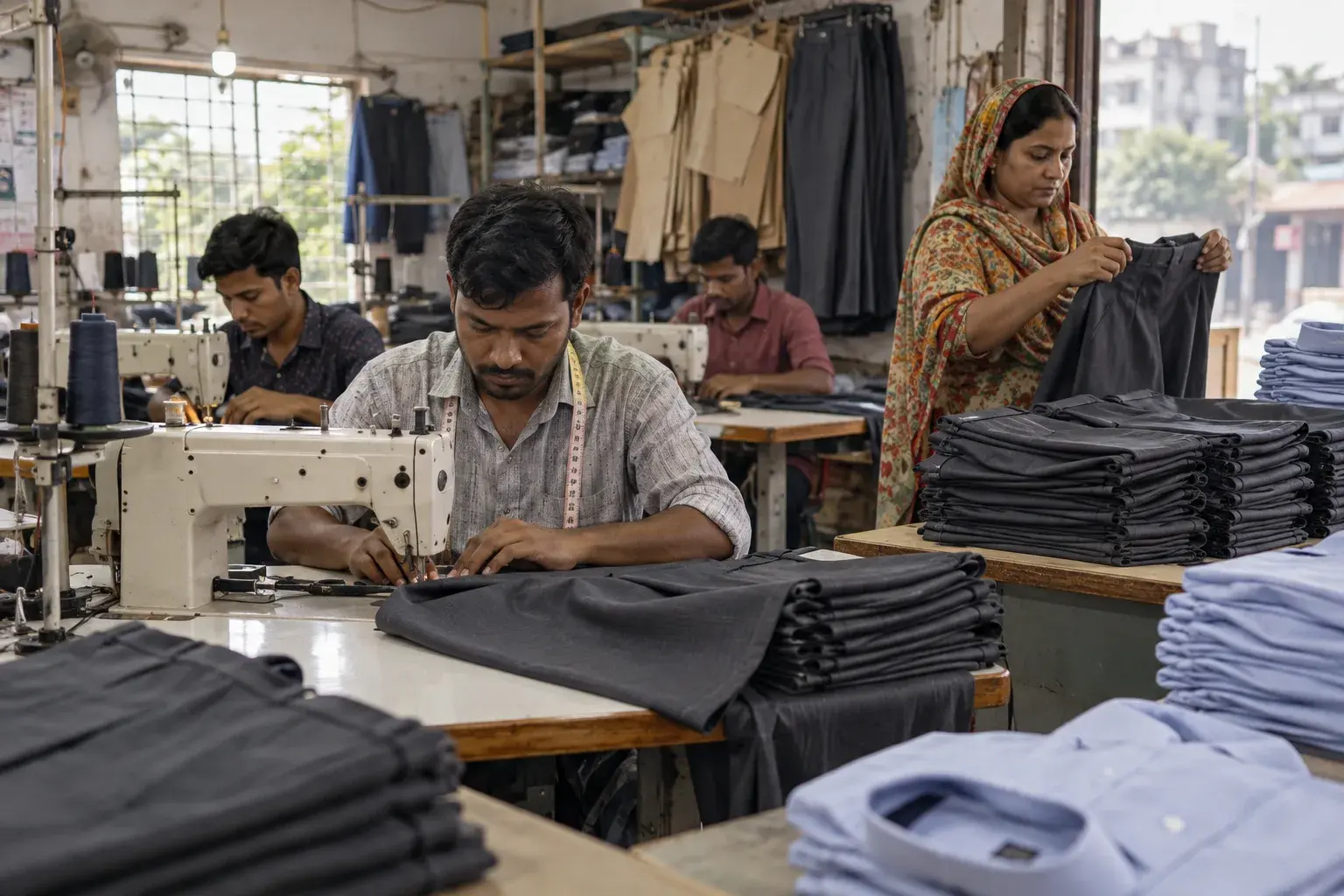
Tailoring and small garment unit
Trousers stitch for Tk 600: Tk 220 to the karigor, Tk 90 other costs, Tk 290 to the shop. One karigor does five trousers or ten shirts a day. The real money is sub-contract work, and its rules just tightened.
- Capital
- ৳60k – ৳8 lakh
- People
- 1 – 30
- First income
- 15 – 45 days
 Light manufacturing & workshop
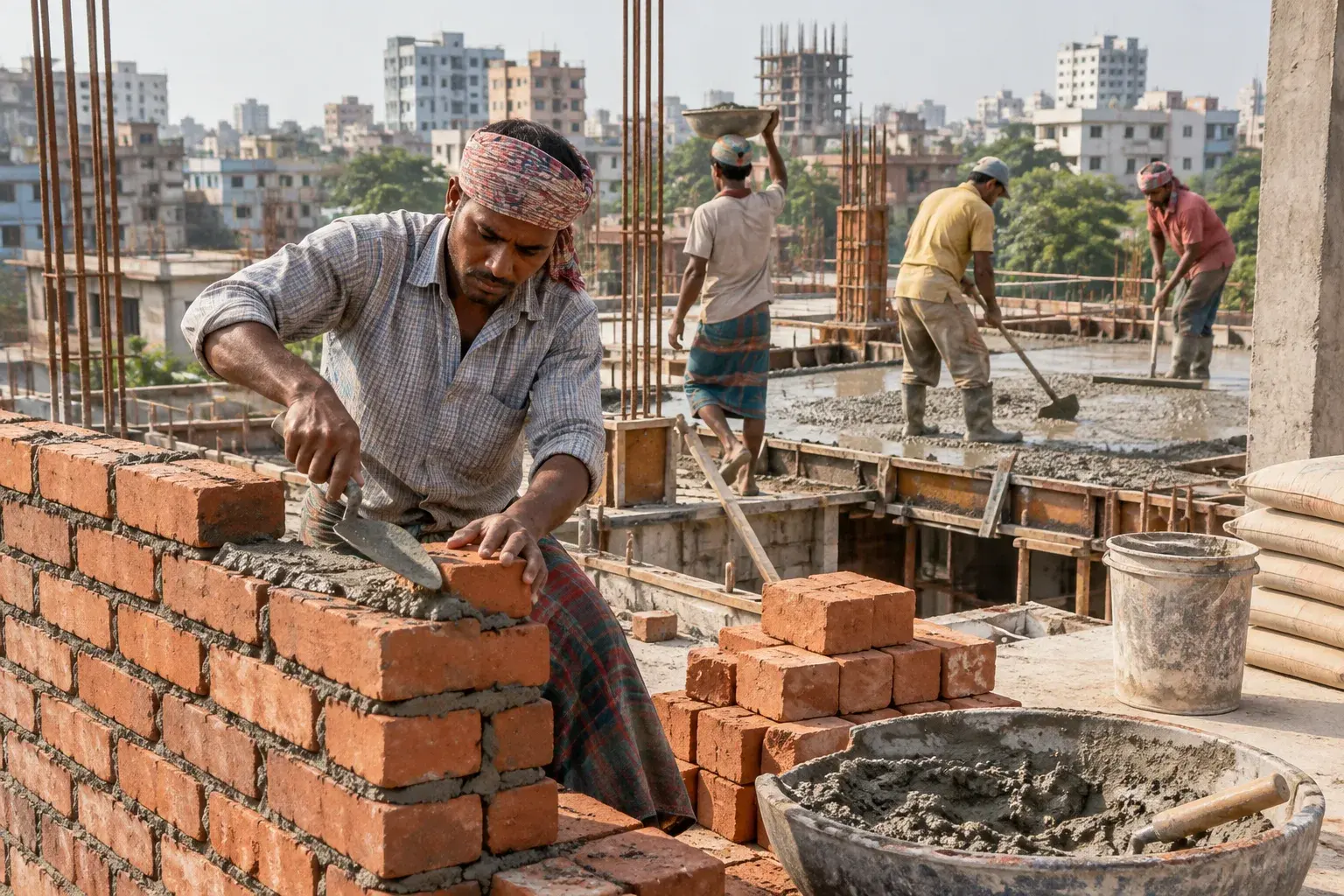
Masonry and building contracting
Contracting the labour of brickwork, casting and finishing. Dhaka construction runs Tk 1,800-3,000 per square foot of plinth area, and the statutory minimum for a mason is Tk 940 a day in town.
- Capital
- ৳50k – ৳5 lakh
- People
- 3 – 25
- First income
- 15 – 60 days