
Tiles and marble fitting
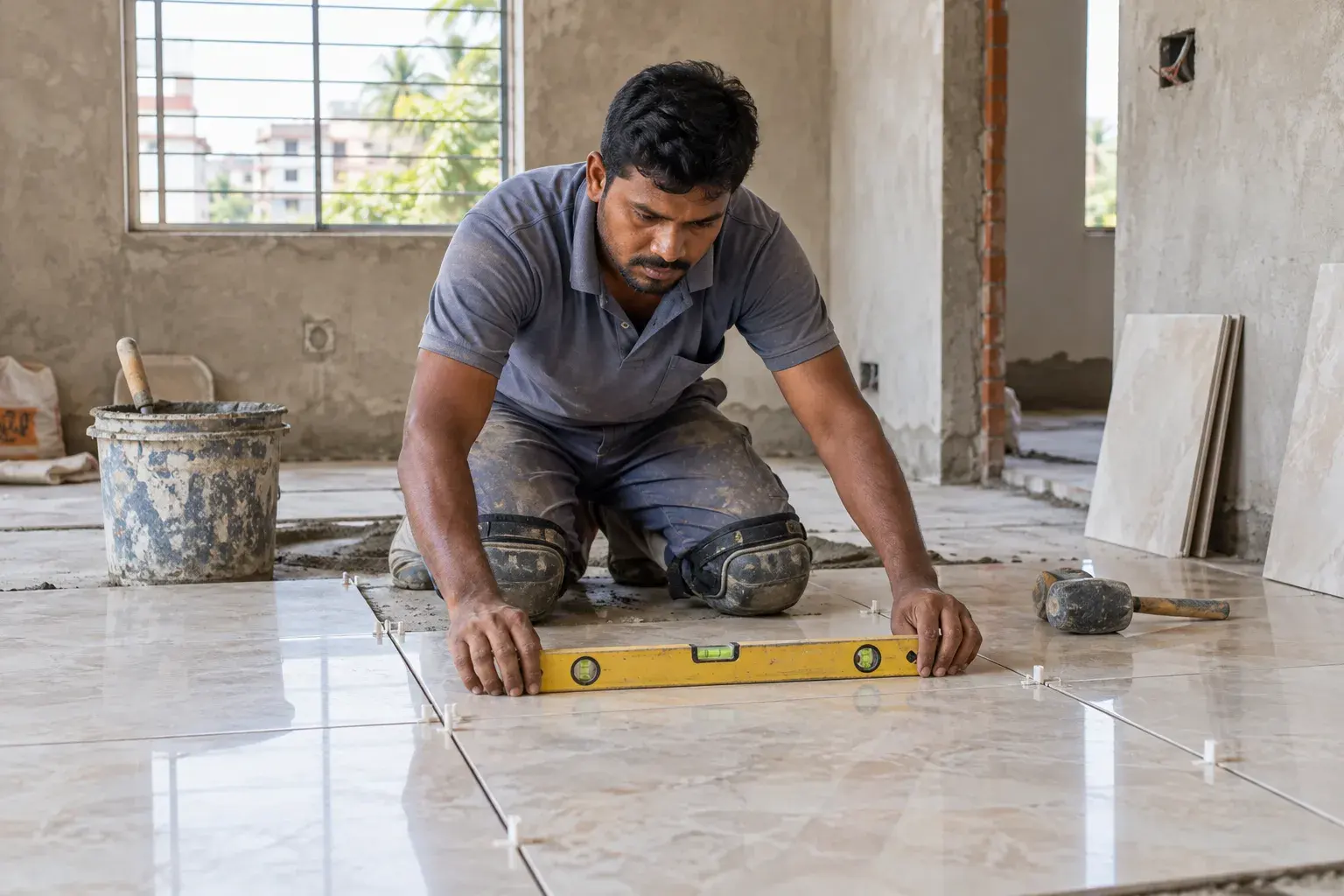
Laying tiles and marble on floors, walls and bathrooms. Tiles run Tk 55-170 a piece and the statutory minimum for a tile man is Tk 1,105 a day in town, the highest on any site.
- Last reviewed: 19 September 2026
- Version 1
Tiles and marble fitting
- Starting capital
- ৳30,000 – ৳2,50,000 Editorial estimate
- Manpower
- 2 – 8 people
- First sale
- 7 – 30 days Editorial estimate
- Break-even
- 1 – 3 months Editorial estimate
- Kind of work
- Mobile service · Medium difficulty
About the business
Laying tiles and marble on floors, walls, bathrooms, stairs and kitchens. It is the very last stage of a house, so the owner is tired and the money is nearly gone by the time the tile man arrives. The work is measured, and the trade quotes by the square foot. Tiles themselves sell by the piece. Prothom Alo's retail market report of 27 July 2025 lists Akij double-charge tiles at Tk 120-130, polished at Tk 93-95 and homogeneous at Tk 78-80; Sapphire wall tiles at Tk 57, Shelltech floor tiles at Tk 65, DBL at Tk 125 and parking tiles at Tk 55 apiece, with larger formats more than double. The labour is the best paid on a site: the construction and wood sector minimum wage structure puts the tiles and mosaic man in grade 1 at Tk 1,105 a day in town and Tk 1,020 in the village, above a mason. That is because a tile laid wrong has to come up and go down again, wasting both the tile and a second day's wage. The biggest problem right now is supply: the gas crisis has cut ceramic sector output to about 30 percent, factories are idle, and a colour runs out mid-job. Without tiles from the same lot the floor does not match, and the fitter gets the blame.
Unit economics
| Item | Range | Evidence | Suggest a correction |
|---|---|---|---|
| Monthly working capital | ৳49,000 – ৳1,50,000 | Editorial estimate | |
| Selling price | ৳55 – ৳170 / unit | Market quote | |
| Variable cost | ৳47 – ৳150 / unit | Editorial estimate | |
| Gross margin | 12% – 15% | Editorial estimate | |
| Time to first revenue | 7 – 30 days | Editorial estimate | |
| Break-even time | 1 – 3 months | Editorial estimate | |
| Cash cycle | 7 – 45 days | Editorial estimate | |
| Waste / loss | 5% – 15% | Editorial estimate | |
| Daily capacity | 40 – 400 | Editorial estimate |
What you need to start
- Tile cutting machine, hand cutter, spirit level, rubber mallet, spacers, notched trowel, string line and tape, grout gun. The tool list is short, but a poor cutting machine breaks more tiles.Equipment
- Cement, sand, tile adhesive and grout. A fitter who also supplies the tiles needs money to buy stock in advance.Starting stock
- Trade licence from the city corporation or municipality: form Tk 10, licence book Tk 50, standard tax Tk 30, stamp Tk 150-300, licence fee Tk 100-60,000 by trade type. Issued in 3-5 working days with papers ready.Licence
- Setting out, levelling the base, understanding drainage falls and cutting corners to fit. The wage structure places the tiles and mosaic man in the top grade, which tells you how the trade values the skill.Skill
- A tiles and sanitary shop and a marble or granite yard. Getting a whole job from one lot needs a settled relationship with one shop.Supplier
- No workshop is needed since the work is on site, but a place is needed to keep tools and leftover tiles.Workspace
How the work is done
- 1Measure the floor or wall and work out the square footage before starting. Count the tiles needed and add extra for cutting.
- 2Settle three things with the owner first: who buys the tiles, who supplies cement and sand, and who bears breakage. Skip these and there will be a dispute later.
- 3Buy tiles from one lot and buy the whole job's worth at once. A different lot means a different shade and the eye catches it.
- 4Get the tools together: a tile cutting machine, hand cutter, spirit level, rubber mallet, spacers, notched trowel and grouting kit.
- 5Take a trade licence from the city corporation or municipality, especially if you want interior and shop work.
- 6Level the base first. On uneven casting or plaster the tile sits hollow and lifts within a few months.
- 7Get the drainage slope right in bathrooms, roofs and verandas. That is where most of the mistakes happen.
- 8Take an advance at the start and bill room by room. Ask for the whole amount at the end and the owner's hand is already empty.
- 9Finish the grouting, call the owner to inspect, and then collect the final instalment.
Seasons
- JanHigh
- FebHigh
- MarHigh
- AprHigh
- MayNormal
- JunLow
- JulLow
- AugLow
- SepLow
- OctNormal
- NovHigh
- DecHigh
Where it works well
- Strong fitChattogram · Steady residential and commercial work, and imported marble and granite lands here first because of the port.
- Strong fitDhaka · The most flat and interior work, and the densest concentration of tile showrooms.
- Strong fitGazipur · Most of the country's ceramic factories are here, so tiles are easier to get and cheaper.
- Strong fitNarayanganj · Both ceramic factories and dense housing.
- Strong fitSylhet · Remittance households buy expensive tiles and marble, and payment tends to come on time.
- PossibleBogura · The northern trading centre, with more new building coming up.
- PossibleCox's Bazar · Hotels and resorts give large-format tile and marble work.
- PossibleCumilla · Plenty of remittance-funded houses, plus shop and restaurant interiors along the highway.
- PossibleHabiganj · The district has ceramic factories, and they suffered less in the gas crisis, so supply is easier.
- PossibleRajshahi · More multi-storey building in the city, with wages below Dhaka.
Risks and cautions
- HighDependency: Supply is now the biggest risk. BCMEA says overall ceramic output has fallen to about 30 percent because of the gas crisis. One Gazipur factory was shut for a full week and at another three of four units were down for 17 days, with output falling from 300,000 square feet a day to 50,000. When a colour runs out mid-job the work stops, and tiles from another lot do not match.
- HighLate payment: Tiling is the last stage of a house, by which time the owner's budget is spent and the bank loan already drawn. The final instalment then sits unpaid for months while the fitter has already paid his assistant. Without room-by-room billing this money is hard to recover.
- MediumOther: A mistake costs twice. A lifted tile cannot be reused, a new one must be bought at Tk 55-170, and the day's wage of Tk 1,105 in town is paid again. An uneven base or a wrong drainage fall only shows up months later, and the blame lands entirely on the fitter.
- MediumDemand: Work follows the building season. When construction slows in the monsoon, tiling slows with it because it is always the last stage, while before Eid there is a rush to do up rooms. Work is never even across the year, so the good months have to carry the bad ones.
Sources
সিটি কর্পোরেশন থেকে ট্রেড লাইসেন্স প্রাপ্তির ধাপ সমূহ
Collected: 16 Sept 2026Supports: Starting capital · বাংলাদেশ
What changed
No corrections have been published yet.
Questions and answers
No questions yet. Be the first to ask.
Similar businesses
 Light manufacturing & workshop
Nakshi kantha embroidery
Hand-embroidered layered quilts. In Jamalpur one kantha costs Tk 1,600-1,800 including wages, goes to Dhaka wholesalers at Tk 2,000, and sells in Dhaka shops for Tk 4,000-5,000.
- Capital
- ৳20k – ৳2 lakh
- People
- 1 – 25
- First income
- 30 – 365 days
 Light manufacturing & workshop
Pottery and terracotta
Making clay pots, planters and terracotta showpieces. Bijoypur's work is exported, but with no gas the kilns run on firewood and part of the output is spoiled.
- Capital
- ৳40k – ৳4 lakh
- People
- 2 – 12
- First income
- 30 – 90 days
 Light manufacturing & workshop
Candle and soap making
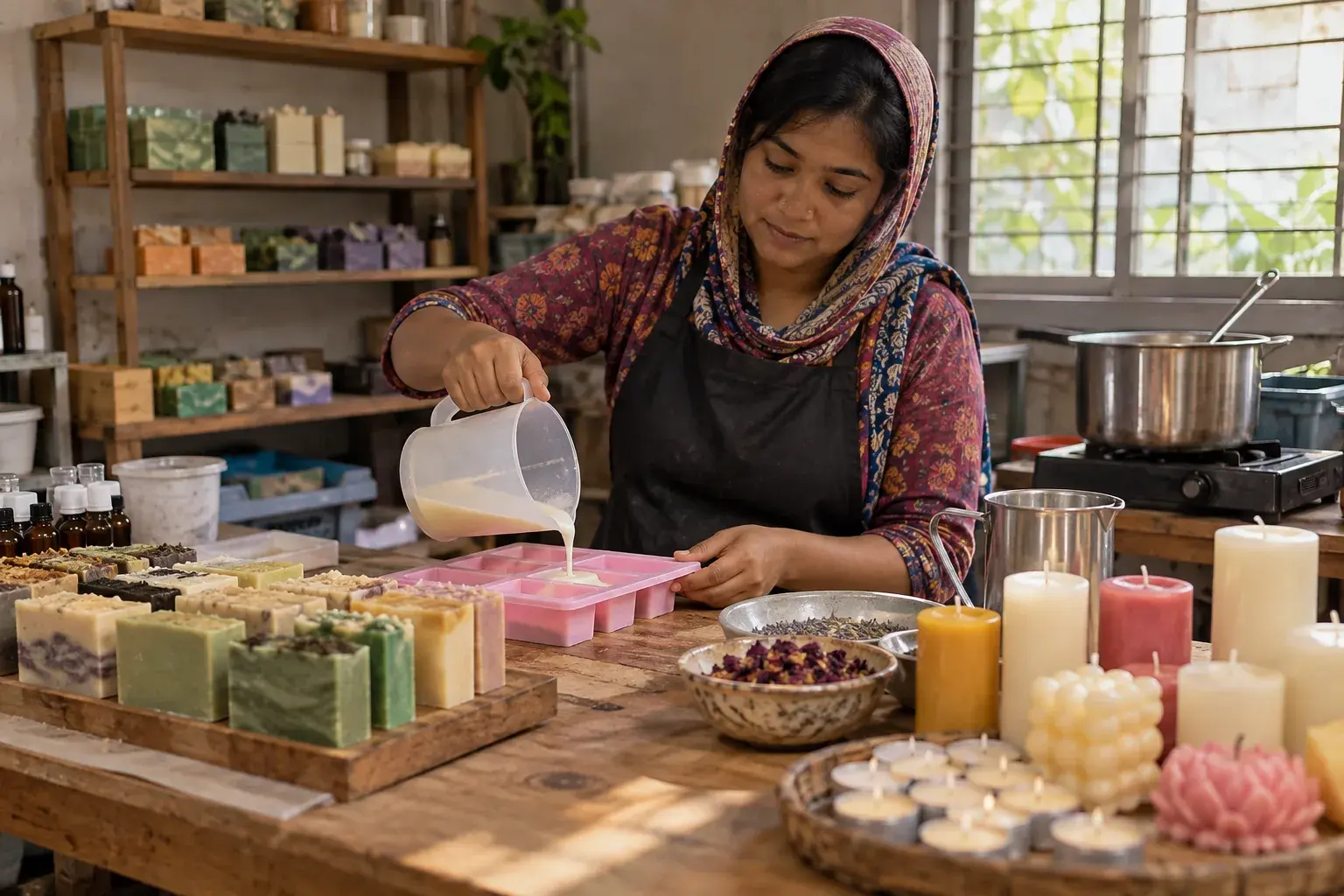
Small-workshop candle and soap making on low capital. Soap is on BSTI's mandatory certification list and cannot be sold without a CM licence; candles are not on the list.
- Capital
- ৳20k – ৳4 lakh
- People
- 1 – 10
- First income
- 19 – 94 days
 Light manufacturing & workshop
Wooden toy making
Making children's toys from the offcuts a furniture workshop discards. Wooden craft items sold at BSCIC's fair between Tk 100 and Tk 3,000.
- Capital
- ৳20k – ৳3 lakh
- People
- 1 – 10
- First income
- 30 – 120 days