
Wooden toy making
Making children's toys from the offcuts a furniture workshop discards. Wooden craft items sold at BSCIC's fair between Tk 100 and Tk 3,000.
- Last reviewed: 19 September 2026
- Version 1

Wooden toy making
- Starting capital
- ৳20,000 – ৳3,00,000 Editorial estimate
- Manpower
- 1 – 10 people
- First sale
- 30 – 120 days Editorial estimate
- Break-even
- 3 – 8 months Editorial estimate
- Kind of work
- Workshop · Medium difficulty
About the business
Wooden tomtoms, cars, dolls, boats and spinners - fair toys are still made by hand, by artisans in a handful of villages. Kholas village in Dupchanchia, Bogura, is now known simply as the toy village: a kilometre and a half from Dhap Sultanganj Hat, at least a hundred households there make toys all year, and the tomtom sells best. Sales rise before Baishakh, before Puja and through the winter fair season. The great advantage of this work is the raw material: the offcuts a furniture workshop throws away are large enough for a toy, so material cost can be kept close to nothing. On price, at BSCIC's autumn fair in Tejgaon in October 2025 a firm called Invent Crafts sold wooden pens, combs, hangers, key rings and children's toys between Tk 100 and Tk 3,000. There is a hard truth too. The Kholas artisans are caught in dadon - taking money in advance against future work, which takes the power to set their own price away from them. Whoever can make on their own capital and sell directly at a fair or online keeps most of the margin at home.
Unit economics
| Item | Range | Evidence | Suggest a correction |
|---|---|---|---|
| Monthly working capital | ৳10,000 – ৳1,50,000 | Editorial estimate | |
| Selling price | ৳100 – ৳3,000 / unit | Market quote | |
| Variable cost | ৳35 – ৳1,100 / unit | Editorial estimate | |
| Gross margin | 63% – 65% | Editorial estimate | |
| Time to first revenue | 30 – 120 days | Editorial estimate | |
| Break-even time | 3 – 8 months | Editorial estimate | |
| Cash cycle | 0 – 45 days | Editorial estimate | |
| Waste / loss | 5% – 10% | Editorial estimate | |
| Daily capacity | 15 – 200 | Editorial estimate |
What you need to start
- Saws, chisels, a drill, a lathe or turning wheel, sandpaper and painting kit. Tool prices could not be verified in this research.Equipment
- Paint, varnish, glue, nails, wheels and axle rods. Because these are children's products the paint must be lead-free.Starting stock
- Trade licence from the city corporation or municipality: form Tk 10, licence book Tk 50, standard tax Tk 30, stamp Tk 150-300, licence fee Tk 100-60,000 by trade type. Issued in 3-5 working days and renewed yearly.Licence
- Cutting, fitting wheels and axles, smoothing and painting. Rounding every edge and making joints strong are the two things that matter most in a children's product.Skill
- Furniture workshops and sawmills, whose offcuts are the toy maker's timber. That relationship is what keeps the material cost low.Supplier
- A working space that can take dust and noise, plus a separate covered area for drying paint. It can start in a courtyard.Workspace
How the work is done
- 1Talk to nearby furniture workshops and sawmills. The size of wood a toy needs is exactly what furniture work throws away, and that is the real advantage of this trade.
- 2Decide which wood to use. Soft, light wood is easy to cut and light to carry but breaks easily; hard wood lasts but takes longer to work. These are children's toys, so splintering edges are not acceptable.
- 3Pick a few designs and repeat them. In Kholas village the tomtom sells best - repeating one design makes the hand faster and the cost lower.
- 4Get the tools: saws, chisels, a drill, a lathe or turning wheel, sandpaper and painting kit.
- 5Make sure the paint and varnish are free of lead and toxic content. Children put toys in their mouths, and export buyers check this first.
- 6Take the trade licence from the city corporation or municipality.
- 7Ask BSCIC about registration and training. BSCIC runs regular handicraft fairs - its five-day autumn fair in Tejgaon in October 2025 had 40 entrepreneurs. Selling at a fair cuts the middleman out.
- 8Plan production around the fair calendar. Most sales happen before Baishakh, before Puja and through the winter fair season. If stock is not ready before a fair, the whole season is lost.
- 9Think twice before taking dadon. The Kholas artisans are caught in it - once you take money in advance the mahajan sets the price and the debt does not clear.
- 10Try selling online. Wooden educational toys and sets on Daraz run from Tk 73 to Tk 944 (16-09-2026) and most are imported, so there is room for a local maker.
- 11Look at export. Bold Partners Limited of Angardaha in Magura makes pet toys and food from local materials and has exported about Tk 33.76 crore worth to Japan, Canada, the USA, Germany and South Korea since 2018 - proof that village raw material can reach an export buyer.
Seasons
- JanNormal
- FebNormal
- MarHigh
- AprHigh
- MayNormal
- JunNormal
- JulNormal
- AugNormal
- SepHigh
- OctHigh
- NovNormal
- DecNormal
Where it works well
- Strong fitBogura · Kholas village in Dupchanchia is known as the toy village, with at least 100 households making toys all year and Dhap Sultanganj Hat a kilometre and a half away.
- Strong fitDhaka · The biggest buyer market, with gift and handicraft shops, and BSCIC's fairs are held in Tejgaon.
- Strong fitNilphamari · Syedpur has an old tradition of wooden toy making and the artisans to go with it.
- PossibleChattogram · A large consumer market with exporters present and the port nearby.
- PossibleGazipur · A dense belt of furniture workshops, so offcuts are easy to get.
- PossibleJashore · Woodworking and handicraft artisans are available, with the western fair circuit close by.
- PossibleKushtia · A large rural fair market, with sawmills and furniture workshops present.
- PossibleMagura · Bold Partners Limited of Angardaha exports locally sourced toys to Japan, Canada and the USA, so export-facing experience exists locally.
- PossibleNaogaon · Villages here already make toys and whistles, and the Bogura market is close.
Risks and cautions
- HighDependency: Dadon is the biggest trap in this trade. The artisans of Kholas village in Bogura work against money taken in advance from a mahajan, so they cannot set their own price. In Prothom Alo's words, behind the busyness of toy making lie the sorrows of many families. Once inside dadon, most of the margin goes to the mahajan.
- HighDemand: Competing with modern and plastic toys on price and looks is hard. Children's wooden toy sets on Daraz run Tk 73-944 (16-09-2026) and most are imported with slick design. Children want what they see, and plastic toys in shops are cheap and bright.
- MediumDemand: Sales stand on fairs. Baishakh, Puja and the winter fair season carry most of the year's turnover. If a fair is cancelled or the weather is bad, a whole season's stock sits unsold although the money to make it has already gone out.
- MediumOther: The supply of offcuts is not guaranteed. A furniture workshop may sell them, burn them or give them to someone else. Depending on one workshop means that when the relationship ends the material cost jumps overnight.
Sources
সিটি কর্পোরেশন থেকে ট্রেড লাইসেন্স প্রাপ্তির ধাপ সমূহ
Collected: 16 Sept 2026Supports: Starting capital · বাংলাদেশ
What changed
No corrections have been published yet.
Questions and answers
No questions yet. Be the first to ask.
Stories about this business
Fairs cancelled: 90,000 taka of toys spoiled, and another 60,000 left unsold
Three months of fairs from Chaitra to Jyaistha are this wooden-toy trade's entire market. One year 90,000 taka of toys spoiled in store; the next season's 60,000 taka of borrowed stock went unsold too.
- Capital
- ৳60k
- Reasons
- Dependency, Spoilage
Similar businesses
 Light manufacturing & workshop
Nakshi kantha embroidery
Hand-embroidered layered quilts. In Jamalpur one kantha costs Tk 1,600-1,800 including wages, goes to Dhaka wholesalers at Tk 2,000, and sells in Dhaka shops for Tk 4,000-5,000.
- Capital
- ৳20k – ৳2 lakh
- People
- 1 – 25
- First income
- 30 – 365 days
 Light manufacturing & workshop
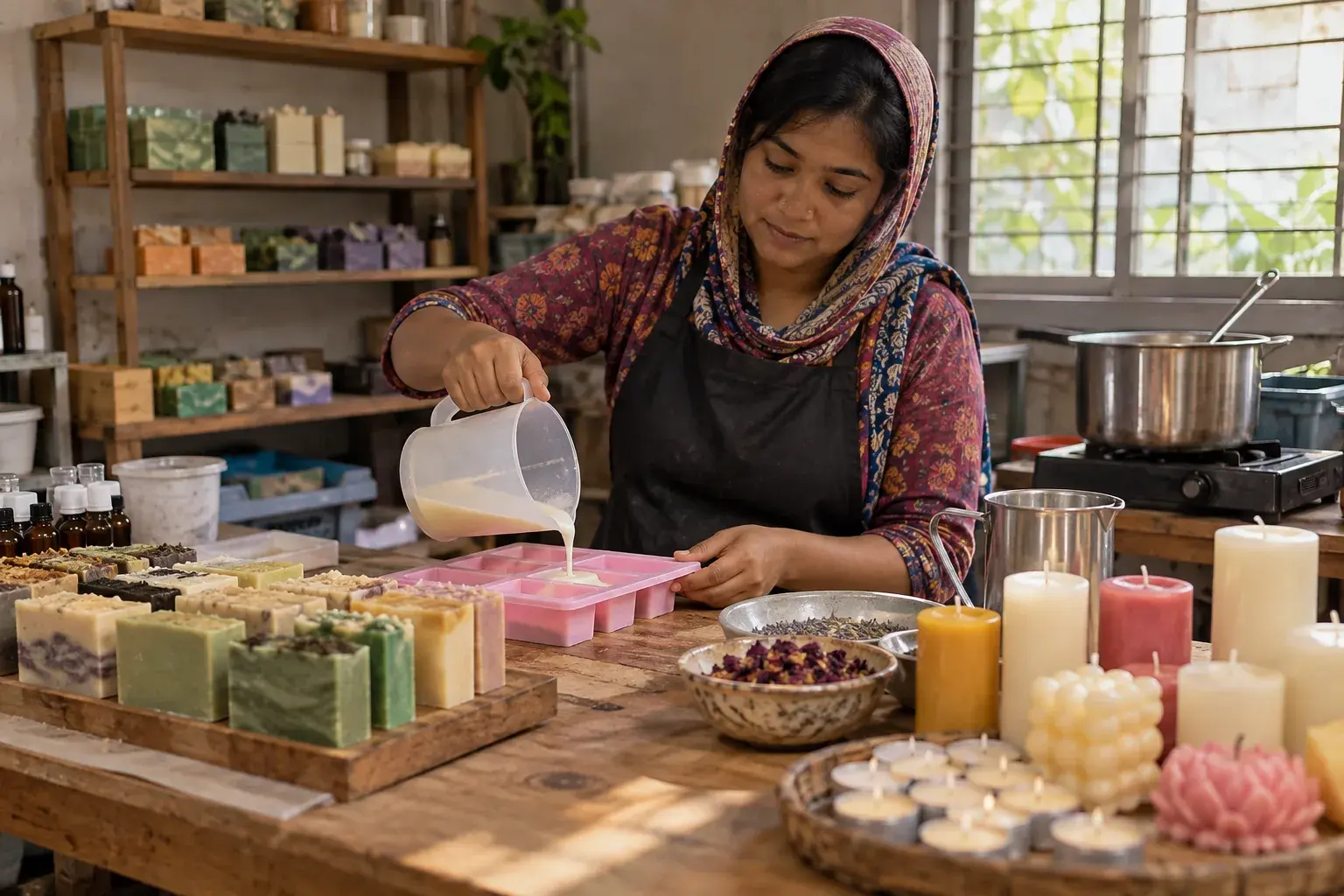
Candle and soap making
Small-workshop candle and soap making on low capital. Soap is on BSTI's mandatory certification list and cannot be sold without a CM licence; candles are not on the list.
- Capital
- ৳20k – ৳4 lakh
- People
- 1 – 10
- First income
- 19 – 94 days
 Light manufacturing & workshop
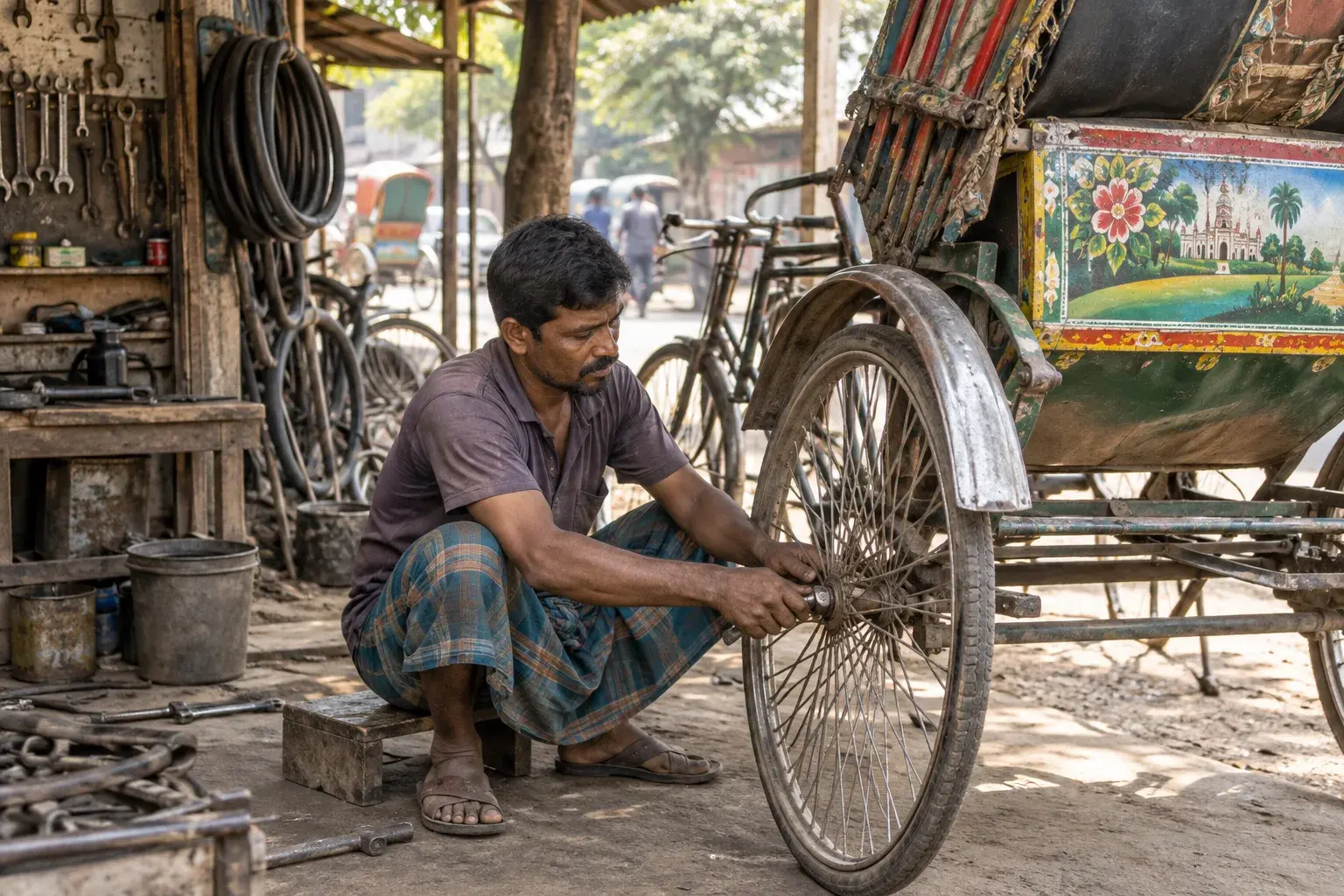
Cycle and rickshaw repair shop
A roadside shop repairing bicycles, rickshaws and e-rickshaws. It can start from about Tk 15,000 of tools and stock, and customers pay cash when the job is done.
- Capital
- ৳15k – ৳1.2 lakh
- People
- 1 – 3
- First income
- 7 – 30 days
 Light manufacturing & workshop
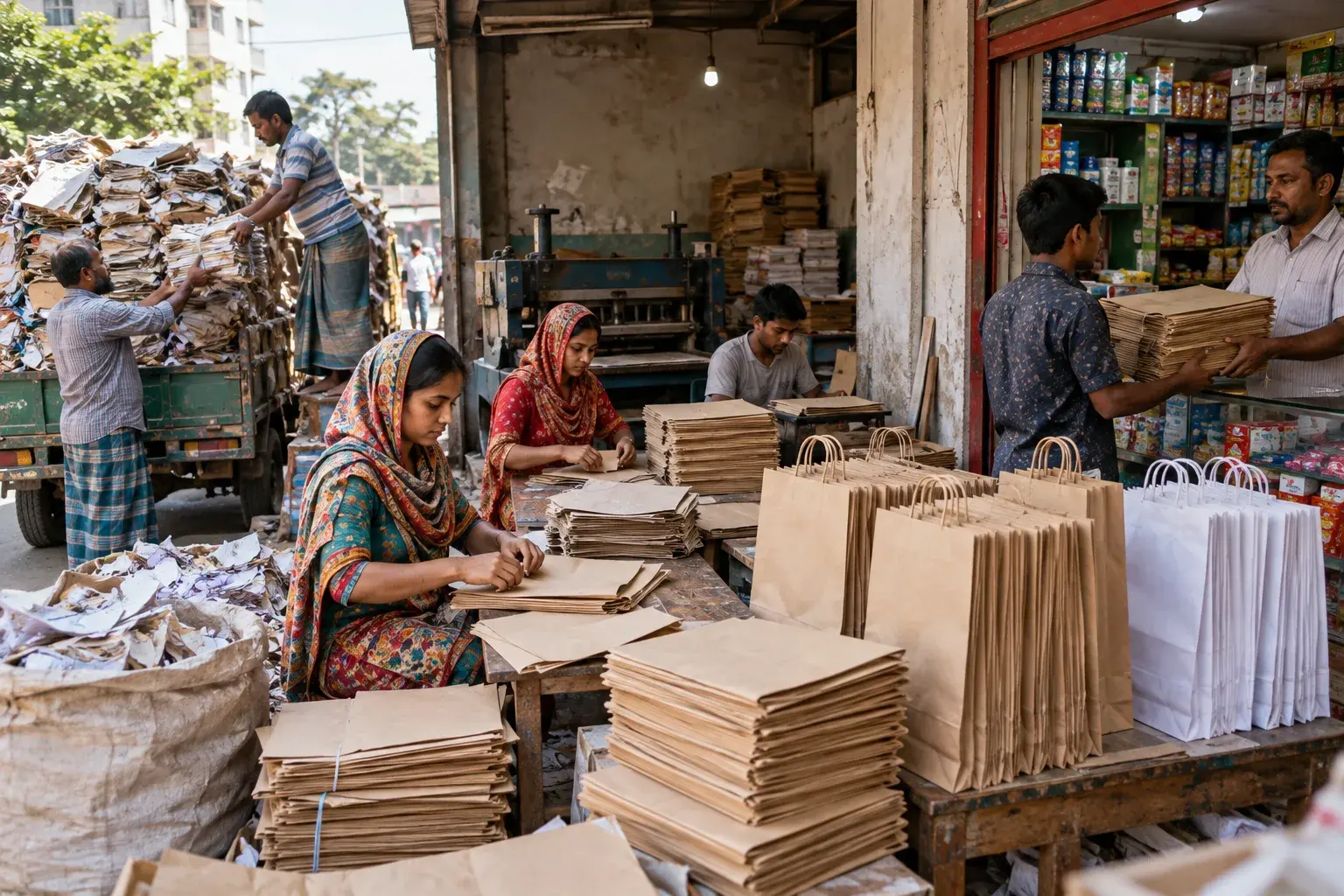
Paper bag and packaging making
Buying waste paper, folding bags by hand and supplying shops. Khaki bags sell at Tk 135-140 a kg and white at Tk 80; 60 kg of paper costs Tk 7,500 and yields 70 kg of bags for Tk 2,300 profit.
- Capital
- ৳10k – ৳60k
- People
- 1 – 20
- First income
- 3 – 15 days