
Nakshi kantha embroidery
Hand-embroidered layered quilts. In Jamalpur one kantha costs Tk 1,600-1,800 including wages, goes to Dhaka wholesalers at Tk 2,000, and sells in Dhaka shops for Tk 4,000-5,000.
- Last reviewed: 19 September 2026
- Version 1

Nakshi kantha embroidery
- Starting capital
- ৳20,000 – ৳2,00,000 Editorial estimate
- Manpower
- 1 – 25 people
- First sale
- 30 – 365 days Disputed
- Break-even
- 15 – 50 months Editorial estimate
- Kind of work
- Home-based · Easy
About the business
Layering old saris or cotton cloth and running a design through them with needle and thread. Jamalpur is the centre of the craft; it is made in every upazila of the district and 'Jamalpur Nakshi Kantha' received Geographical Indication status in February 2024. Across the district there are around 400 establishments, over two thousand entrepreneurs, about 200 shops and close to two lakh women involved. The system is simple: an entrepreneur buys cloth and thread and hands it to village women, who stitch at home between household chores and return the finished piece on an agreed date. A standard kantha takes five to seven saris and one to one and a half months to stitch, and for some it takes a year. The money is the real story. Small Jamalpur entrepreneurs put the cost of one nakshi kantha, wages included, at Tk 1,600-1,800, and they have to sell it to Dhaka wholesalers at Tk 2,000. The same kantha then sells in Dhaka's big stores for Tk 4,000-5,000. The woman who stitched it for a month and the entrepreneur who bought her cloth share less than half of what the buyer pays. Lacking capital, the entrepreneurs cannot market in Dhaka themselves, and that single fact sends most of the margin out of the district.
Unit economics
| Item | Range | Evidence | Suggest a correction |
|---|---|---|---|
| Monthly working capital | ৳1,500 – ৳45,000 | Editorial estimate | |
| Selling price | ৳2,000 / unit | Market quote | |
| Variable cost | ৳1,600 – ৳1,800 / unit | Market quote | |
| Gross margin | 10% – 20% | Editorial estimate | |
| Time to first revenue | 30 – 365 days | Disputed | |
| Break-even time | 15 – 50 months | Editorial estimate | |
| Cash cycle | 45 – 105 days | Editorial estimate | |
| Waste / loss | 3% – 8% | Editorial estimate | |
| Daily capacity | 0 – 0.8 | Editorial estimate |
What you need to start
- Needles, scissors, tracing paper and design sheets. Larger units also keep embroidery machines, but hand work is what Jamalpur is known for.Equipment
- Cloth and thread. A standard kantha takes five to seven saris. Thread was once pulled from the borders of old cloth; now blue, red and yellow thread is bought from weavers.Starting stock
- Trade licence from the municipality, union parishad or city corporation: form Tk 10, licence book Tk 50, standard tax Tk 30, stamp Tk 150-300, licence fee Tk 100-60,000 by trade type, plus VAT and signboard fee. Issued in three to five working days.Licence
- The hand for dense filled-in motifs, which is Jamalpur's signature. Drawing the design, keeping the stitch even and matching colours take time to learn, and the learning happens within the family or under a group leader.Skill
- A group leader in each area who hands out cloth and collects finished work. One trader's ten-member committee covering Jamalpur Sadar, Melandaha and Nandina has each member giving work to two and a half to three thousand women.Supplier
- No separate factory is needed; the workers stitch at home. Most Jamalpur shops are simply a showroom built into the front of the entrepreneur's own house.Workspace
How the work is done
- 1Decide where you stand: stitching yourself, or buying cloth and thread and putting a group to work. Both exist in Jamalpur and the money works out differently.
- 2Walk the showrooms on Bakultala, Madrasa Road, College Road and Azam Chattar in Jamalpur town to see which designs and products are moving. Designs follow the market: human and animal motifs have thinned out and flowers, vines and alpona patterns are what sell now.
- 3Buy cloth and thread. A standard kantha takes five to seven saris, and new cotton cloth has largely replaced old cloth.
- 4Trace the design onto the cloth with tracing paper, then stitch along the lines. Wooden blocks were once used; tracing paper has replaced them.
- 5Appoint a group leader in each area to distribute the cloth and bring the finished pieces back. This arrangement is what lets women work from their own homes.
- 6Fix the piece rate per kantha in writing and tell the worker what it is. Agree the return date up front as well.
- 7Do not stop at kanthas: put the same motifs on bedsheets, cushion covers, wall mats, panjabis, three-pieces, fotuas, shawls, pillow covers, bags and purses. Small items finish in five to seven days, so the money turns over faster.
- 8Build stock ahead of Boishakh, Eid and the cold season. Before Boishakh buyers come to Jamalpur from all over the country.
- 9Deal with Dhaka wholesalers directly and, if you can, go and sell in Dhaka yourself. Not being able to market for want of capital is the single biggest loss Jamalpur's entrepreneurs take.
- 10Look after the workers' eyes: daylight, breaks and glasses when needed. Long hours of stitching in poor light have damaged the eyesight of many women in Jamalpur, and when the eyes go the worker goes.
Seasons
- JanHigh
- FebNormal
- MarHigh
- AprHigh
- MayNormal
- JunNormal
- JulLow
- AugLow
- SepNormal
- OctNormal
- NovHigh
- DecHigh
Where it works well
- Strong fitDhaka · Not where it is made but where it sells. Jamalpur kanthas go to wholesale and retail markets across Dhaka and reach Tk 4,000-5,000 in the big stores. An entrepreneur who can sell in Dhaka directly earns several times the margin.
- Strong fitJamalpur · The national centre. Nakshi kantha is made in every upazila, most heavily in Sadar, Sarishabari, Madarganj, Melandaha, Islampur, Dewanganj and Bakshiganj and in the Nandina, Narundi, Bhatara and Beltia areas. There are around 400 establishments, about 200 shops and over two thousand entrepreneurs. SME Foundation runs a nakshi kantha cluster here and the district administration has branded the district with it.
- PossibleMymensingh · The neighbouring divisional town. Buyers come from Mymensingh to Jamalpur at Boishakh and Eid, and Jamalpur goods also reach Mymensingh shops.
- Weak fitNetrokona · It sits inside Mymensingh division and needlework is practised, but there is no organised buyer-seller network like Jamalpur's.
- Weak fitSherpur · It adjoins Jamalpur's Bakshiganj-Dewanganj belt so workers may be easier to find, but no separate nakshi kantha cluster or establishment was documented here. The case rests on proximity alone.
- Weak fitTangail · Its old weaving and thread markets make raw material easy to get, but no separate nakshi kantha cluster was evidenced.
Risks and cautions
- HighDependency: You do not control the market. For want of capital Jamalpur entrepreneurs cannot sell in Dhaka themselves, so the kantha goes to a Dhaka wholesaler at Tk 2,000 and sells in a Dhaka store for Tk 4,000-5,000. After one to one and a half months of labour and Tk 1,600-1,800 of cost, Tk 200-400 is left. Nothing about that split changes until the marketing changes.
- HighOther: Workers going blind. Because the pay is low many stitch more than fourteen hours a day, and at night in poor light. There are women in Jamalpur who within a few years lost the ability to thread a needle and gave up stitching altogether. Being unable to afford treatment or glasses makes it worse, and losing a skilled hand costs the entrepreneur too.
- HighWorking capital: Money is tied up for one to one and a half months, sometimes a year. Cloth and thread are bought up front and wages are paid, but not a taka comes back until the kantha is finished. Ten or twelve kanthas running at once locks up Tk 16,000-22,000 in cloth, thread and wages.
- MediumDemand: Sales are not even through the year. Demand jumps before Boishakh, Eid and the cold season and mid-sized entrepreneurs struggle to keep up, while the rest of the year stock sits and workers still have to be kept busy.
- MediumOther: Raw material prices. In April 2026 Jamalpur entrepreneurs said cloth and thread had grown dearer and they had to raise prices a little. Costs rise but the Dhaka wholesale rate does not follow at once, and that is when a ten percent margin disappears.
Sources
সিটি কর্পোরেশন থেকে ট্রেড লাইসেন্স প্রাপ্তির ধাপ সমূহ
Collected: 16 Sept 2026Supports: Starting capital · বাংলাদেশ
What changed
No corrections have been published yet.
Questions and answers
No questions yet. Be the first to ask.
Stories about this business
10,000 taka to start, 50 lakh a year in sales, and 5,000 people stitching
Started in 2011 with 10,000 taka; sales now run at 4-5 lakh taka a month, about 50 lakh a year, with more than 5,000 people stitching. The same report puts a stitcher of twenty years on 3,000 taka a month.
- Capital
- ৳10k
- Reasons
- Strong network, Weak demand
Similar businesses
 Light manufacturing & workshop
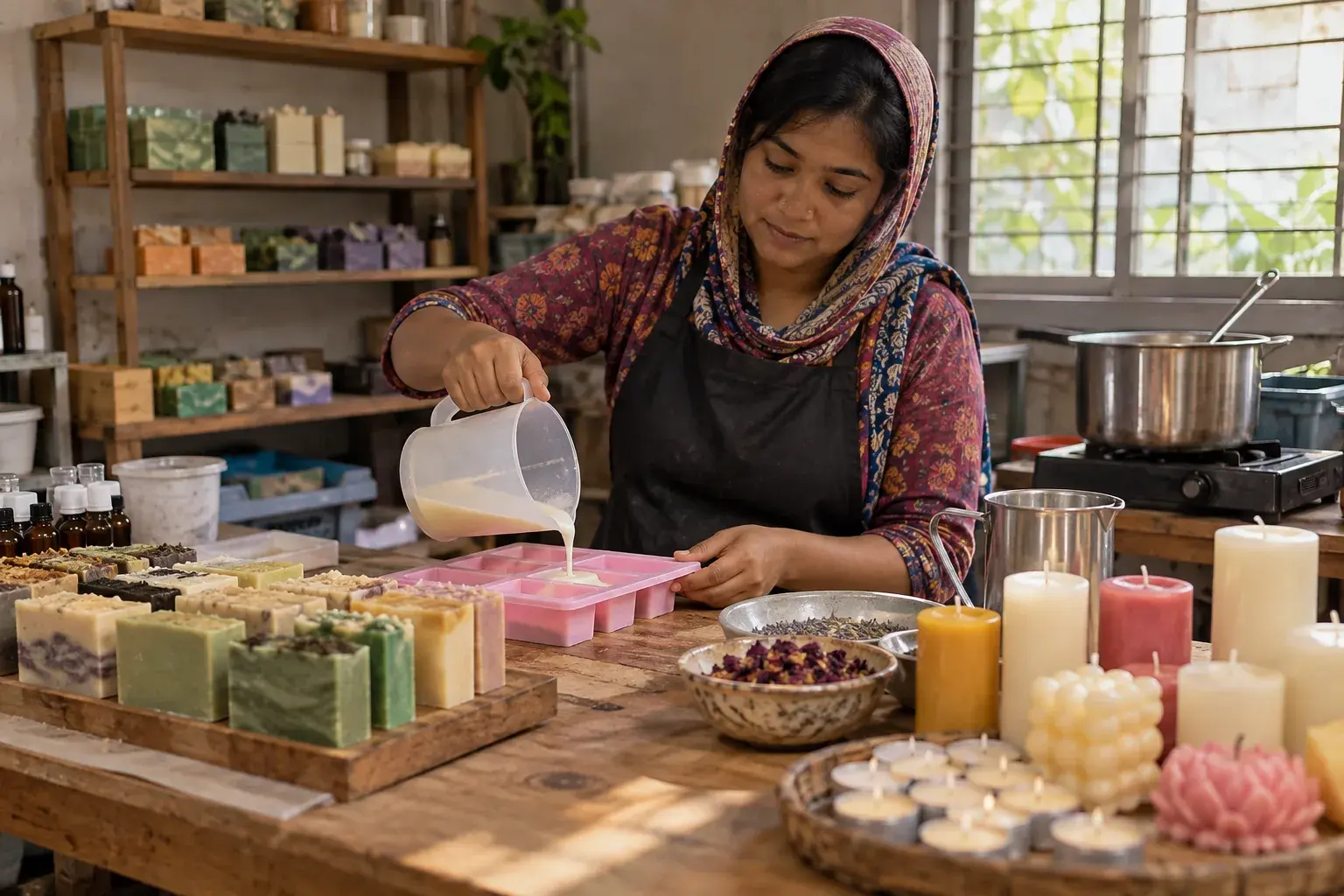
Candle and soap making
Small-workshop candle and soap making on low capital. Soap is on BSTI's mandatory certification list and cannot be sold without a CM licence; candles are not on the list.
- Capital
- ৳20k – ৳4 lakh
- People
- 1 – 10
- First income
- 19 – 94 days
 Light manufacturing & workshop
Wooden toy making
Making children's toys from the offcuts a furniture workshop discards. Wooden craft items sold at BSCIC's fair between Tk 100 and Tk 3,000.
- Capital
- ৳20k – ৳3 lakh
- People
- 1 – 10
- First income
- 30 – 120 days
 Light manufacturing & workshop
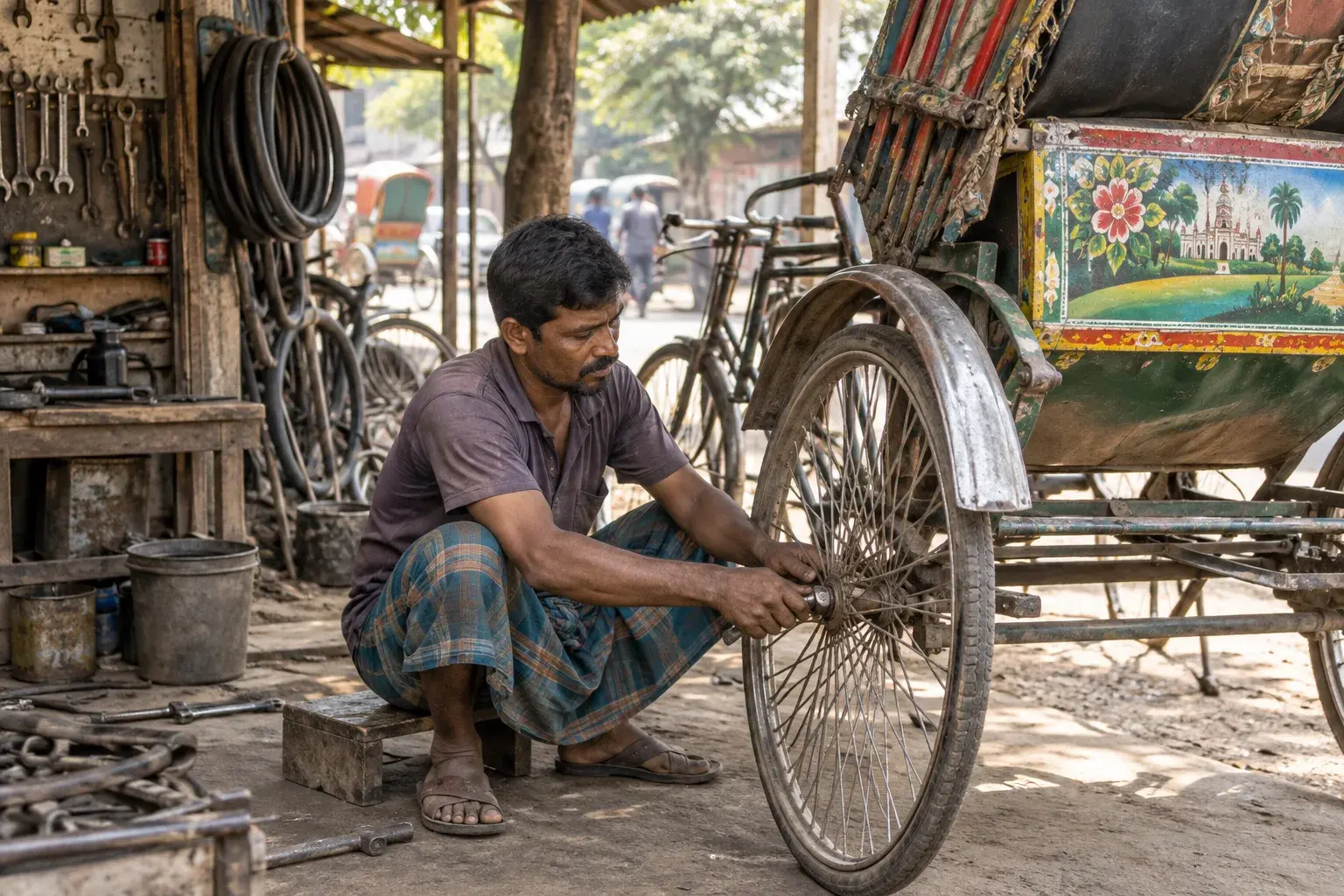
Cycle and rickshaw repair shop
A roadside shop repairing bicycles, rickshaws and e-rickshaws. It can start from about Tk 15,000 of tools and stock, and customers pay cash when the job is done.
- Capital
- ৳15k – ৳1.2 lakh
- People
- 1 – 3
- First income
- 7 – 30 days
 Light manufacturing & workshop
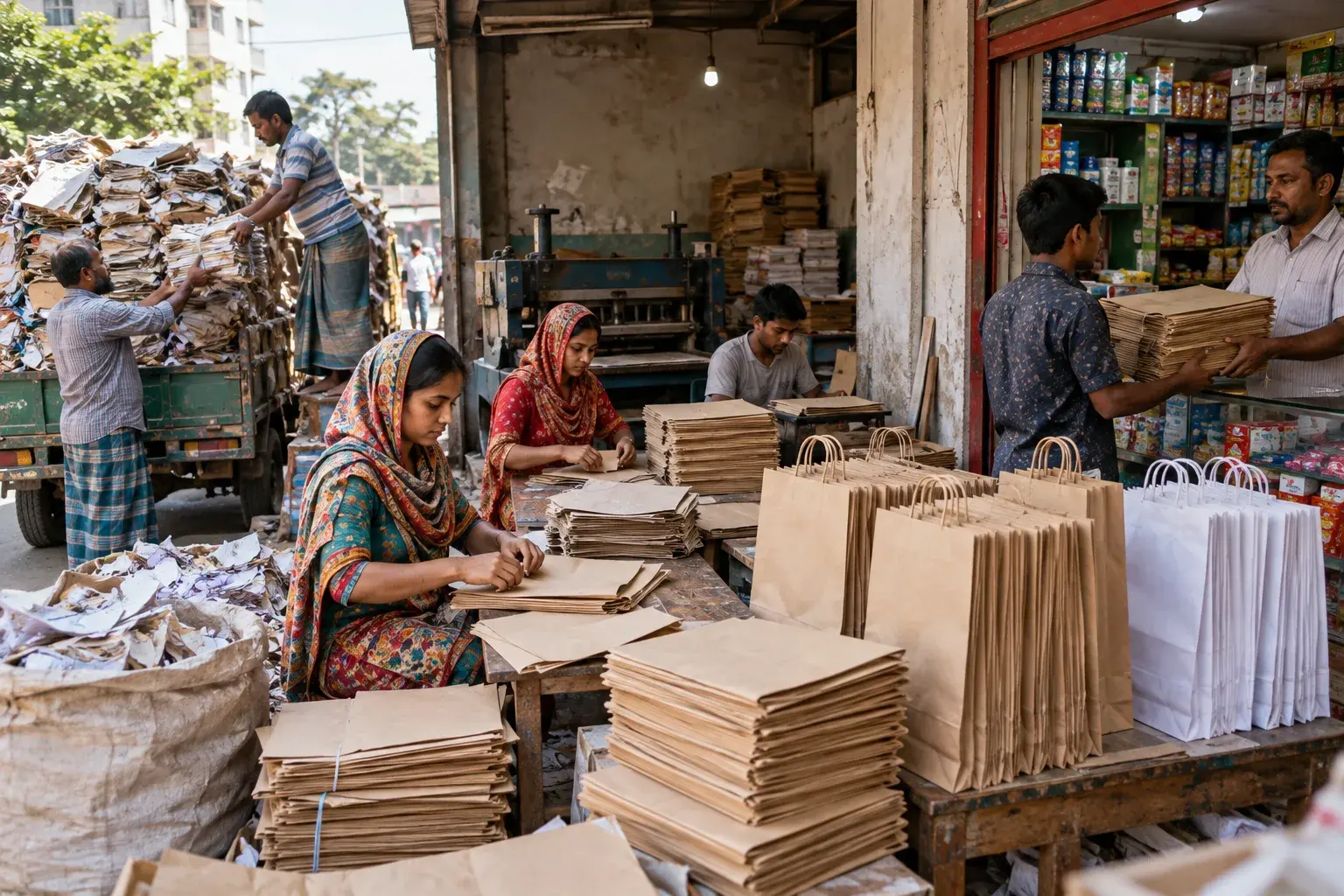
Paper bag and packaging making
Buying waste paper, folding bags by hand and supplying shops. Khaki bags sell at Tk 135-140 a kg and white at Tk 80; 60 kg of paper costs Tk 7,500 and yields 70 kg of bags for Tk 2,300 profit.
- Capital
- ৳10k – ৳60k
- People
- 1 – 20
- First income
- 3 – 15 days