
Carton and box making
A unit making corrugated cartons and boxes. Small parcel cartons retail at Tk 24-40 each, and the 350,000-400,000 parcels moving daily are the biggest market.
- Last reviewed: 19 September 2026
- Version 1

Carton and box making
- Starting capital
- ৳3,00,000 – ৳30,00,000 Editorial estimate
- Manpower
- 4 – 30 people
- First sale
- 45 – 120 days Editorial estimate
- Break-even
- 6 – 12 months Editorial estimate
- Kind of work
- Workshop · Medium difficulty
About the business
A unit that cuts, creases, folds and glues corrugated board into cartons and boxes. The customers are not strangers: bakeries, sweet shops, pickle and spice units, shoe factories, garment factories, pharmacies, and above all courier and e-commerce. e-CAB puts national parcel volume at 350,000 to 400,000 a day, and nearly every one of them needs a box. The government has declared paper and packaging the product of the year for 2026; the commerce secretary has said export incentives and production support will follow. The Bangladesh Flexible Packaging Industries Association puts the packaging market at more than Tk 6,000 crore with 50,000 direct and indirect jobs, and the polythene bag ban is pushing paper packaging demand up further. On Daraz on 16 September 2026 small parcel cartons retailed at Tk 24-40 each and a 20-inch heavy three-ply carton at Tk 560. There is one problem and it is a large one: the price of paper. When raw material costs rise, the carton price cannot follow immediately, because buyers contract for a year at a fixed rate.
Unit economics
| Item | Range | Evidence | Suggest a correction |
|---|---|---|---|
| Monthly working capital | ৳2,00,000 – ৳20,00,000 | Editorial estimate | |
| Selling price | ৳24 – ৳40 / unit | Market quote | |
| Variable cost | ৳12 – ৳22 / unit | Editorial estimate | |
| Gross margin | 45% – 50% | Editorial estimate | |
| Time to first revenue | 45 – 120 days | Editorial estimate | |
| Break-even time | 6 – 12 months | Editorial estimate | |
| Cash cycle | 15 – 60 days | Editorial estimate | |
| Waste / loss | 5% – 10% | Editorial estimate | |
| Daily capacity | 500 – 5,000 | Editorial estimate |
What you need to start
- Corrugation machine, cutting and creasing machine, stitching or gluing machine, flexo printer, strapping machine and scales. No documented machine prices were found, so the capital figure is an estimate.Equipment
- Kraft paper rolls, medium paper, glue, stitching wire and printing ink. No published paper price could be found, which is the largest gap on this page.Starting stock
- TIN and VAT registration from the National Board of Revenue. Billing factories and companies is impossible without them, and tax is deducted at source.Licence
- Fire licence from Fire Service and Civil Defence, required because a paper store and plant are a fire risk. The fee and validity vary with plant size and could not be verified.Licence
- Trade licence from the city corporation or municipality: form Tk 10, licence book Tk 50, standard tax Tk 30, stamp Tk 150-300, licence fee Tk 100-60,000 by trade type, in 3-5 working days.Licence
- A paper mill or a paper importer and distributor, plus glue and ink suppliers. Keep more than one paper source, because a supply stoppage idles the whole plant.Supplier
- A dry, roomy shed with uninterrupted power and truck access. Cartons are light but bulky, so the godown is the largest space.Workspace
How the work is done
- 1Find the buyer before the machine. Do not buy equipment until you know which factory or courier will take cartons from you regularly.
- 2Find out which sizes are in demand. Big orders in one or two sizes cut the die and setup cost sharply.
- 3Take a shed with room for paper rolls, board and finished cartons, and it must be dry. Damp paper makes weak cartons.
- 4Take the trade licence, register for TIN and VAT, and check the fire licence requirement: a paper store is a fire risk.
- 5Install the machines: a corrugation machine, cutting and creasing machine, stitching or gluing machine, and a flexo printer for printing.
- 6Fix a paper supplier and settle in advance what happens when the price rises. Raw material cost decides the profit in this business.
- 7Make a sample for each buyer and get it approved: size, ply, board GSM and print design all settled in writing.
- 8Keep contract periods short when quoting. Lock a one-year rate and any mid-term rise in paper cost is entirely your loss.
- 9Give courier and e-commerce separate attention. With 350,000 to 400,000 parcels moving daily, this is the biggest and fastest growing market.
- 10Build stock ahead of the seasonal rushes. Demand spikes before mango, litchi and Eid, and paper gets tight at exactly those times.
Seasons
- JanNormal
- FebNormal
- MarNormal
- AprHigh
- MayHigh
- JunHigh
- JulNormal
- AugNormal
- SepNormal
- OctHigh
- NovHigh
- DecHigh
Where it works well
- Strong fitChattogram · Port, garment factories and exporters, where demand for export cartons is highest.
- Strong fitDhaka · Couriers, e-commerce, pharmaceutical and cosmetics distributors, every kind of buyer, though rents are high.
- Strong fitGazipur · The densest cluster of garment and food factories, so regular carton buyers are next door.
- Strong fitNarayanganj · Factories and wholesale markets both close, with easy delivery into Dhaka.
- PossibleBogura · The northern industrial and trading centre, with food and agro-processing units.
- PossibleChapai Nawabganj · Demand for shipping boxes spikes in the mango season, though the rest of the year the market is small.
- PossibleCumilla · Factories growing along the highway, with delivery possible towards both Dhaka and Chattogram.
- PossibleJashore · Agricultural and flower consignments, plus business around the Benapole port.
- PossibleMymensingh · Growing food and agro-processing units, with less competition in the local market.
- PossibleSylhet · Demand from tea, food and expatriate gift packing, though there are fewer factories.
Risks and cautions
- HighWorking capital: Raw material cost is the real risk. Carton buyers normally contract on size and rate for a long period, while paper prices move with the world market and imports. Any rise has to be absorbed by the plant until the contract runs out. The government declared the sector product of the year for 2026 and promised policy support, but nothing specific on raw material prices has been announced.
- HighLate payment: Almost every buyer is a factory or a company paying in 30 to 60 days or later, while paper has to be bought for cash or short credit. A big order therefore means a big sum tied up, and this is where many small plants fail. No verified figure for the payment period could be found, which is why no cash cycle figure appears on this page.
- MediumDependency: Leaning on one or two large buyers is dangerous. If a factory or courier leaves, half the month's work goes at once, and the electricity bill and wages continue while the machines sit. The same happens if a buyer sets up its own unit or switches to cheaper imported cartons.
- MediumOther: Fire and damp are both enemies of paper. A godown full of paper and finished cartons leaves nothing behind if it catches, and a humid shed in the monsoon softens the board and weakens the carton. If a buyer rejects a consignment the whole lot is a loss, because printed cartons cannot be sold to anyone else.
Sources
সিটি কর্পোরেশন থেকে ট্রেড লাইসেন্স প্রাপ্তির ধাপ সমূহ
Collected: 16 Sept 2026Supports: Starting capital · বাংলাদেশ
What changed
No corrections have been published yet.
Questions and answers
No questions yet. Be the first to ask.
Similar businesses
 Light manufacturing & workshop
Computer embroidery unit
Machine-stitching thread designs onto cloth as a job for others. The customers are cap factories, boutiques and saree workshops. What takes fifteen days by hand, the machine does in hours.
- Capital
- ৳3 lakh – ৳12 lakh
- People
- 2 – 30
- First income
- 30 – 90 days
 Light manufacturing & workshop
Rubber and plastic sandal making
Melting old shoes and waste plastic into cheap sandals. Bangladesh has 300-400 such factories making over a crore pairs a year, and they retail at Tk 100-500 a pair.
- Capital
- ৳2.5 lakh – ৳25 lakh
- People
- 3 – 25
- First income
- 60 – 180 days
 Light manufacturing & workshop
Hosiery unit: socks and vests
A factory making vests, socks and sweaters from jhut cloth. Pabna has about a thousand units making 180-200 million pieces a year, but with the land route to India closed 65 percent of the workers are idle.
- Capital
- ৳2 lakh – ৳25 lakh
- People
- 5 – 100
- First income
- 30 – 90 days
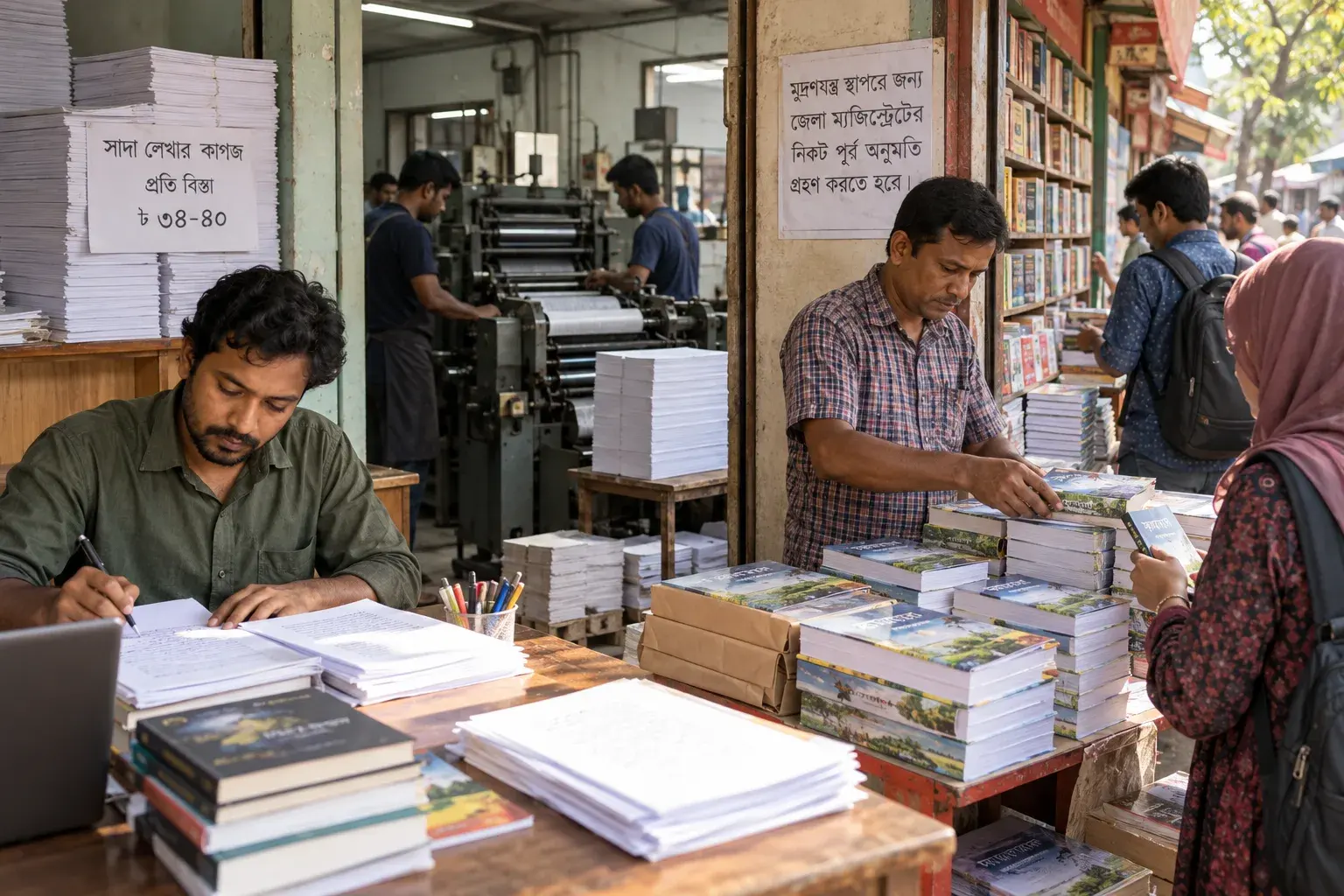 Light manufacturing & workshop
Book publishing and printing
Turning a manuscript into a printed book and getting it to market. White writing paper is Tk 34-40 per dista, and keeping a press requires a declaration before the District Magistrate.
- Capital
- ৳2 lakh – ৳50 lakh
- People
- 2 – 20
- First income
- 60 – 240 days