
Computer embroidery unit
Machine-stitching thread designs onto cloth as a job for others. The customers are cap factories, boutiques and saree workshops. What takes fifteen days by hand, the machine does in hours.
- Last reviewed: 19 September 2026
- Version 1

Computer embroidery unit
- Starting capital
- ৳3,00,000 – ৳12,00,000 Market quote
- Manpower
- 2 – 30 people
- First sale
- 30 – 90 days Editorial estimate
- Break-even
- 5.5 – 11 months Editorial estimate
- Kind of work
- Workshop · Medium difficulty
About the business
A computer embroidery unit makes the design on a computer and lets the machine stitch it onto cloth. It sells no garments of its own; the work comes from others - cap factories, boutiques, tailoring shops, saree and benarasi workshops and small garment units. Two reference points show what the work is worth. From the cap factories of Kamrangirchar and Keraniganj in Dhaka on 10 April 2023, each embroidered nakshi cap went to the wholesaler at Tk 30 and reached the retail counter at Tk 80-100 or more. In Mirpur's Benarasi Palli on 9 March 2026, sarees and lehengas carrying karchupi, stone and thread work were selling wholesale at Tk 1,300 to Tk 5,000 depending on the work; as one workshop owner there put it, 'we bring in the fabric, then we put the designs on it, and from here the sarees go to the big showrooms.' Why a machine is needed becomes obvious from the hand-work arithmetic. In Saidpur, Nilphamari on 6 April 2024, some 30,000 women were doing karchupi by hand; finishing the sequin, bead and zari work on one saree took at least fifteen days for a wage of Tk 700-800, giving a monthly income of Tk 3,000-3,500. What takes a person fifteen days a machine does in hours, and that gap is the whole basis of this business. The season is equally clear: cap factories run about one lakh caps a month from January to April and 25,000-30,000 in the other months. It can be started small. In Pratap Choyghari, Sadullapur in Gaibandha, Latifa Begum and her daughter took Rural Development Board training in 2022 and began taking orders; by 6 September 2026 about 200 women were working there, and she says the unit clears Tk 25,000-30,000 a month after all costs. Putting in a machine is a different order of money: she needs at least Tk 500,000 more for a shed, an embroidery machine, modern equipment and raw material.
Unit economics
| Item | Range | Evidence | Suggest a correction |
|---|---|---|---|
| Monthly working capital | ৳1,50,000 – ৳9,50,000 | Editorial estimate | |
| Selling price | ৳26 – ৳30 / unit | Market quote | |
| Variable cost | ৳19 – ৳23 / unit | Editorial estimate | |
| Gross margin | 23.3% – 26.9% | Editorial estimate | |
| Time to first revenue | 30 – 90 days | Editorial estimate | |
| Break-even time | 5.5 – 11 months | Editorial estimate | |
| Cash cycle | 15 – 45 days | Editorial estimate | |
| Waste / loss | 2% – 5% | Editorial estimate | |
| Daily capacity | 830 – 3,330 | Market quote |
What you need to start
- A computer embroidery machine, single-head or multi-head. No published Bangladeshi price for this machine could be verified, so no price is given on this page. Compare quotes from at least three importers and the used-machine market before buying.Equipment
- A design computer with digitising software, a voltage stabiliser and a cutting table. In Kamrangirchar's cap factories 20-25 layers of cloth are cut at once by machine, and one millimetre out ruins the size.Equipment
- Trade licence from the city corporation or municipality: form Tk 10, licence book Tk 50, standard tax Tk 30, non-judicial stamp Tk 150-300, licence fee Tk 100-60,000 by trade type. Usually issued in 3-5 working days.Licence
- Digitising - turning a picture into a stitch file. That is where the unit's real skill sits. In one union of Tetulia, Panchagarh, five of six cap factories closed for want of capital and skilled workers.Skill
- Finishing. As the Kamrangirchar craftsmen put it, however much the machine does, the beauty of a cap comes from hand finishing; before shipping to Oman, Qatar or Saudi Arabia every cap's inner thread and weave is checked by hand.Skill
- Thread, sequins, beads, zari and gum, and Islampur in old Dhaka for fabric - that is where Kamrangirchar's cap factories buy. Plus a machine mechanic, because needles and hooks need constant replacement.Supplier
- A solid floor and a clean space where the machine stays steady and the cloth stays free of dust. Being close to the buyers' factories is the biggest advantage of all.Workspace
How the work is done
- 1First decide whose work you will take: cap factories, boutiques, saree workshops or tailoring shops. Each has different designs, different cloth and a different price per piece.
- 2Sit where the work already is. Kamrangirchar in Dhaka has more than 30 cap factories, and there are others in Keraniganj, Sign Board, Mirpur, Lalbagh and Chawkbazar. Away from the buyers, orders do not come.
- 3Tie up two or three regular buyers before you start. This is subcontract work: installing a machine and waiting for orders will burn the money.
- 4Decide the number of heads before buying. A single-head machine handles samples and small orders; a multi-head machine runs many pieces at once, but costs far more to buy and to power.
- 5Arrange the design person. Without someone who can digitise on a computer the machine is dead weight - digitising, not stitching, is the real skill of the unit.
- 6Sort out uninterrupted power and voltage stabilisation. A cut mid-run snaps the thread, ruins the design and writes off that piece of cloth.
- 7Take the trade licence from the city corporation or municipality, and check whether the factory needs a fire service clearance.
- 8Fix the per-piece rate in writing: how many stitches, how many colours, who supplies the thread, and whether samples are charged for. On a verbal deal nobody pays for the extra colour or the extra stitches.
- 9Send a sample first, then the full lot. If a lot comes out wrong, the cost of the buyer's cloth lands on you as well.
- 10From Shab-e-Barat to the twentieth day of Ramadan is the year's peak, when cap and Eid clothing factories run day and night. Line up materials and workers for that window in advance.
- 11Find off-season work: school and company uniform monograms, sports jerseys, bags and bedsheets. On Eid work alone the machine sits idle half the year.
Seasons
- JanHigh
- FebHigh
- MarHigh
- AprHigh
- MayNormal
- JunNormal
- JulLow
- AugLow
- SepLow
- OctNormal
- NovHigh
- DecHigh
Where it works well
- Strong fitBogura · Women in Sherpur upazila knit jali caps; the district makes about two lakh caps a day and one-third of that output is exported.
- Strong fitDhaka · Kamrangirchar alone has more than 30 cap factories, with more in Keraniganj, Sign Board, Mirpur, Lalbagh and Chawkbazar; fabric comes from Islampur and the wholesale markets are Chawkbazar and Gulistan's Khaddar Market. Mirpur's Benarasi Palli holds many karchupi and stone-work workshops.
- Strong fitNilphamari · Saidpur has some 30,000 women in karchupi work, done house to house in Kazihat, Munshipara, Mistripara, Bashbari, Hatikhana and Golahat, with mahajans supplying Dhaka.
- PossibleChattogram · Riazuddin Bazar and Bakshir Hat are major cap wholesale markets, and caps are made in the district too.
- PossibleGaibandha · An embroidery cluster of about 200 women has grown up in Pratap Choyghari, Sadullapur, with Rural Development Board training and microcredit available locally and finished garments going to other districts.
- PossibleNaogaon · Caps are made in Mahadebpur, Niamatpur, Manda and the sadar upazila, much of it for export.
- PossibleNarsingdi · The big cloth markets including Madhabdi are here, and boutiques and saree workshops need design work.
- PossibleRangpur · Caps are made in most villages of Kaunia upazila and go to Oman, Qatar, Kuwait and Saudi Arabia.
- PossibleSirajganj · A known cap-making district with weaving and fabric clusters nearby, so materials are easy to get.
- Weak fitPanchagarh · Tetulia has factories, but in one union five of six closed for want of capital and skilled workers.
Risks and cautions
- HighDependency: This business stands entirely on other people's orders. Saidpur's mahajans release work only once an order arrives from Dhaka by email; with no order, 30,000 pairs of hands sit idle. A machine unit is no different - depend on two or three buyers and one of them leaving stops the machine. In one union of Tetulia, Panchagarh, five of six cap factories have closed for want of capital and skilled workers.
- HighDemand: Half the year there is no work. Al Saif Cap reckons about one lakh caps a month sell from January to April and 25,000-30,000 in the other months, so after the peak the work falls to a third. The machine instalment, however, falls due all twelve months.
- HighOther: Pressure from imports. On 9 March 2026 workshop owners in Mirpur's Benarasi Palli said demand for domestic handmade goods is falling: a jimichu party saree sells at Tk 2,200-3,000 there while a comparable Indian one goes for Tk 6,000-7,000, and buyers still take the Indian. In caps too, cheap glossy Chinese imports are in higher demand. When the buyer's factory suffers, the embroidery orders shrink with it.
- MediumWorking capital: Input costs rise but the per-piece rate cannot be raised at once. On 10 April 2023 the owner of Al Saif Cap said fabric, power, gas and wages had pushed the production cost up by Tk 5-7 per cap in a year, against a wholesale price of Tk 26-30. In a small unit that squeeze is what exhausts the capital.
- MediumOther: Extortion and security risk at the workshop is real. On 21-22 February 2026 an armed attack on a factory in Adabar, Dhaka over a refused extortion demand led to several arrests, and local traders surrounded the police station in protest. A small unit holds an expensive machine, so this risk cannot be left out of the calculation.
Sources
সিটি কর্পোরেশন থেকে ট্রেড লাইসেন্স প্রাপ্তির ধাপ সমূহ
Collected: 16 Sept 2026Supports: Starting capital · বাংলাদেশ
What changed
No corrections have been published yet.
Questions and answers
No questions yet. Be the first to ask.
Similar businesses
 Light manufacturing & workshop
Carton and box making
A unit making corrugated cartons and boxes. Small parcel cartons retail at Tk 24-40 each, and the 350,000-400,000 parcels moving daily are the biggest market.
- Capital
- ৳3 lakh – ৳30 lakh
- People
- 4 – 30
- First income
- 45 – 120 days
 Light manufacturing & workshop
Rubber and plastic sandal making
Melting old shoes and waste plastic into cheap sandals. Bangladesh has 300-400 such factories making over a crore pairs a year, and they retail at Tk 100-500 a pair.
- Capital
- ৳2.5 lakh – ৳25 lakh
- People
- 3 – 25
- First income
- 60 – 180 days
 Light manufacturing & workshop
Hosiery unit: socks and vests
A factory making vests, socks and sweaters from jhut cloth. Pabna has about a thousand units making 180-200 million pieces a year, but with the land route to India closed 65 percent of the workers are idle.
- Capital
- ৳2 lakh – ৳25 lakh
- People
- 5 – 100
- First income
- 30 – 90 days
 Light manufacturing & workshop
Book publishing and printing
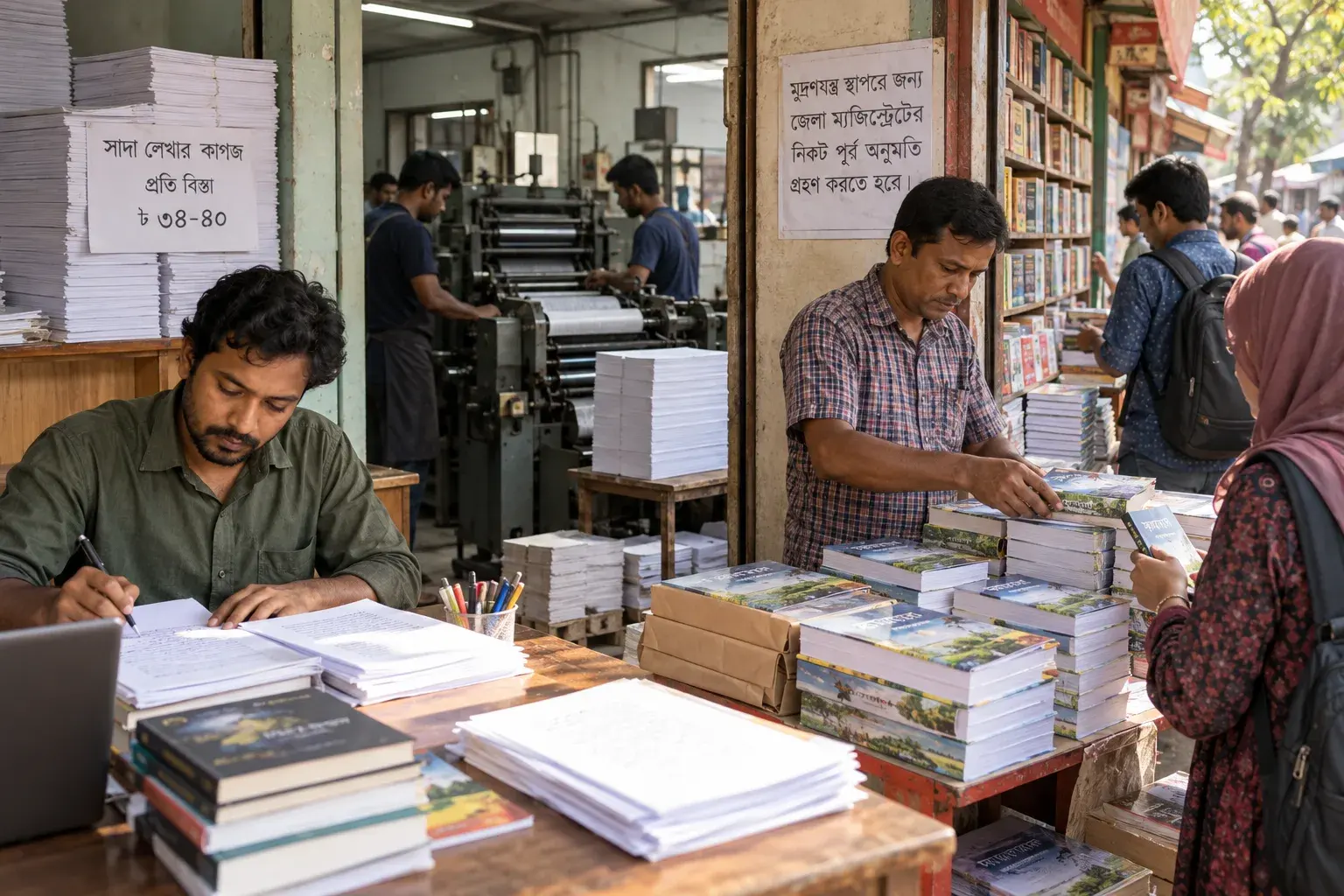
Turning a manuscript into a printed book and getting it to market. White writing paper is Tk 34-40 per dista, and keeping a press requires a declaration before the District Magistrate.
- Capital
- ৳2 lakh – ৳50 lakh
- People
- 2 – 20
- First income
- 60 – 240 days