
Date and sugarcane molasses (gur)
Boiling date palm or sugarcane sap into gur and patali through the three winter months. Gur was Tk 340/kg in Jashore and patali up to Tk 500. The hardest fight is not price but adulteration.
- Last reviewed: 19 September 2026
- Version 1

Date and sugarcane molasses (gur)
- Starting capital
- ৳25,000 – ৳2,00,000 Editorial estimate
- Manpower
- 1 – 4 people
- First sale
- 40 – 60 days Editorial estimate
- Break-even
- 3.5 – 14 months Editorial estimate
- Kind of work
- Workshop · Medium difficulty
About the business
Tapping date palms in winter, boiling the sap down in a wide pan into liquid gur or patali cakes, and selling it at the haat or to a wholesaler - three months of work that carries part of a year's income. Sugarcane gur is the same job with sap from a cane crusher instead. Trees are prepared from the month of Kartik, sap starts running from mid-Agrahayan, and selling runs to the end of Chaitra. Jashore date gur received Geographical Indication status on 15 February 2024 and Manikganj's Hazari gur was certified on 15 June 2026. On 2 November 2025, at the opening of the Jashore season, the agriculture department counted 3,07,130 tappable trees and at least 6,000 gachhis, with sap at Tk 35 a litre and gur at Tk 340 a kg; the previous season liquid gur sold at Tk 400 a kg and patali averaged Tk 500. That gap is the problem. Sugar was Tk 110-115 a kg on 15 September 2026, three to four times cheaper than gur, so faking gur with sugar, molasses, flour, soda, hydros and colour pays well. On 3 December 2025 a mobile court in Faridpur Sadar destroyed 6,500 kg of adulterated gur bound for the Dhaka and Rajshahi markets, and on 6 January 2026 a Manikganj unit was caught making date gur with no sap in it at all. The gachhi who makes the real thing has to compete on price with that.
Unit economics
| Item | Range | Evidence | Suggest a correction |
|---|---|---|---|
| Monthly working capital | ৳8,000 – ৳50,000 | Editorial estimate | |
| Selling price | ৳340 – ৳500 / kg | Market quote | |
| Variable cost | ৳210 – ৳300 / kg | Editorial estimate | |
| Gross margin | 12% – 58% | Editorial estimate | |
| Time to first revenue | 40 – 60 days | Editorial estimate | |
| Break-even time | 3.5 – 14 months | Editorial estimate | |
| Cash cycle | 1 – 15 days | Editorial estimate | |
| Waste / loss | 5% – 15% | Editorial estimate | |
| Daily capacity | 4 – 5 | Editorial estimate |
What you need to start
- A shaving blade and rope, spouts, clay pots, a strainer, a large boiling pan, a stirring ladle, patali moulds and scales - plus netting for the pot mouths.Equipment
- A season's fuel - palm fronds, trimmings and straw. Each batch needs two to three hours of fire, so fuel is the largest running cost.Starting stock
- Compliance with the Safe Food Act 2013. Mobile courts seize and destroy adulterated gur and file cases in the pure food court - on 3 December 2025 in Faridpur Sadar 6,500 kg was destroyed this way.Licence
- Trade licence from the union parishad, municipality or city corporation: form Tk 10, licence book Tk 50, standard tax Tk 30, non-judicial stamp Tk 150-300, licence fee Tk 100-60,000 by trade type. Issued in 3-5 working days, renewed yearly.Licence
- Registration with the Bangladesh Food Safety Authority under the Food Safety (Registration and Licensing) Regulations 2026, gazetted 16 July 2026. Registration is compulsory for packaged food producers: Tk 1,000 new, Tk 500 renewal, valid three years; licensing for establishments runs Tk 1,000-5,000.Licence
- Tree shaving. How deep to cut which tree, how often, and when to rest it cannot be taught from a book - it is learned by watching. At least 6,000 people do this work in Jashore alone.Skill
- Tree owners for the season's lease, a potter for the clay pots, and a gur wholesaler or arotdar. The haats around Khajura and Chaugachha in Jashore are the centre of this trade.Supplier
- A boiling shed: furnace, wide pan, smoke outlet, water, and space for pots and fuel. It should sit close to the trees, because dawn sap sours if it has to travel.Workspace
How the work is done
- 1Fix your trees in Kartik. If the trees are not yours, settle the season's arrangement with the owner - how many trees, what share or rent - and write it down.
- 2Shave the trunk and set the spout. This is the real skill: shave too deep and the tree dies, too little and the sap is thin. A good gachhi takes three or four seasons to make.
- 3Scald the clay pots clean, tie them up in the afternoon and bring them down at dawn. Sap that turns sour will not set into gur, so there is no room for delay.
- 4Tie a net over the pot mouth so bats cannot reach the sap at night. Nipah spreads through bat saliva in raw sap, and one such report stops raw juice sales across a whole area.
- 5Set up the boiling shed with a furnace and a wide pan, and stock the season's fuel - palm fronds, trimmings, straw - in advance. Buying it daily costs more.
- 6Strain the sap and boil it for two to three hours. Take it off as liquid gur when it thickens, or keep stirring and pour into moulds for patali.
- 7Decide whether to sell raw sap at all. Sap at Tk 35 a litre pays at once, but boiled into gur it fetches Tk 340-500 a kg, and boiling also removes the Nipah risk.
- 8Do not mix in sugar, molasses, flour, soda, alum, hydros or colour. Cases are filed under the Safe Food Act 2013, mobile courts destroy the stock, and once an area's gur gets a bad name the honest maker's price falls too.
- 9Pack the gur with your name, address, date of making and weight on the label, and register with the Food Safety Authority as a packaged food producer - registration is Tk 1,000 and lasts three years.
- 10Fix your haat days and bargain with the wholesaler, and if you have taken an advance, agree beforehand how many kilos it will be adjusted against.
- 11After Chaitra gur melts and moulds. Keep what is unsold cool and dry, and divide the season's earnings across the whole year.
Seasons
- JanHigh
- FebHigh
- MarHigh
- AprLow
- MayLow
- JunLow
- JulLow
- AugLow
- SepLow
- OctNormal
- NovNormal
- DecHigh
Where it works well
- Strong fitFaridpur · Greater Faridpur is a major gur trading centre, feeding the Dhaka and Rajshahi markets - which is also why the fake units are here: 6,500 kg of adulterated gur was destroyed at Machchar in the sadar on 3 December 2025.
- Strong fitJashore · The country's date gur centre - Jashore date gur received GI status on 15 February 2024, and on 2 November 2025 the district counted 3,07,130 tappable trees and at least 6,000 gachhis. The haats around Chaugachha and Khajura are the main market.
- Strong fitManikganj · Hazari gur from the Jhitka area of Harirampur received its GI certificate on 15 June 2026 (GI-62); 30-32 gachhi families in Balla, Gopinathpur, Kanchanpur and Gala unions make it, and it has fetched up to Tk 2,200 a kg.
- PossibleBogura · Patali is made in villages such as Khadash in Shajahanpur upazila, with sap from mid-Agrahayan boiled two to three hours (22 December 2025). As a northern trading centre the wholesale market is close by.
- PossibleChapai Nawabganj · Sugarcane gur country - 5,400 hectares of cane in the district, 4,880 of it in Shibganj alone. It is also where imported unrefined sugar arriving through Sonamasjid port is most often mixed into cane juice (20 November 2024).
- PossibleDhaka · The biggest buying market, with pitha and sweet demand at its peak in winter; GI-recognised gur sold in a labelled pack gets its best price here.
- PossibleJhenaidah · Adjacent to the Jashore date palm belt and feeding the same wholesale market along the Jashore-Jhenaidah road. No separate official count of trees, gachhis or prices for this district was found in this research.
- PossibleRajshahi · A large consuming market - the adulterated consignments caught in Faridpur were going to Rajshahi as well as Dhaka, so demand exists here and so does the chance to compete on proven purity.
Risks and cautions
- HighCompliance: Adulteration is the biggest problem in this trade and it cuts both ways. On 3 December 2025 a mobile court in Machchar union, Faridpur Sadar destroyed 6,500 kg of fake gur made from low-grade molasses with banned hydros, alum, non-food-grade colour and flavour, spoilt sweets, flour, soda and sugar, bound for the Dhaka and Rajshahi markets. On 6 January 2026 a man in Harirampur, Manikganj was caught making 10-15 kg of 'date gur' a day with no sap in it at all. Getting caught means destruction of stock and a case under the Safe Food Act 2013; not getting caught still poisons the market, because buyers who cannot tell real from fake distrust all of it.
- HighDependency: The sugar price sets the arithmetic of fake gur. On 15 September 2026 sugar was Tk 110-115 a kg against gur at Tk 340-500. The wider that gap, the more it pays to melt sugar into gur, and the harder the honest gachhi is pushed on price. Ten to fifteen trucks of unrefined sugar and molasses come from India through Sonamasjid land port in Chapai Nawabganj every day, some of it mixed into cane juice (20 November 2024).
- HighDemand: The season is three months. Trees are cut in Kartik, sap runs from mid-Agrahayan, and it ends with Chaitra. For the other nine months this trade earns nothing while the household still eats. Without dividing the season's income the summer runs on borrowing, and by the next Kartik there is no money left to lease trees.
- MediumOther: Raw sap carries Nipah risk, because bats reach the pots at night and their saliva mixes with the sap. Boiled gur does not carry it, but one reported infection in winter stops raw sap sales across a whole area, and a seller who depends on raw sap can lose the season to that single news item.
- MediumSpoilage: Sap not brought down at dawn turns sour and will not set, losing a whole day's work. Finished gur melts and moulds in warm, damp weather, so stock held past Chaitra is at risk. No figure for the percentage lost was found in this research.
Sources
সিটি কর্পোরেশন থেকে ট্রেড লাইসেন্স প্রাপ্তির ধাপ সমূহ
Collected: 16 Sept 2026Supports: Starting capital · বাংলাদেশ
All food businesses now need safety registration
Collected: 22 Jul 2026Supports: Starting capital · বাংলাদেশ
What changed
No corrections have been published yet.
Questions and answers
No questions yet. Be the first to ask.
Stories about this business
55,000 taka of cost against 2.5 lakh of sales, and still no labour
Three kiyar of cane cost about 55,000 taka this season against 100,000 taka already sold and another 150,000 expected. Juice sells at 60 taka a litre, gur at 250 and lali at 220 - the problem is not price but finding anyone to cut the cane.
- Capital
- ৳55k
- Reasons
- Other, Dependency
Similar businesses
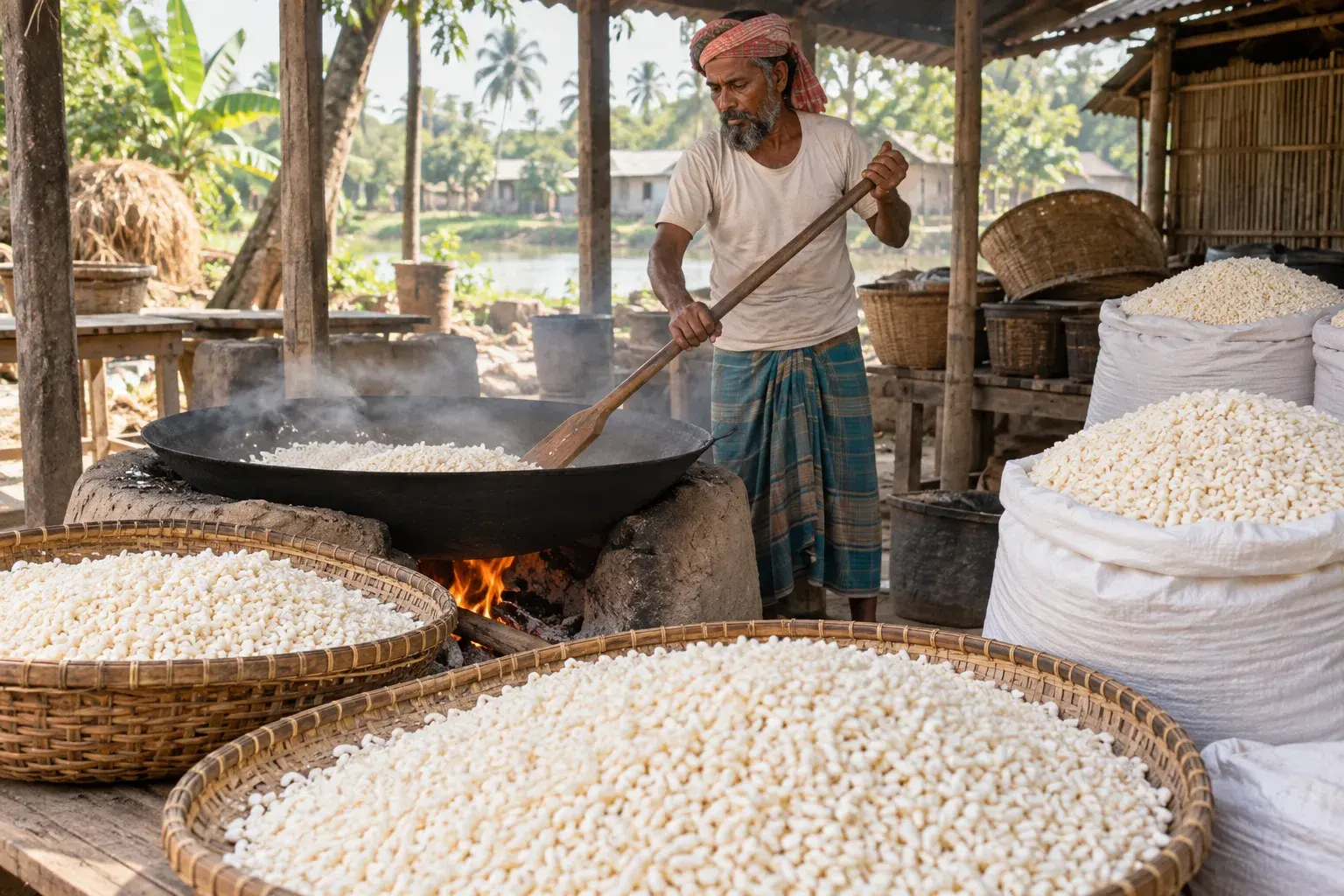 Food processing
Puffed rice (muri) making
Frying rice into muri. One kilo of rice gives 900 grams of muri and coarse rice costs Tk 50-55/kg, so machine muri keeps only Tk 4-6 a kilo while hand-fried pure muri wholesales at Tk 90.
- Capital
- ৳20k – ৳2 lakh
- People
- 2 – 8
- First income
- 7 – 30 days
 Food processing
Pickle (achar) making
Making mango, olive and garlic pickle for jars. Branded pickle retails at Tk 375-525 a kilo, and selling packaged food means a Tk 1,000 food safety registration even from a home kitchen.
- Capital
- ৳20k – ৳90k
- People
- 1 – 4
- First income
- 14 – 28 days
 Food processing
Tea stall and small cafe
About 250 cups come out of a kilo of tea leaf, and a cup sells for Tk 5-30. Tk 20,000 buys a stove, a cylinder, cups and a week of stock - not a shop deposit and not a fridge.
- Capital
- ৳20k – ৳1.5 lakh
- People
- 1 – 3
- First income
- 7 – 30 days
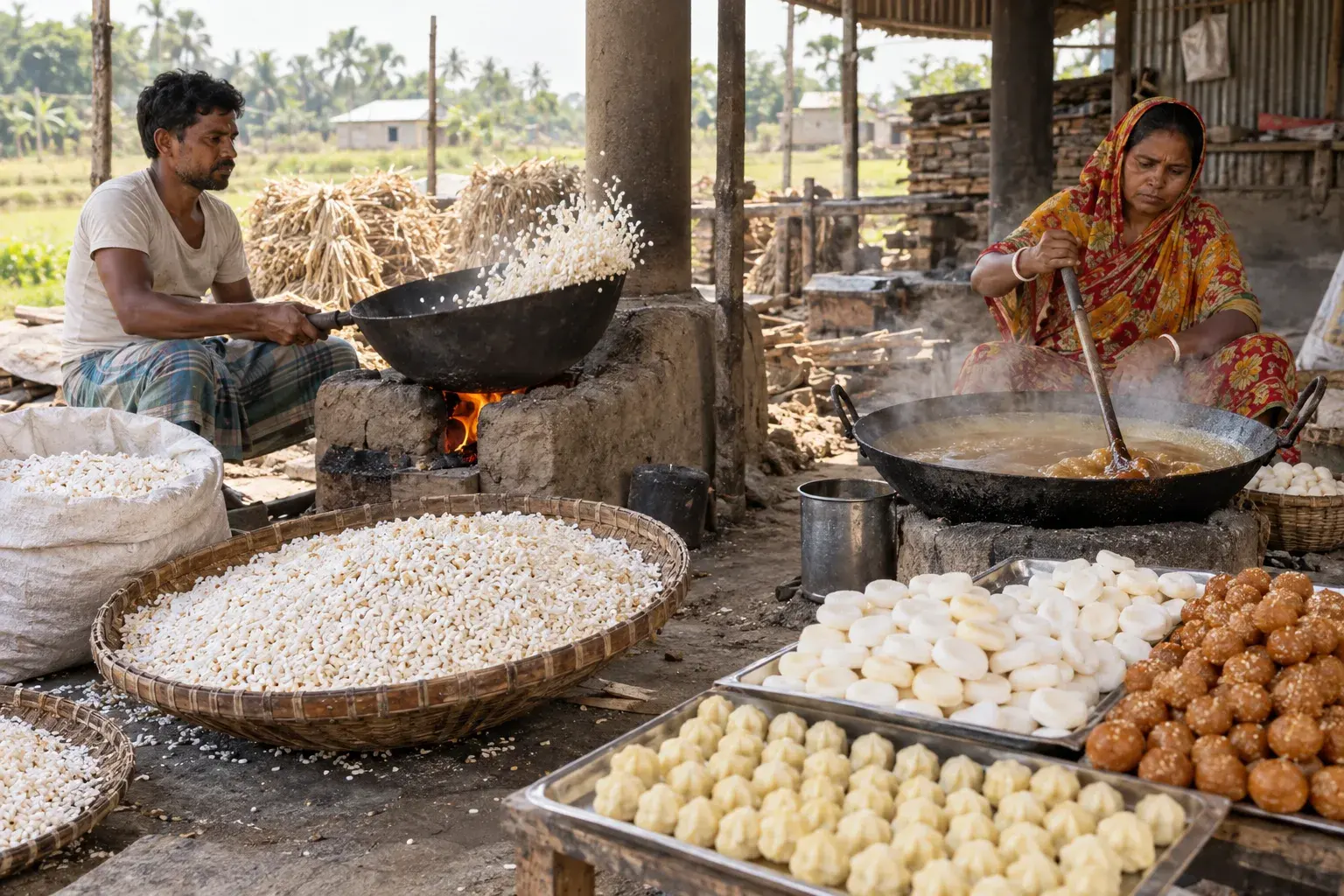 Food processing
Khoi and batasa making
Popping paddy into khoi and boiling sugar or gur into batasa and kadma. Wholesale sugar is Tk 102-103 a kg and batasa sells at Tk 190-300. Very low capital and no BSTI CM licence.
- Capital
- ৳15k – ৳1.5 lakh
- People
- 2 – 6
- First income
- 10 – 40 days