
Event catering
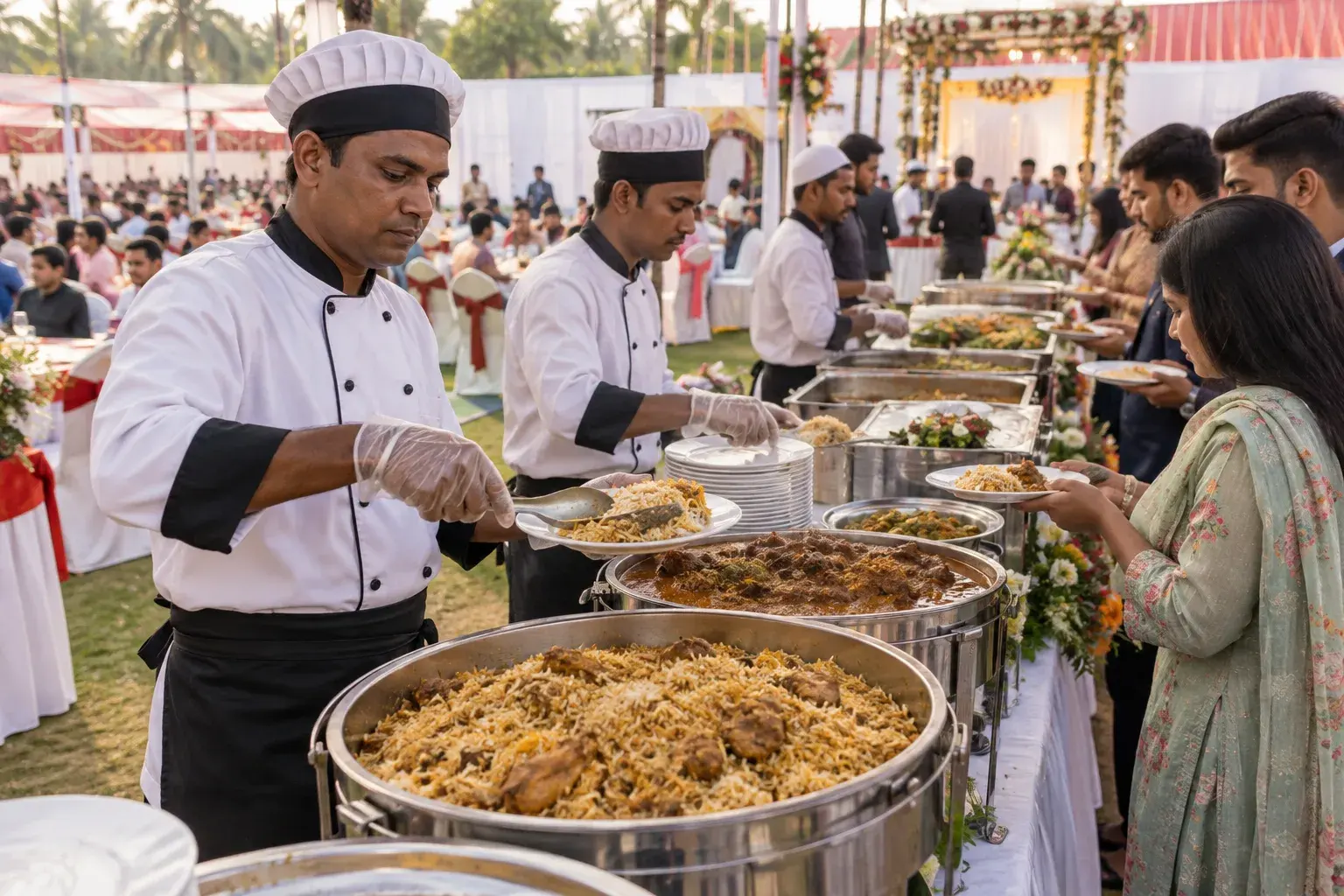
Cooking and serving for three to five hundred guests at events. The booking advance comes first, but catering services carry 15 percent VAT, not the restaurant's 5 percent.
- Last reviewed: 19 September 2026
- Version 1
Event catering
- Starting capital
- ৳1,50,000 – ৳8,00,000 Editorial estimate
- Manpower
- 5 – 25 people
- First sale
- 14 – 30 days Official source
- Break-even
- 4 – 10 months Editorial estimate
- Kind of work
- Mobile service · Hard
About the business
Cooking for three to five hundred people at a wedding, a gaye holud, an akika, a milad or an office function, and serving it on a fixed day at a fixed hour. The big difference from a restaurant is the direction the money runs. A restaurant buys, cooks and then waits to see whether customers come. Catering is the other way round: the date is fixed first, the head count is fixed first, the booking advance arrives first, and only then is the market done against that number. So there is no unsold food to throw away, but being a day late or a hundred plates short is ruinous. The tax is heavier too: dine-in at a restaurant carries 5 percent VAT while catering services carry 15 percent, and a per-plate rate quoted without allowing for that 15 percent eats the margin. Food safety registration is compulsory - Tk 1,000 new, Tk 500 to renew, valid three years, and granted only after the kitchen is physically inspected. Input prices do not hold still: on 15 September 2026 mutton was Tk 1,200-1,350 a kg, beef Tk 780-850 and polao rice Tk 170-215, with mutton up 13 percent and soybean oil up 11 percent over the year. The rate you accepted three months ago is not the rate the market will honour on cooking day. Only the caterer who costs every dish, item by item, survives this.
Unit economics
| Item | Range | Evidence | Suggest a correction |
|---|---|---|---|
| Monthly working capital | ৳51,000 – ৳81,000 | Editorial estimate | |
| Selling price | ৳326 – ৳330 / unit | Market quote | |
| Variable cost | ৳170 – ৳270 / unit | Editorial estimate | |
| Gross margin | 17% – 48% | Editorial estimate | |
| Time to first revenue | 14 – 30 days | Official source | |
| Break-even time | 4 – 10 months | Editorial estimate | |
| Cash cycle | 0 – 7 days | Editorial estimate | |
| Waste / loss | 3% – 8% | Editorial estimate | |
| Daily capacity | 300 – 1,000 | Editorial estimate |
What you need to start
- Large degs and pots, burners, LPG cylinders (12 kg at Tk 1,585, BERC-regulated, effective 2 September 2026), hot boxes, serving dishes and vessels, and a vehicle to move it all.Equipment
- Food registration from the Bangladesh Food Safety Authority under the Food Safety (Registration and Licensing) Regulations 2026: Tk 1,000 new, Tk 500 renewal, valid three years, compulsory for catering and granted after a physical kitchen inspection.Licence
- VAT registration from the National Board of Revenue. Catering services are taxed at 15 percent, against 5 percent for dine-in at a restaurant. A TIN is needed as well.Licence
- Fire licence from Fire Service and Civil Defence for a large kitchen using gas cylinders, plus environmental clearance from the Department of Environment where required.Licence
- Trade licence from the city corporation or municipality naming catering as the trade: form Tk 10, licence book Tk 50, standard tax Tk 30, stamp Tk 150-300, licence fee Tk 100-60,000.Licence
- A cook's hand and a head for numbers: how many kilos of meat and rice for how many guests, and when to put it on so hot food reaches the table on time.Skill
- Wholesalers for meat, rice and spice, an LPG dealer, a crockery hire shop, and someone who can supply waiters for the day.Supplier
- A kitchen with water, drainage and waste handling, and open space to set up large degs. This is the room inspected before registration.Workspace
How the work is done
- 1Fix a kitchen with water, drainage and waste disposal. That room is physically inspected when food safety registration is granted.
- 2Have the trade licence name catering as the trade. A wrong trade description on it blocks every licence that comes after.
- 3Take Bangladesh Food Safety Authority registration: Tk 1,000 new, Tk 500 to renew, valid three years. It is compulsory for catering.
- 4Take TIN and VAT registration from the NBR, and remember that catering services carry 15 percent VAT, not the 5 percent charged on dine-in.
- 5Build a costing sheet with the weight of every ingredient in every dish. A 150 g mutton portion is Tk 180-203 on the plate, and mutton rose 13 percent in a year.
- 6When you quote, add gas, cooks' and waiters' wages, transport, hired crockery and the 15 percent VAT on top of the per-plate ingredient cost, and only then your margin.
- 7Take the order in writing: date, time, head count, menu, per-plate rate, the advance, and the rate if the count goes up. Orders taken by word of mouth turn into a fight on the day.
- 8Do the market only after the advance is in hand, and buy the meat and rice for a large order on the morning of the previous day, when the price is known and the goods are fresh.
- 9Move the food in hot boxes on a timed run. Rice and meat standing too long go off, and one event that makes guests ill ends the next order.
- 10Collect the balance on the day. For an office or institutional order, get it in writing beforehand when the bill will be passed.
- 11Put aside part of what the November to February wedding season brings in, because there is almost nothing during the monsoon and Ramadan.
Seasons
- JanHigh
- FebHigh
- MarNormal
- AprNormal
- MayNormal
- JunLow
- JulLow
- AugLow
- SepNormal
- OctNormal
- NovHigh
- DecHigh
Where it works well
- Strong fitChattogram · A big city with its own mezban tradition and a port economy full of institutional functions, so orders come from both sides.
- Strong fitDhaka · The largest number of community centres and convention halls, and corporate events as well, though licensing and VAT scrutiny are strictest here.
- Strong fitGazipur · Regular orders from factory annual functions and mass meals for workers, with less competition than in Dhaka.
- Strong fitNarayanganj · Dense settlement with many community centres, and Dhaka's wholesale markets close by for buying.
- Strong fitSylhet · Remittance families hold large weddings and spend more per head, and events crowd together in winter when relatives come home.
- PossibleBogura · The northern trading hub, with community centres and wholesale meat and rice markets both at hand.
- PossibleCumilla · Community centres are multiplying along the highway and remittance families hold large weddings.
- PossibleKhulna · A divisional city where both institutional functions and wedding orders are available.
- PossibleRajshahi · University and college reunions and seminars alongside the winter wedding season keep work coming.
Risks and cautions
- HighCompliance: Catering carries 15 percent VAT while dine-in carries 5 percent. New operators often quote at the restaurant rate, and then ten taka in every hundred billed comes out of their own pocket - several thousand taka on a single 300-plate event. The restaurant owners' association counts 10 to 12 separate approvals needed to open a food business at all.
- HighDependency: The rate is quoted two or three months ahead but the market is done the day before. On 15 September 2026 mutton was Tk 1,200-1,350 a kg and had risen 13.3 percent in a year, soybean oil 11.4 percent and packet maida 14.3 percent. A 10 percent rise on a 150 g mutton portion is Tk 20 a plate, and Tk 10,000 on 500 plates.
- HighSpoilage: The food is cooked once and eaten in one hour. Rice and meat standing in hot boxes spoil, faster in hot weather. Food trouble at one event does not just lose that order: the food safety registration is at risk and the next orders in that neighbourhood stop coming.
- HighDemand: The income arrives in four or five months of the year. Orders run from November to February, weddings stop during Ramadan, and open-air events do not happen in the monsoon, while the kitchen rent, the vehicle and the permanent staff cost twelve months.
- MediumLate payment: A family event settles on the day, but office, factory and institutional orders wait for a bill to be passed. One or two large bills stuck mid-season leaves nothing to do the market for the next event.
Sources
সিটি কর্পোরেশন থেকে ট্রেড লাইসেন্স প্রাপ্তির ধাপ সমূহ
Collected: 16 Sept 2026Supports: Starting capital · বাংলাদেশ
- Collected: 15 Sept 2026
Supports: Starting capital, Monthly working capital, Variable cost · ঢাকা মহানগর — সিপাহীবাগ, মিরপুর-৬, মোহাম্মদপুর টাউন হল, নিউমার্কেট, রামপুরা, মহাখালী বাজার
LPG price cut by Tk 13, 12kg cylinder now Tk 1,585 (BERC, কার্যকর ২ সেপ্টেম্বর ২০২৬)
Collected: 2 Sept 2026Supports: Starting capital, Variable cost · বাংলাদেশ
All food businesses now need safety registration
Collected: 22 Jul 2026Supports: Starting capital · বাংলাদেশ
Budget FY27: Restaurant owners demand flat 5% VAT (বসে খাওয়ায় ভ্যাট ৫%, ক্যাটারিংয়ে ১৫%)
Collected: 20 Jun 2026Supports: Cash cycle · বাংলাদেশ
What changed
No corrections have been published yet.
Questions and answers
No questions yet. Be the first to ask.
Stories about this business
The catering training came; the money to buy anything did not
Catering training taken in 2022 never became work, because there was no money for equipment or ingredients. A survey of 2,000 trained women found 44 percent had set up nothing six months on.
- Reasons
- Working capital
Similar businesses
 Food processing
Sweet shop
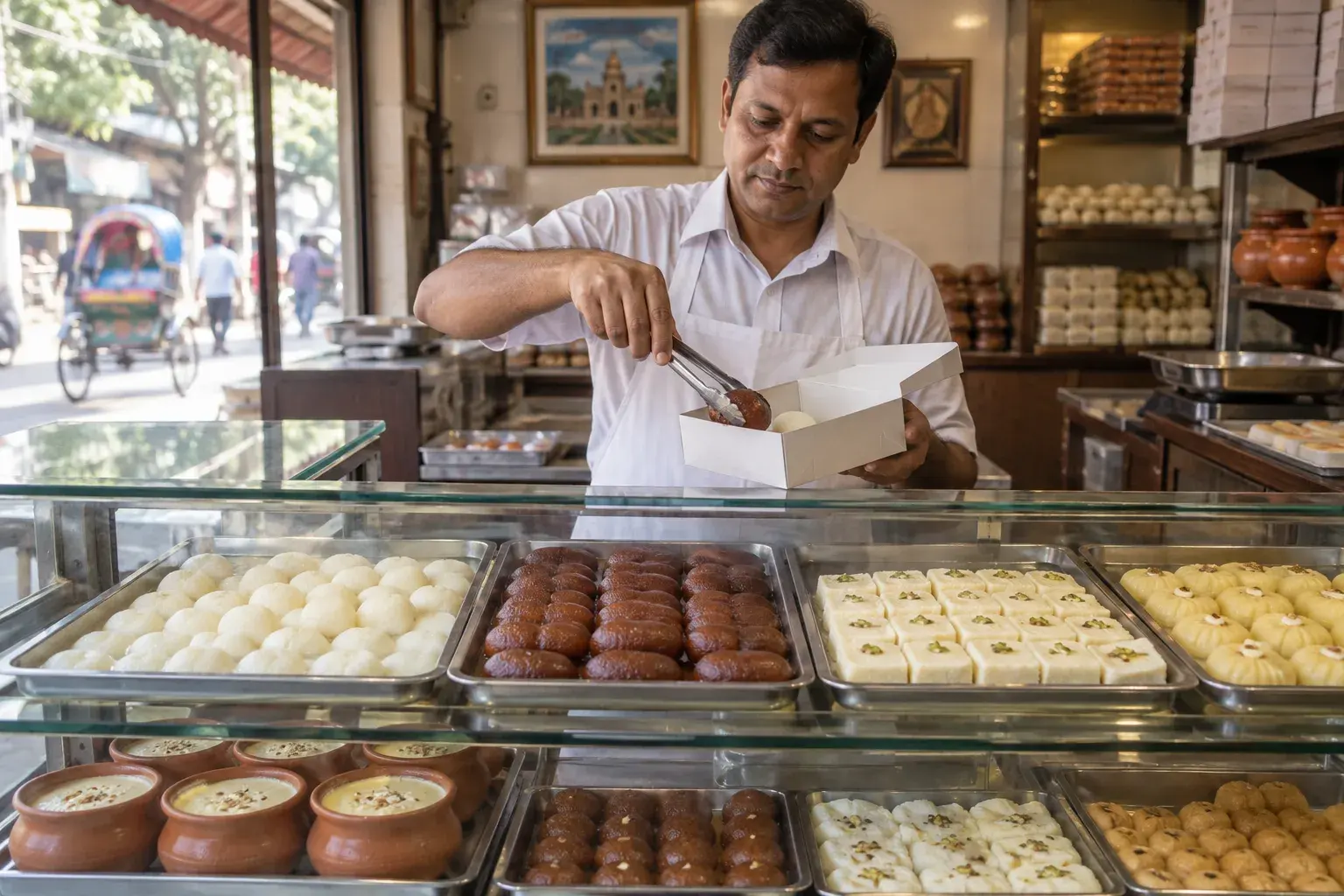
Making sweets from chhana and selling them over a counter. Sweets run Tk 380-600 a kg and doi Tk 210-300 a litre, but milk is Tk 120-140 a litre, so the margin is the milk price.
- Capital
- ৳1.5 lakh – ৳9 lakh
- People
- 2 – 8
- First income
- 14 – 45 days
 Food processing
Dried mango production
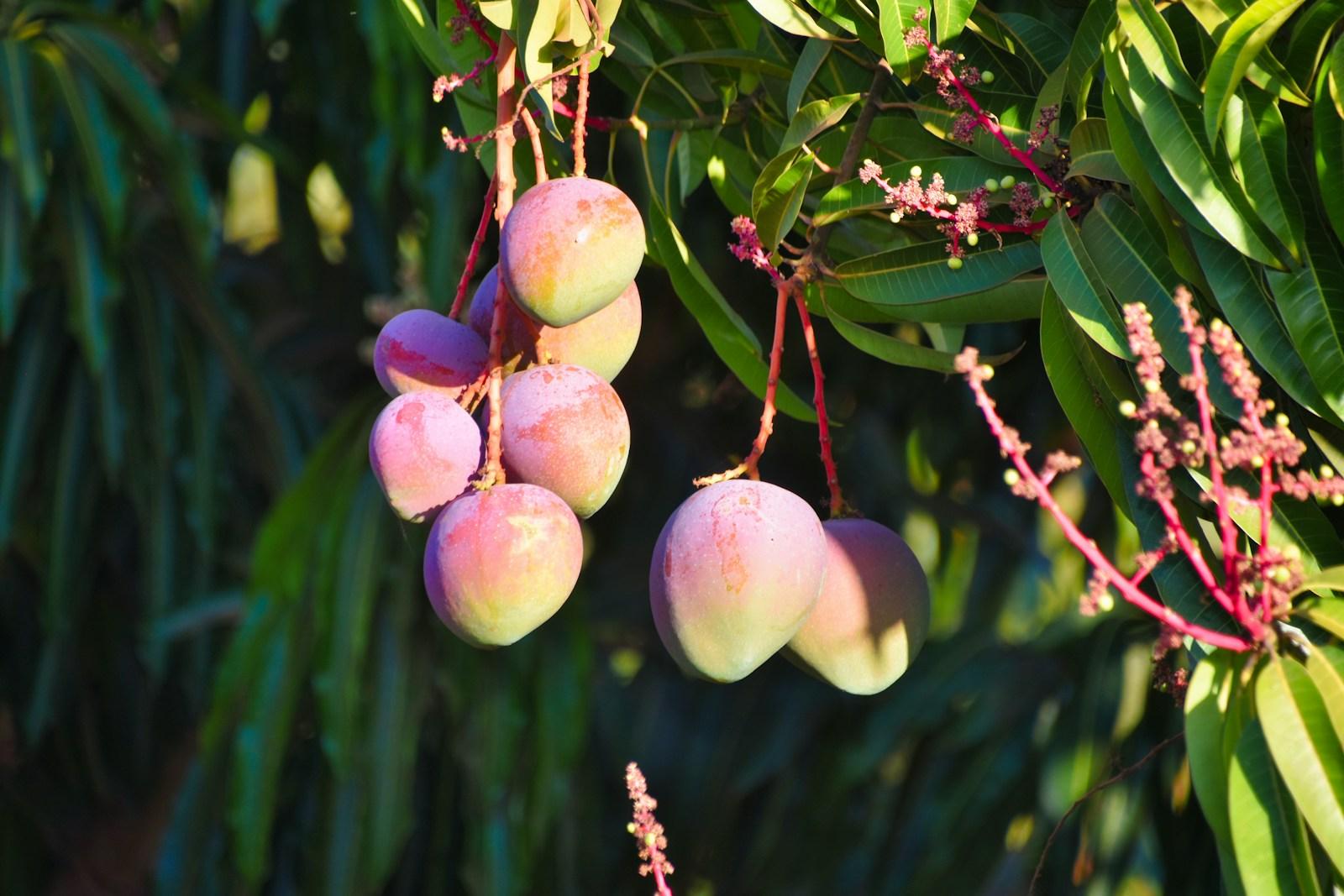
Buy raw mango at ৳15–40/kg in season, dry it and sell all year. 8–10 kg of fresh mango makes 1 kg dried.
- Capital
- ৳1.5 lakh – ৳4 lakh
- People
- 2 – 4
- First income
- 30 – 60 days
 Food processing
Honey processing and bottling
Buying raw honey from keepers, straining and bottling it under your own label. Bottled honey runs Tk 800-2,100 a kg, but a BSTI CM licence is compulsory and the sample test alone is Tk 7,500.
- Capital
- ৳1.5 lakh – ৳8 lakh
- People
- 2 – 6
- First income
- 45 – 150 days
 Food processing
Chanachur and snack making
Goods go to shops on credit and the money comes back in 15-30 days, so working capital is the limit, not the machine. Branded chanachur is Tk 300-333 a kg; a small maker has to sell at Tk 200-250.
- Capital
- ৳1.5 lakh – ৳8 lakh
- People
- 2 – 12
- First income
- 30 – 130 days