
F-commerce page selling
A parcel outside Dhaka costs Tk 135-150 in courier charge plus 1 percent COD. A refused parcel costs both legs. The return rate is the number that decides this business.
- Last reviewed: 19 September 2026
- Version 1
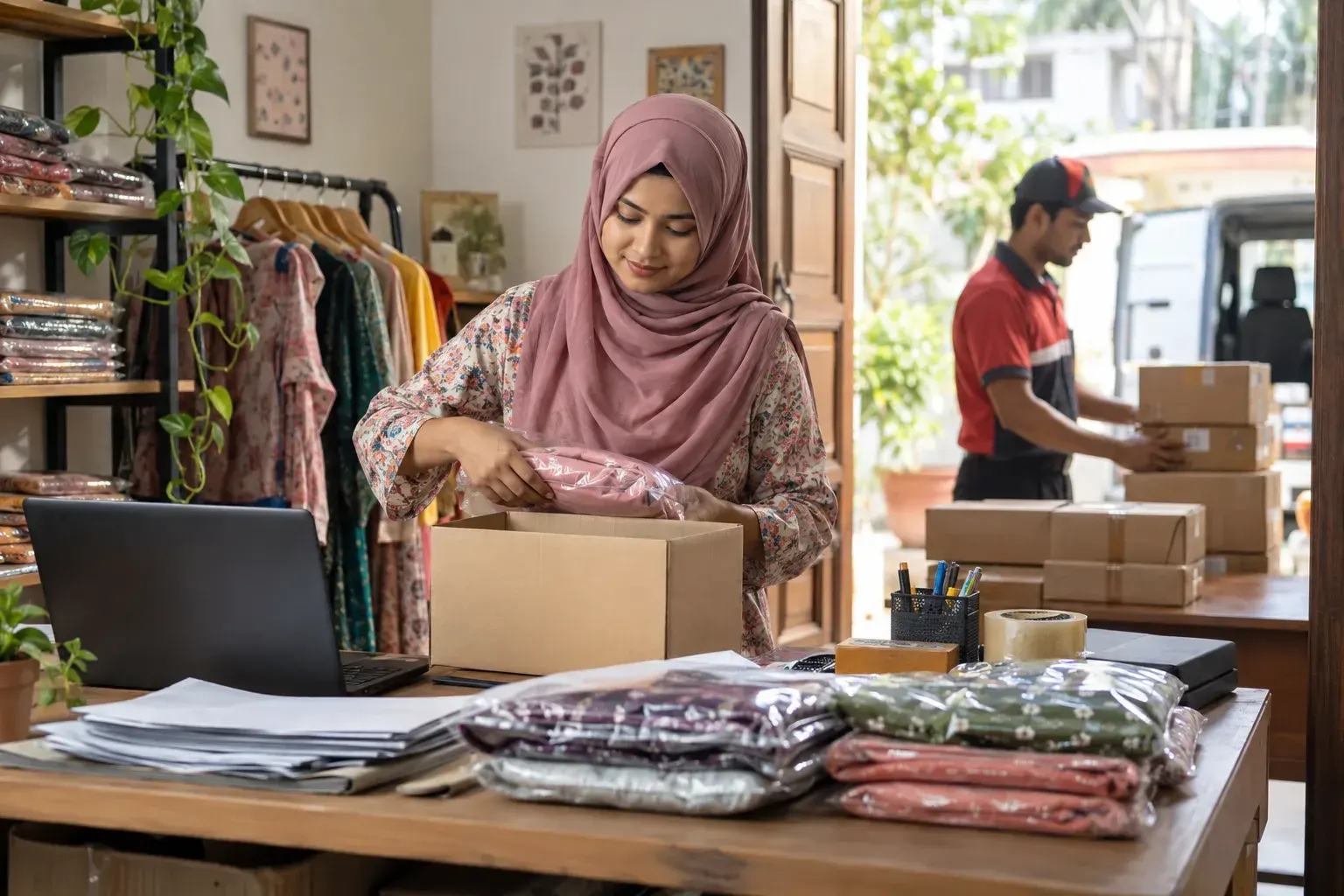
F-commerce page selling
- Starting capital
- ৳15,000 – ৳2,00,000 Editorial estimate
- Manpower
- 1 – 3 people
- First sale
- 3 – 21 days Editorial estimate
- Break-even
- 2 – 6 months Editorial estimate
- Kind of work
- Online · Easy
About the business
Selling goods from a Facebook page and sending them by courier, with the customer paying cash on delivery. No shop rent and no signboard, so everyone assumes there are no costs. The costs are in two places: the courier and the returns. The courier rates are not a secret. Steadfast charges Tk 55 inside Dhaka up to one kilogram and Tk 135 city-to-city outside Dhaka, plus 1 percent of the amount collected on cash on delivery. RedX charges Tk 70 inside Dhaka and Tk 150 outside, with no COD fee inside Dhaka and 1 percent outside. So a Tk 500 dress sent outside Dhaka loses about Tk 140 before it reaches you. If the margin on it was Tk 150, that parcel earned Tk 10. And if the customer refuses the parcel, both legs of the fare are yours and the sale is zero. That makes the return rate - how many out of a hundred parcels come back - the number this business lives or dies on, and selling on Facebook without knowing it is accounting in the dark. e-CAB puts national parcel volume at 350,000 to 400,000 a day, so the field is crowded: you survive on product and trust, not on price.
Unit economics
| Item | Range | Evidence | Suggest a correction |
|---|---|---|---|
| Monthly working capital | ৳15,000 – ৳1,50,000 | Editorial estimate | |
| Selling price | ৳600 – ৳2,500 / unit | Editorial estimate | |
| Variable cost | ৳55 – ৳150 / unit | Market quote | |
| Gross margin | 21% – 48% | Editorial estimate | |
| Time to first revenue | 3 – 21 days | Editorial estimate | |
| Break-even time | 2 – 6 months | Editorial estimate | |
| Cash cycle | 2 – 10 days | Editorial estimate | |
| Waste / loss | 8% – 20% | Editorial estimate | |
| Daily capacity | 5 – 40 | Editorial estimate |
What you need to start
- A phone with a decent camera, a light source, packing material - poly bags, bubble wrap, tape - and a register or spreadsheet for orders.Equipment
- Stock on hand. Sourcing after the order comes in means delay, and delay is the biggest single cause of returns.Starting stock
- Trade licence from the city corporation, municipality or union parishad: form Tk 10, licence book Tk 50, standard tax Tk 30, stamp Tk 150-300, licence fee Tk 100-60,000 by trade type, issued in 3-5 working days. Couriers and payment gateways ask for it to sign you up as a merchant.Licence
- Photography and writing, answering messages fast, and keeping the arithmetic of every parcel: sent, collected, returned.Skill
- A courier: registering as a merchant with a company such as Steadfast or RedX. Steadfast is Tk 55 inside Dhaka and Tk 135 outside with 1 percent COD; RedX is Tk 70 inside Dhaka and Tk 150 outside, COD 0 percent in Dhaka and 1 percent outside.Supplier
- A wholesale source: a Dhaka wholesale market, a local maker or an importer. Without a settled source the photographs stop matching what arrives.Supplier
- A corner of the house: a shelf for stock, a table to pack on, and a spot with daylight for photographs. No shop is needed.Workspace
How the work is done
- 1Decide what you sell and pick one narrow thing. A page that sells everything does not stick, because there is nothing for the customer to remember it by.
- 2Fix the wholesale source: a Dhaka wholesale market, a local maker, or import. Write down the buying price; without it you cannot work out what is left after the courier.
- 3Shoot your own product photographs. Pictures pulled off the internet do not match what arrives, and that is exactly when parcels come back.
- 4Add the courier cost before you price anything. Tk 135-150 outside Dhaka plus 1 percent on COD is your cost, not the customer's, unless you charge it separately.
- 5Decide whether you take the delivery charge in advance or the whole amount on delivery, and write it on the page. Taking the delivery charge up front cuts fake orders sharply.
- 6Confirm the address and the item by phone before despatch. Parcels sent on the strength of a message alone are the ones that come back.
- 7Pick one courier and keep the tracking number of every parcel in a register: sent, delivered, paid.
- 8Pack properly and put the return and exchange terms inside the parcel. A broken item on arrival is entirely your loss.
- 9Work out the return rate every month: parcels sent against parcels returned. That single number tells you whether the business is making money.
- 10Stop sending to areas that keep returning parcels unless payment is made in advance. That is the simplest way to cut the return bill.
- 11Build stock before Ramadan, Eid and winter, and cut it in the two monsoon months when both sales and courier times get worse.
Seasons
- JanNormal
- FebNormal
- MarHigh
- AprHigh
- MayHigh
- JunNormal
- JulLow
- AugLow
- SepNormal
- OctNormal
- NovHigh
- DecHigh
Where it works well
- Strong fitChattogram · A big-city buyer base with a courier hub in the city itself; city-to-city despatch is Tk 135-150.
- Strong fitDhaka · Courier is cheapest and fastest here at Tk 55-70 inside Dhaka, with no COD fee on RedX, and the wholesale markets are close.
- Strong fitGazipur · Next to Dhaka, so pickups are easy and the buyer base is large.
- Strong fitNarayanganj · A major wholesale clothing source is close by, and it sits inside the Dhaka courier network.
- PossibleCumilla · On the highway so parcels from Dhaka arrive quickly, and the district town wants Dhaka goods.
- PossibleKhulna · Good city buyers and courier coverage, but the return risk rises in upazilas outside the city.
- PossibleMymensingh · Plenty of students and young buyers, though on cheap items the courier charge eats the margin.
- PossibleRajshahi · A university city with young buyers, though despatch from Dhaka costs more and takes longer.
- PossibleSylhet · Remittance families buy higher-priced items, so the courier charge is a smaller share of the sale.
- Weak fitBandarban · Limited courier coverage, long delivery times and a higher chance of return.
Risks and cautions
- HighWorking capital: With cash on delivery the money arrives last. Stock is bought first, despatched first, and paid for only after the customer accepts and the courier's own remittance cycle completes. The more orders you take, the more money sits on the road: the business grows while the cash in hand shrinks.
- HighDemand: A returned parcel is zero revenue and double cost: the seller pays both legs. A Tk 500 item refused outside Dhaka burns Tk 270-300 in courier alone and the item is out of your hands for days. A high return rate turns a good product into a losing business.
- HighDependency: The whole business stands on someone else's platform. If the page is restricted or taken down the customer list goes with it, because the names and addresses live inside the page. Equally, when the courier performs badly the customer blames the seller.
- MediumOther: Fake orders: wrong numbers, wrong addresses, or orders placed as a joke. Without an advance delivery charge the full cost falls on the seller, and the item is tied up for days as well.
- MediumCompliance: When the item does not match the photograph, complaints go to the Directorate of National Consumer Rights Protection and fines follow. And one bad-experience video circulating on Facebook can stop sales the same day.
Sources
সিটি কর্পোরেশন থেকে ট্রেড লাইসেন্স প্রাপ্তির ধাপ সমূহ
Collected: 16 Sept 2026Supports: Starting capital · বাংলাদেশ
What changed
No corrections have been published yet.
Questions and answers
No questions yet. Be the first to ask.
Stories about this business
More than 5 lakh taka lost in the days Facebook was down
Two women run a fashion page that sells entirely through Facebook. During the July 2024 shutdown they could take no orders at all, and put their losses at more than 5 lakh taka.
- Reasons
- Dependency, Other
A thousand taka a day and a parlour, and the shutdown stopped both at once
Selling through Facebook brought about 1,000 taka a day, alongside a small beauty parlour. The shutdown stopped the Facebook income, and no parlour customers came in the same period.
- Reasons
- Dependency, Weak demand
Facebook down, and ten days later a single order for 20 pithas
Customers find her home-made pitha through Facebook. No orders came at all during the shutdown; ten days in, she got one order, for 20 pithas.
- Reasons
- Dependency, Weak demand
Similar businesses
 Digital & B2B services
Data entry service
Typing and list work from home. Easy to enter, very low starting pay - one named freelancer's first month was USD 13, and reaching a lakh a month took four years.
- Capital
- ৳15k – ৳90k
- People
- 1 – 4
- First income
- 90 – 180 days
 Digital & B2B services
Dropshipping and reselling
Selling online without holding stock, shipping by courier and collecting cash on delivery. Courier is Tk 60-180 plus 1 percent COD, and a returned parcel adds 50 percent of the delivery charge - which is where the profit goes.
- Capital
- ৳20k – ৳2 lakh
- People
- 1 – 4
- First income
- 3 – 30 days
 Digital & B2B services
Graphic design service
Designing and selling logos, banners and packaging. Training is nearly free so competition is fierce; overseas work loses 5-8 percent to gateways and conversion, offset by a 2.5 percent cash incentive.
- Capital
- ৳25k – ৳1.8 lakh
- People
- 1 – 5
- First income
- 90 – 365 days
 Digital & B2B services
YouTube and content creation
Making videos for YouTube and earning from ads. Creators get 55 percent of long-form ad revenue and 45 percent on Shorts; entry needs 1,000 subscribers and 4,000 watch hours, and both thresholds are doubling.
- Capital
- ৳3k – ৳2 lakh
- People
- 1 – 40
- First income
- 365 – 730 days