
Pitha shop
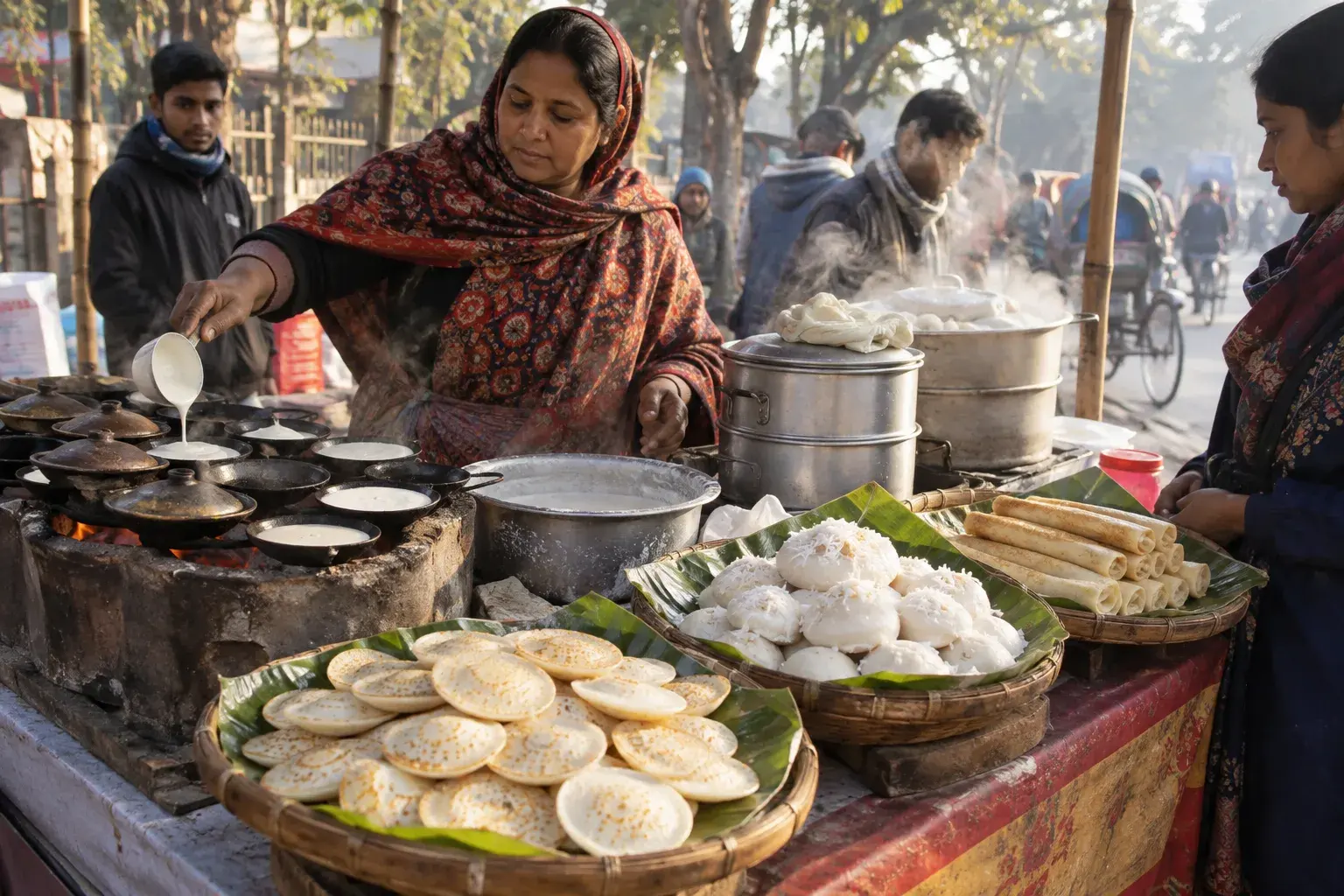
A winter footpath stall selling vapa, chitoi and patishapta. Chitoi Tk 5-10, vapa Tk 10-20; a stall sells 250-800 pitha a day, but the trade only runs three or four months a year.
- Last reviewed: 21 September 2026
- Version 1
Pitha shop
- Starting capital
- ৳5,000 – ৳60,000 Editorial estimate
- Manpower
- 1 – 4 people
- First sale
- 3 – 60 days Editorial estimate
- Break-even
- 1 – 3 months Editorial estimate
- Kind of work
- Shop · Easy
About the business
A clay stove on the footpath on a winter evening, selling hot rice cakes. On 23 November 2025 the national news agency BSS counted more than a hundred temporary pitha stalls in Khulna city alone, at Rupsha Ghat, PTI Mor, Dolkhola Mor, the Sonadanga bus stand, Khalishpur and Daulatpur. The thing itself is simple: rice flour, date-palm jaggery, coconut, some firewood and a stove. The arithmetic is not simple, because this is not a twelve-month trade. The Business Standard puts the season at the three or four months of winter, running mainly to the end of January. Whatever the stall earns has to be earned in those months; for the other eight the stove brings in nothing. The selling also splits sharply. Morjina Begum in Khulna sells 250-300 pitha a day and keeps about Tk 800 after costs, while Manjur Rahman's stall in the same city takes Tk 5,000-6,000 a day. The difference is the spot: where the crowd is, where people stand after dark. The prices are small - chitoi Tk 5, vapa Tk 10 to 20. And there is a new line in the accounts: the Safe Food (Registration and Licensing) Regulations gazetted on 16 July 2026 bring street pitha sellers under registration with the Food Safety Authority; the Authority's own draft named 'pitha, puli, puri, piyaju' outright in schedule 1, item 1.
Unit economics
| Item | Range | Evidence | Suggest a correction |
|---|---|---|---|
| Monthly working capital | ৳15,000 – ৳70,000 | Editorial estimate | |
| Selling price | ৳5 – ৳50 / unit | Market quote | |
| Variable cost | ৳3 – ৳15 / unit | Editorial estimate | |
| Gross margin | 55% – 70% | Editorial estimate | |
| Time to first revenue | 3 – 60 days | Editorial estimate | |
| Break-even time | 1 – 3 months | Editorial estimate | |
| Cash cycle | 0 – 1 days | Editorial estimate | |
| Waste / loss | 5% – 20% | Editorial estimate | |
| Daily capacity | 250 – 800 | Practitioner verified |
What you need to start
- Clay stoves (four to ten together at the Madaripur stalls), clay griddles with lids for chitoi, a steaming pot and cloth for vapa, a basin for the batter, a coconut grater, paper bags, stools and a tin or tarpaulin shelter. Prices could not be verified here.Equipment
- Rice flour or coarse rice (guti swarna Tk 43-45 a kg wholesale), atta (loose Tk 48-50, packet Tk 60-65 a kg retail), sugar (Tk 108-112 a kg retail) - Department of Agricultural Marketing, 17-09-2026. Date-palm jaggery, coconut, dried fish and bhorta ingredients could not be priced here.Starting stock
- Food business registration with the Bangladesh Food Safety Authority under the Safe Food (Registration and Licensing) Regulations gazetted 16 July 2026. Schedule 1, item 1 of the Authority's draft names 'pitha, puli, puri, piyaju' outright, and The Daily Star's report on the final gazette also puts street pitha sellers under registration; the full text of the final gazette was not available online. Valid three years, with the renewal application due at least 90 days before expiry. Two sources give two different fees - see the risks below.Licence
- No BSTI CM licence is needed here. Pitha and rice-cake products do not appear on the 315-item mandatory certification list, and the CM licence is a licence to put the standard mark on a product or its wrapper. Loose pitha handed over the counter has no wrapper and no mark. If someone starts packing and branding pitha, a separate set of rules begins as a packaged food producer.Licence
- Trade licence. In a pourashava a temporary footpath stall is covered outright: clause 6(2) of the Model Tax Schedule allows a licence for any permanent or temporary business not otherwise listed at a minimum of Tk 300 a year; a tea, ice cream, pan or cigarette shop is Tk 300 (class A) or Tk 200 (class B and C), plus a Tk 50 application fee and signboard tax at Tk 100 per square foot. A city corporation has no pitha line, so serial 295 (residual) of the 2016 Model Tax Schedule applies at Tk 1,000 if income tax is paid or Tk 500 if not, or serial 95, tea and pan shop, at Tk 500; signboard tax is Tk 80 per square foot. It runs on the fiscal year, and missing the 30 September renewal costs Tk 100 a month or 10 percent of the fee a month, whichever is higher, in a city corporation, and 5 percent plus 10 percent a year on arrears in a pourashava. Issued in 3 working days in Dhaka North and South, renewed in 1-2.Licence
- Fire safety certificate under section 4(1) of the Fire Prevention and Extinguishing Act 2003. There is no size exemption: the lowest band is 'up to 150 square feet'. Storing rice, sugar and paper puts it in group 1 - Tk 900 up to 150 sq ft, Tk 1,000 for 151-300, Tk 2,000 for 301-500. Cooking oil, ghee or an LPG cylinder puts it in group 3 or 4 - Tk 2,000 up to 150 sq ft, Tk 2,400 for 151-500. The application form is Tk 100, payable by treasury challan only. Whatever date it is issued, it expires on 30 June of that financial year; a late fee of 5 percent a month runs for six months, after which the licence is deemed cancelled. Rebates of 5 percent in a pourashava and 10 percent in a union parishad. 'Tea and pan shop' is a listed business type on the Fire Service e-licence portal.Licence
- No environmental clearance is needed here. The note to schedule 1 of the Environment Conservation Rules 2023 puts cottage industry - run by family members, investment up to Tk 5 lakh, and expressly including service activities - outside the clearance requirement altogether. A footpath pitha stall is far below that. For comparison, a restaurant with capital above Tk 30 lakh falls in the Green class, cleared in 7 working days and valid five years.Licence
- Judging the batter's thickness, knowing how hot the griddle must be before the chitoi goes on, timing the vapa so it does not go hard, and not stopping for the two hours of the rush. Everyone knows the recipe; not everyone has the speed.Skill
- A fixed supplier of date-palm jaggery lined up before the cold, and a steady coconut supply. The price rises in season and everyone wants it at once.Supplier
- A spot on the footpath or roadside where the evening crowd gathers, a light, and access to water. Hawker permission differs by city and its rules and cost could not be verified here.Workspace
How the work is done
- 1Settle the spot before the recipe. A bus stand, a ferry ghat, a college gate, a factory gate - wherever people stand after dark. In Khulna the stalls sit at Rupsha Ghat, PTI Mor, Dolkhola Mor, the Sonadanga bus stand and Khalishpur; ten other people will want the same spot the same winter.
- 2Ask the revenue section of the city corporation or municipality about permission to set up on the footpath or roadside. How hawker space is allotted differs from city to city, and the rules and cost of that permission could not be verified here; the local office has to be asked.
- 3Take the trade licence: form Tk 10, licence book Tk 50, standard tax Tk 30, stamp Tk 150-300, licence fee Tk 100-60,000, issued in 3-5 working days.
- 4Register the food business with the Food Safety Authority. Schedule 1 of the Authority's draft regulations names 'pitha, puli, puri, piyaju' outright, and reporting on the final gazette names street pitha sellers too, so a footpath stall gets no exemption. The application is online and the registration runs three years.
- 5Set up the stoves. The Madaripur stalls run four to ten clay stoves side by side: if you cannot turn out many at once you lose the evening rush, and most of the day's selling happens in those two hours.
- 6Line up rice flour, date-palm jaggery and coconut before the season opens. Demand for khejur gur rises all at once when the cold sets in, and the price is then the seller's to name.
- 7Serve bhorta with the chitoi. Dried fish, coriander, mustard, peanut, black cumin, chilli - that is what the Madaripur stalls put alongside. The bhorta may be free, but it is what brings the customer back.
- 8Buy the day's stock on the day. What is unsold at night does not keep, and soaked flour sours. Watch two or three evenings before fixing how much batter to make.
- 9Keep an extra pair of hands for the rush: one turning out pitha, one taking money and filling bags. When the line gets long the customer moves to the next stall.
- 10Write the day down: how many went, what came in, what it cost. In a three or four month trade, not knowing which evenings sell means repeating the same mistake next winter.
- 11At the end of the season put the stoves, griddles and shelter away and arrange another income for eight months. On its own this trade leaves most of the year with nothing coming in.
Seasons
- JanHigh
- FebNormal
- MarLow
- AprLow
- MayLow
- JunLow
- JulLow
- AugLow
- SepLow
- OctNormal
- NovHigh
- DecHigh
Where it works well
- Strong fitDhaka · The long-standing centre of the footpath pitha trade; Samakal reported a seller at Nababganj Chaurasta shifting about 500 pitha a day, and Baruakhali bazar too. The city has both the evening crowd and enough buyers to keep twelve kinds of pitha at one stall.
- Strong fitDinajpur · At Nimtala on 02-01-2026 both vapa and chitoi were Tk 10, and Hannan's stall took Tk 8,000-10,000 a day with two or three employees. It has both the northern cold and the town crowd.
- Strong fitKhulna · BSS counted more than a hundred temporary pitha stalls in Khulna city on 23-11-2025, at Rupsha Ghat, PTI Mor, Dolkhola Mor, Shishu Hospital Road, the Sonadanga bus stand, Khalishpur and Daulatpur.
- Strong fitLalmonirhat · A northern district where the cold lasts longest. On 25-11-2025 chitoi was Tk 10 and other pitha ran Tk 10 to Tk 50 by quality; one stall with six employees took Tk 10,000-20,000 a day. This is where the stalls were seen at their largest.
- Strong fitMadaripur · On 15-11-2025 chitoi was Tk 10 here, vapa Tk 15 and patishapta Tk 15, with sellers taking Tk 2,000-5,000 a day. The town stalls run four to ten clay stoves together and are mostly run by women.
- Strong fitPatuakhali · Stalls go up at Kalaiya Bazar, Keshabpur, Kalishuri, Nazirpur and Boga in Bauphal as soon as the cold comes, at Tk 5-10 a piece (19-11-2025). The trade works in upazila bazars, not only in the big cities.
- PossibleChattogram · The same big-city pattern as Dhaka and Khulna: footpaths, bus stands and ghats with an evening crowd. No separate figures for pitha stalls in this district were verified here; this is inferred from the structure.
- PossibleGazipur · Garment factory gates release large numbers of workers at one hour on a winter evening, exactly the kind of crowd a pitha stall needs. Sales figures for this district were not verified here.
- PossibleJhenaidah · This is jaggery country: at Safdarpur bazar in Kotchandpur on 18-01-2026 a 10-12 kg pot of date-palm gur traded at Tk 1,300-1,800, which is Tk 110-180 a kg. The main input of a vapa pitha is available here at source price.
Risks and cautions
- HighDemand: The whole year's income sits in three or four months. The Business Standard puts the season at three or four winter months, mainly to the end of January. A late or mild winter costs those weeks, and the next chance is a year away. In the eight months between, the stove brings in nothing while the household still eats.
- HighSpoilage: Pitha does not sell the next day and soaked rice batter sours. One rainy evening, or one without a crowd, and much of the batter goes in the bin - that day's ingredient money gone. Sellers take the risk of mixing too much every evening, because mixing too little means running out in the rush.
- MediumCompliance: Two credible sources give two different registration fees. The Authority's own draft regulations, schedule 10, make food business registration free, renewal Tk 100 and the late fee Tk 100. The Daily Star, reporting the final gazette on 22-07-2026, says registration fees start at Tk 1,000 with renewal at Tk 500. The SRO number and fee schedule of the final gazette are still not published online, so which applies has to be asked at the Food Safety Authority office. The draft is trusted more here because it is the Authority's own document, but it is a draft, not the final text.
- MediumCompliance: Running a food business without registration breaches section 38 of the Safe Food Act 2013. Under serial 19 of the Act's schedule a first offence carries six months to one year in prison, or a fine of Tk 1,00,000 to Tk 2,00,000, or both; a repeat carries one year or Tk 4,00,000 or both. That fine is several times a footpath stall's whole season.
- MediumWorking capital: Input prices rise through the year; the stall's price does not. In December 2023 a Dhaka seller said sugar had gone from Tk 52 a kg the previous year to Tk 130, and that they had shrunk the pitha rather than raise the price. On 17 September 2026 sugar was Tk 108-112 a kg retail in Dhaka. On a Tk 5 chitoi, one taka more of cost takes a third of the margin, but you cannot move Tk 5 to Tk 6 - nobody carries the change.
- MediumDependency: The spot is the business. More than a hundred temporary stalls went up in Khulna in one winter, and good corners are few. An eviction, road works or the spot changing hands loses the customers mid-season, because the customer does not know the stall, only the corner.
Sources
- Collected: 21 Sept 2026
Supports: Starting capital · বাংলাদেশ (অনলাইন)
Supports: Starting capital, Starting capital · বাংলাদেশ (অনলাইন)
- Collected: 21 Sept 2026
Supports: Starting capital, requirements · বাংলাদেশ
- Collected: 21 Sept 2026
Supports: requirements · বাংলাদেশ
- Collected: 21 Sept 2026
Supports: requirements · বাংলাদেশ
খাবারের ছোট দোকানগুলোকেও নিবন্ধন নিতে হবে, কার্যকর হবে কীভাবে
Collected: 21 Sept 2026Supports: requirements · বাংলাদেশ
নিরাপদ খাদ্য আইন, ২০১৩ (২০১৩ সনের ৪৩ নং আইন) — তফসিল, ধারা ৩১ ও ৩৮ এর দণ্ড
Collected: 21 Sept 2026Supports: risks · বাংলাদেশ
- Collected: 21 Sept 2026
Supports: requirements · বাংলাদেশ
- Collected: 21 Sept 2026
Supports: Starting capital, requirements · বাংলাদেশের সকল পৌরসভা
- Collected: 21 Sept 2026
Supports: requirements · বাংলাদেশ
- Collected: 21 Sept 2026
Supports: Starting capital, requirements · বাংলাদেশ
- Collected: 21 Sept 2026
Supports: Starting capital, requirements · ঢাকা উত্তর, ঢাকা দক্ষিণ, চট্টগ্রাম ও অন্যান্য সিটি কর্পোরেশন
- Collected: 20 Sept 2026
Supports: Starting capital, Variable cost · ঢাকা মহানগর — সিপাহীবাগ, মিরপুর-৬, মোহাম্মদপুর টাউন হল, নিউমার্কেট, রামপুরা, মহাখালী বাজার
- Collected: 17 Sept 2026
Supports: Monthly working capital, risks · ঢাকা মহানগর
- Collected: 17 Sept 2026
Supports: Monthly working capital · ঢাকা মহানগর — কারওয়ান বাজার, যাত্রাবাড়ী, তেজগাঁও, রহমতগঞ্জ ও মৌলভী বাজার, কাপ্তান বাজার, বাদামতলী ও বাবুবাজার, শ্যামবাজার, মিরপুর-১ ও ২
সিটি কর্পোরেশন থেকে ট্রেড লাইসেন্স প্রাপ্তির ধাপ সমূহ
Collected: 16 Sept 2026Supports: requirements · বাংলাদেশ
- Collected: 2 Sept 2026
Supports: Starting capital · বাংলাদেশ
পণ্যভিত্তিক মাসিক পাইকারী ও খুচরা জাতীয় গড় বাজারদর, আগস্ট ২০২৬ — ২৭১টি কৃষিপণ্যের বুলেটিন
Collected: 31 Aug 2026Supports: Variable cost · বাংলাদেশ (জাতীয় গড়)
All food businesses now need safety registration
Collected: 22 Jul 2026Supports: requirements · বাংলাদেশ
জমজমাট হাটে কোটি টাকার খেজুর গুড় বেচাকেনা
Collected: 18 Jan 2026Supports: districts · ঝিনাইদহ — কোটচাঁদপুরের সাফদারপুর বাজার
শীতে রংপুরে জমে উঠেছে 'রাসায়নিকমুক্ত খেজুর গুড়ে'র ব্যবসা
Collected: 11 Jan 2026Supports: risks · রংপুর অঞ্চল — লালমনিরহাট, নীলফামারী, গাইবান্ধা, কুড়িগ্রাম
দিনাজপুরে শীতে বাহারি পিঠার উৎসব, ভাগ্য ফিরেছে অনেকের
Collected: 2 Jan 2026Supports: Daily capacity · দিনাজপুর — নিমতলা
শীতের হাওয়ায় পিঠার আমেজ, জমজমাট লালমনিরহাট
Collected: 25 Nov 2025Supports: Selling price · লালমনিরহাট
আসছে শীত, জমজমাট পিঠার ব্যবসা — খুলনা মহানগরীতে শতাধিক অস্থায়ী পিঠার দোকান
Collected: 23 Nov 2025Supports: districts, Daily capacity, Gross margin, Selling price, Variable cost · খুলনা মহানগর — রূপসা ঘাট, পিটিআই মোড়, দোলখোলা মোড়, শিশু হাসপাতাল রোড, সোনাডাঙ্গা বাসস্ট্যান্ড, খালিশপুর, দৌলতপুর
শীত এলেই জমে ওঠে বাউফলে পিঠার ব্যবসা
Collected: 19 Nov 2025Supports: districts, Selling price · পটুয়াখালী — বাউফল, কালাইয়া বাজার, কেশবপুর, কালিশুরী, নাজিরপুর, বগা
শীত এলেই কদর বাড়ে: বাড়তি আয়ের সুযোগ মেলে
Collected: 15 Nov 2025Supports: Selling price · মাদারীপুর
ফুটপাতের শীতের হরেক পিঠা: বেড়েছে দাম, ছোট হয়েছে পিঠার আকার
Collected: 12 Dec 2023Supports: Daily capacity, Selling price, risks, seasonality · ঢাকা
শীতের পিঠা বিক্রি করে দৈনিক আয় ২০০০-৩৫০০ টাকা
Collected: 8 Jan 2023Supports: Break-even time, Selling price, seasonality · মাদারীপুর শহর
ভাপা ও চিতই পিঠা বিক্রির ধুম নবাবগঞ্জের ফুটপাতে
Collected: 15 Dec 2022Supports: districts, Daily capacity · ঢাকা — নবাবগঞ্জ চৌরাস্তা, বারুয়াখালী বাজার
What changed
No corrections have been published yet.
Questions and answers
No questions yet. Be the first to ask.
Stories about this business
Cloth gave way to a pitha cart, and 500-600 taka a day
Unable to fund restocking, he left the cloth trade for a bhapa pitha cart: 6-7 kg of rice flour a day, 25-26 pithas from each kilo at 10 taka each, and 500-600 taka left after expenses.
- Reasons
- Working capital
Similar businesses
 Food processing
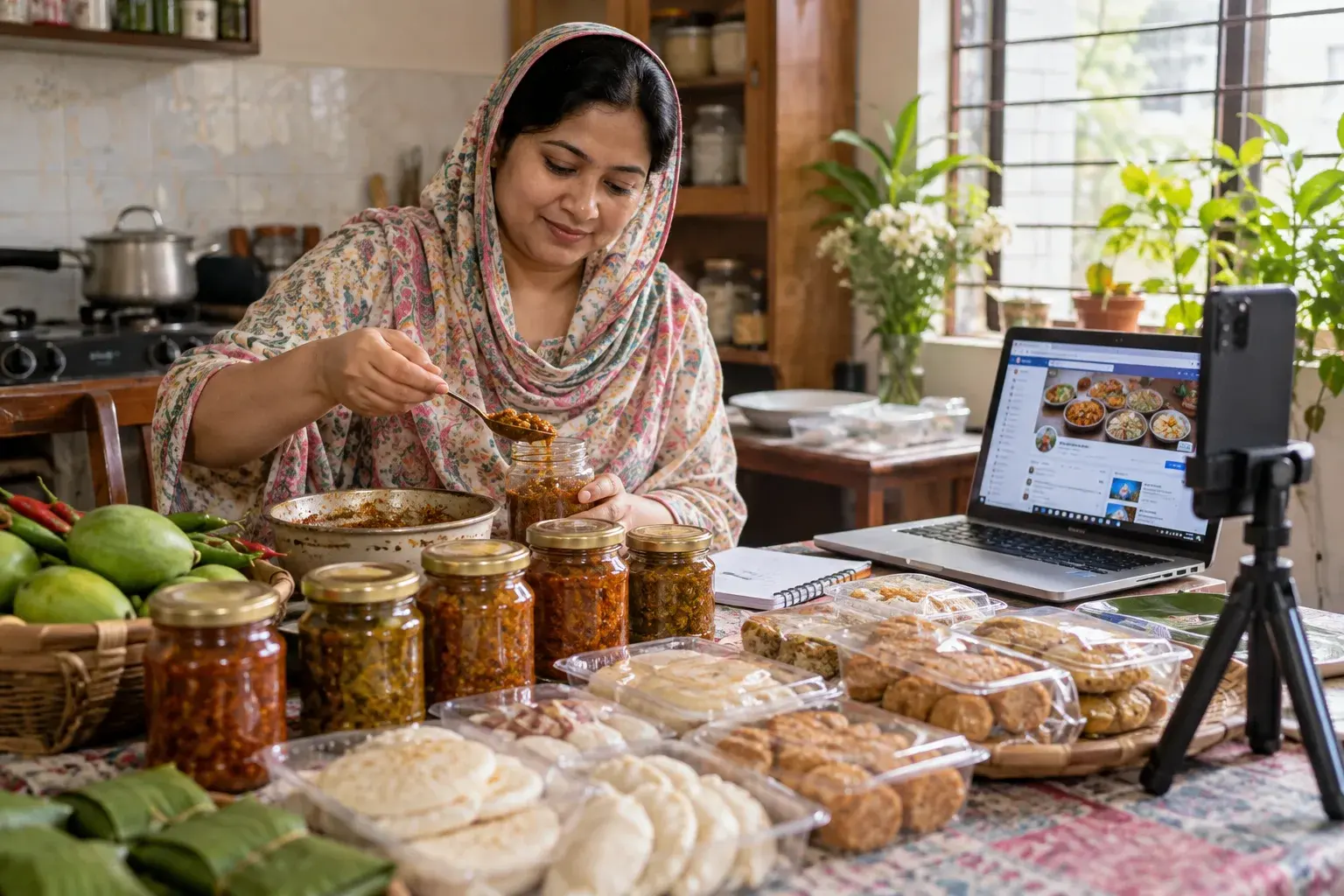
Home kitchen selling online
Cooking pickles, pitha and meals at home and selling them through a Facebook page. A jar of pickle sells for Tk 150-465, and the 2026 food safety rules now require packaged-food registration at Tk 1,000 for three years.
- Capital
- ৳5k – ৳60k
- People
- 1 – 3
- First income
- 7 – 30 days
 Food processing
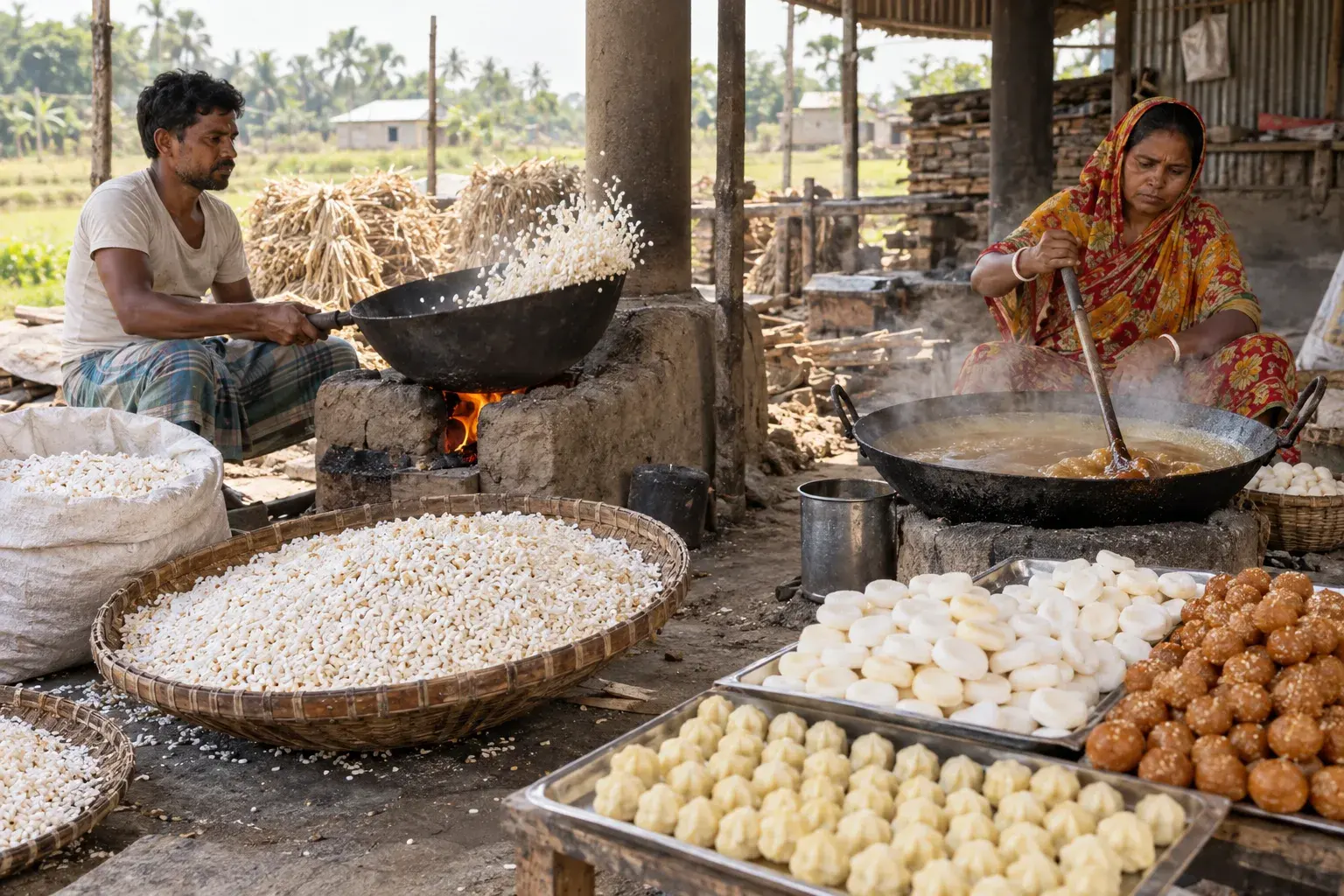
Khoi and batasa making
Popping paddy into khoi and boiling sugar or gur into batasa and kadma. Wholesale sugar is Tk 102-103 a kg and batasa sells at Tk 190-300. Very low capital and no BSTI CM licence.
- Capital
- ৳15k – ৳1.5 lakh
- People
- 2 – 6
- First income
- 10 – 40 days
 Food processing
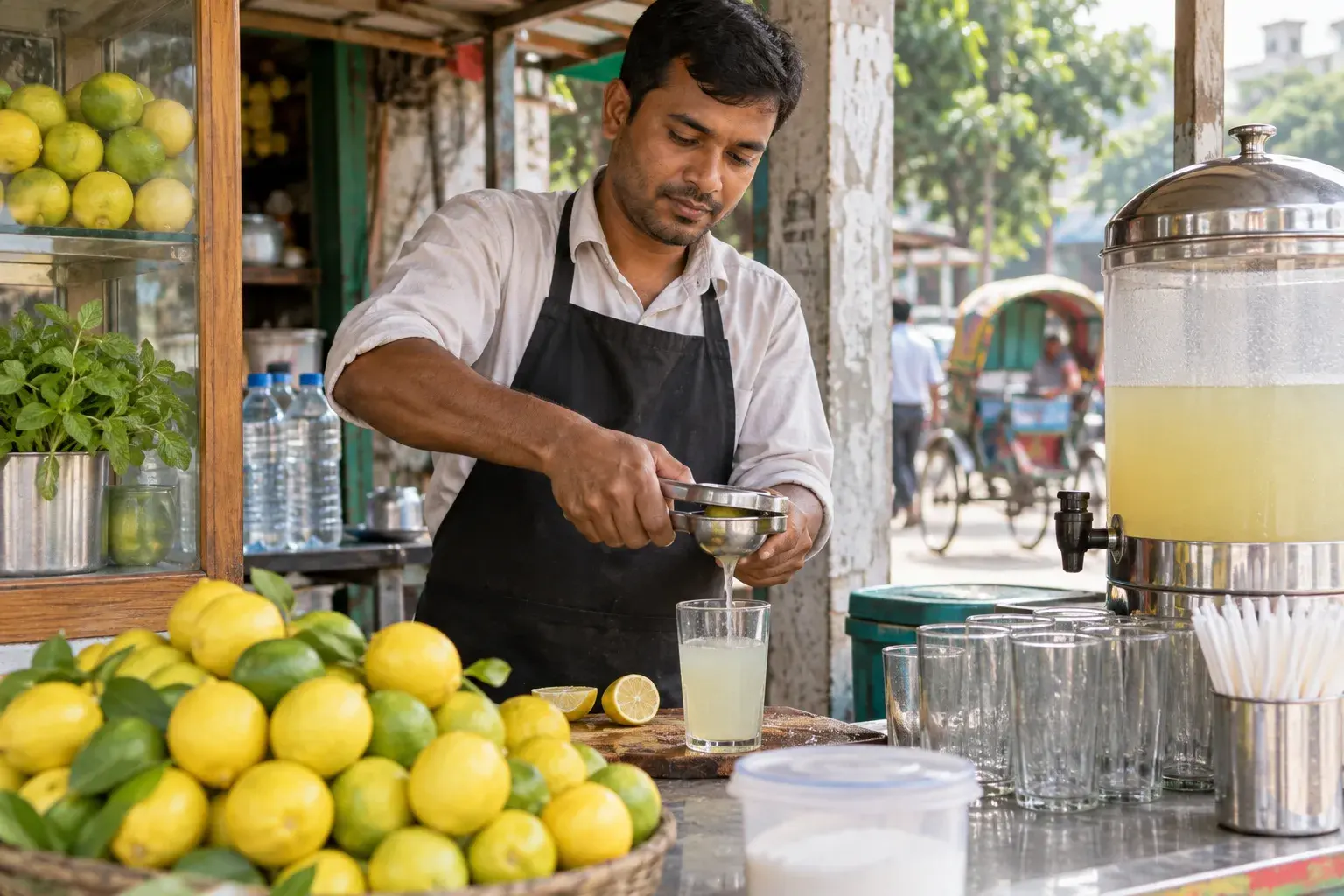
Juice and sharbat shop
Lemon, sugarcane and bael sharbat through the hot months at Tk 10-25 a glass, lassi at Tk 50. The trade stands on three things: ice, electricity and one hot season.
- Capital
- ৳15k – ৳3 lakh
- People
- 1 – 4
- First income
- 5 – 45 days
 Food processing
Puffed rice (muri) making
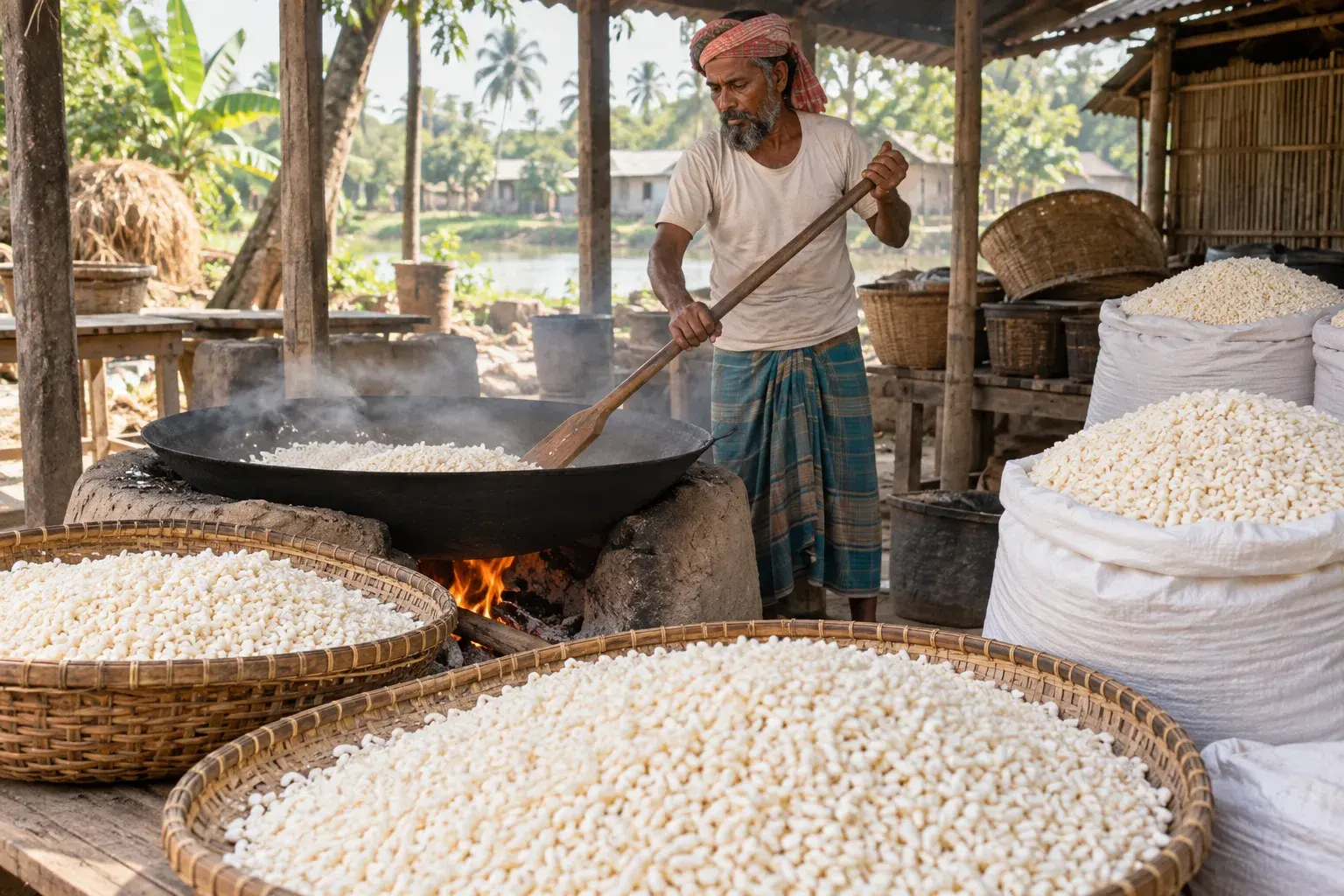
Frying rice into muri. One kilo of rice gives 900 grams of muri and coarse rice costs Tk 50-55/kg, so machine muri keeps only Tk 4-6 a kilo while hand-fried pure muri wholesales at Tk 90.
- Capital
- ৳20k – ৳2 lakh
- People
- 2 – 8
- First income
- 7 – 30 days