
Pigeon and bird rearing
Rearing pigeons on a roof or in a yard with no land at all. A pair sells for Tk 500-5,000 at Bhojeshwar hat, and one Jashore farmer's 400 birds cost Tk 20,000 a month to keep against Tk 30,000-35,000 of sales.
- Last reviewed: 19 September 2026
- Version 1

Pigeon and bird rearing
- Starting capital
- ৳15,000 – ৳1,50,000 Editorial estimate
- Manpower
- 1 – 2 people
- First sale
- 45 – 75 days Practitioner verified
- Break-even
- 12 – 17 months Editorial estimate
- Kind of work
- Farm · Easy
About the business
Rearing pigeons in cages and a tin shed on the roof or in the yard. No land is needed, and that is the whole point: a city family without an inch of ground can run a farm on a 900 square foot roof. Raju Ray of Mohiran village in Bagharpara, Jashore, started in 2018 with seven pairs given by friends. His roof now carries about 400 pigeons of 16 breeds worth six to seven lakh taka. His accounts are open: about Tk 15,000 a month on feed and roughly Tk 5,000 on medicine, against Tk 30,000 to 35,000 a month from selling birds. One pigeon eats two to three taka of feed a day, and he mixes it himself from wheat, maize, mung, sunflower, paddy, groundnut, chhola, kaun, china and bajra. The breeding arithmetic matters too: the hen lays 8-10 days after pairing, the egg hatches in 18 days, the squab flies at 45 days and the bird is adult at six months. Prices follow breed and age. At the Bhojeshwar hat in Naria, Shariatpur, where a pigeon market has run on Fridays and Mondays for a hundred years, a pair fetches Tk 500 to Tk 5,000, and those two days turn over Tk 30-40 lakh of birds. Fancy breeds go far higher: on Raju's farm a pair ranges from two thousand to a lakh.
Unit economics
| Item | Range | Evidence | Suggest a correction |
|---|---|---|---|
| Monthly working capital | ৳15,000 – ৳20,000 | Practitioner verified | |
| Selling price | ৳500 – ৳5,000 / unit | Market quote | |
| Variable cost | ৳300 – ৳600 / unit | Editorial estimate | |
| Gross margin | 33% – 43% | Editorial estimate | |
| Time to first revenue | 45 – 75 days | Practitioner verified | |
| Break-even time | 12 – 17 months | Editorial estimate | |
| Cash cycle | 45 – 75 days | Editorial estimate | |
| Waste / loss | 10% – 20% | Editorial estimate | |
| Daily capacity | 0.1 – 1.3 | Editorial estimate |
What you need to start
- Iron wire cages, nesting boxes, feed and water pots, and leg tags carrying a serial and mobile number for the flying birds.Equipment
- Breeding pairs at Tk 500-5,000 at a market like Bhojeshwar. Raju Ray began with seven pairs. Feed is wheat, maize, mung, sunflower, paddy, groundnut, chhola, kaun, china and bajra, at Tk 2-3 per bird per day.Starting stock
- Trade licence from the union parishad, municipality or city corporation once you sell regularly: form Tk 10, licence book Tk 50, standard tax Tk 30, stamp Tk 150-300, licence fee Tk 100-60,000 by trade type, issued in 3-5 working days. Hobby keepers do not take one.Licence
- Reading the birds' temper, knowing what care each kind of weather needs, and pairing them to raise young. Raju Ray took no training and learned it by keeping them.Skill
- The weekly pigeon hat (Fridays and Mondays at Bhojeshwar), the feed, medicine and cage shops beside it, and the local pigeon keepers' party.Supplier
- A roof or yard: a 900 square foot roof carries a 400-bird farm. It needs a brick or tin shed, wire mesh inside and out, and a fenced open space for flying. No land is required, and that is the whole advantage of this trade.Workspace
How the work is done
- 1Look at the roof or yard first. Raju Ray fitted two tin sheds on a 900 square foot roof, another shed on the stairwell roof and three wire cages, and that is a realistic measure.
- 2Get the landlord's or the family's permission. A pigeon loft means daily droppings, feathers and noise, and that is where trouble with neighbours starts. Never let water stand on the roof.
- 3Build the loft: brick or tin, wire mesh inside and out, and a fenced open space in front for flying. Without mesh, cats and hawks take the squabs.
- 4Divide the shed into three: a room for hens, a room for cocks and a breeder room. To take young, one pair is put together in the breeder room. Without this division you have no control over breeding at all.
- 5Buy pairs at a hat. At a market like Bhojeshwar trading runs from dawn to noon on Friday. Start with cheap local or giribaj pairs and leave the expensive breeds for later.
- 6Mix the feed yourself from wheat, maize, green mung, sunflower, paddy, groundnut, chhola, kaun, china and bajra. Budget two to three taka of feed per bird per day. Ready-made feed pushes the cost up.
- 7Budget for medicine and vaccination from the start: about Tk 5,000 a month on a 400-bird farm. When disease spreads the loss is far bigger than the feed bill.
- 8Tag the legs of flying birds with a serial number and your mobile number. Raju lost 25 pigeons and got only two back, and without the tag he would not have had even those.
- 9Learn which breed sells where. Giribaj carries both the highest price and the highest demand, and prices of a breed rise after a high-flyer tournament. There are about eight tournaments a year.
- 10Join a local pigeon keepers' party or group. Raju got 20 pairs from a party in Narayanganj; for a new keeper the breeds, the prices and the buyers all come through that network.
- 11Keep a book: which pair laid when, how many young survived, and what each sold for. Without it you never learn which pair is paying and which is only eating.
Seasons
- JanNormal
- FebNormal
- MarNormal
- AprNormal
- MayNormal
- JunNormal
- JulNormal
- AugNormal
- SepNormal
- OctNormal
- NovNormal
- DecNormal
Where it works well
- Strong fitJashore · At Mohiran village in Bagharpara a 400-bird farm of 16 breeds runs on a 900 square foot roof, and the Khulna bird market is close by.
- Strong fitMadaripur · People come regularly from Kalkini, Sadar and Shibchar to Bhojeshwar hat, so both buying and selling markets are close at hand.
- Strong fitNarayanganj · There are organised pigeon keepers' parties here, one of them with 19 members, and new keepers get their pairs and breeds through them.
- Strong fitShariatpur · Bhojeshwar hat on the bank of the Kirtinasha in Naria: a hundred years old, held on Fridays and Mondays, turning over Tk 30-40 lakh of pigeons in those two days, with feed, medicine and cage shops beside it.
- PossibleBogura · The commercial centre of the north with cheap grain feed close by, though there are fewer buyers for expensive breeds.
- PossibleCumilla · There is an old tradition of busy pigeon markets here, and traders move easily on the Dhaka-Chattogram highway.
- PossibleDhaka · A pigeon market runs at Kaptanbazar and city roofs can carry a loft, but neighbours' and landlords' objections are the real obstacle here.
- PossibleKhulna · A regular bird market runs here selling not just pigeons but many kinds of animals, so the buyer base is good.
Risks and cautions
- HighSpoilage: Disease. On a 400-bird farm medicine alone runs about Tk 5,000 a month, a quarter of the total cost, just to keep it out. In a crowded loft with dirty mesh and nests, disease travels through the whole shed in a day, and when it does it takes many birds at once. This is where the biggest single loss in this trade comes from.
- HighOther: Flying birds get lost. Raju Ray lost 25 pigeons and recovered only two, and only because his mobile number was on the leg tag. High-flyers are the most valuable birds and they are the ones that go. Hawks, cats and theft take a steady toll too.
- MediumDependency: Almost the entire cost is grain: wheat, maize, chhola, groundnut. When grain rises the cost rises immediately, while pigeon prices do not follow. Retail chhola was Tk 100-110 a kg in 2026, and even if only a quarter of the mix is bought grain it is a large monthly number.
- MediumDemand: The market for expensive pigeons is a hobby market. Prices rise after tournaments and fall when interest cools. There is no fixed rate for a lakh-taka pair; on a day with no buyer there is no price. Those who buy for meat pay far less, so tying too much capital up in fancy breeds is a risk.
- MediumWorking capital: Feed money goes out every month in advance, while sales happen on market days and only if a buyer turns up. Tk 20,000 a month for 400 birds is fixed; a slow month has to be paid from the household, and cutting the feed drops both the birds' condition and their price.
Sources
সিটি কর্পোরেশন থেকে ট্রেড লাইসেন্স প্রাপ্তির ধাপ সমূহ
Collected: 16 Sept 2026Supports: Starting capital · বাংলাদেশ
- Collected: 15 Sept 2026
Supports: Monthly working capital · ঢাকা মহানগর — সিপাহীবাগ, মিরপুর-৬, মোহাম্মদপুর টাউন হল, নিউমার্কেট, রামপুরা, মহাখালী বাজার
What changed
No corrections have been published yet.
Questions and answers
No questions yet. Be the first to ask.
Stories about this business
Two pairs of pigeons kept for pleasure, now 700 birds and 70,000-80,000 a month
A 5,000-taka stationery shop in class nine, two pairs of pigeons bought for pleasure in 2014: now about 700 birds of 20 breeds worth 8-9 lakh taka, and 70,000-80,000 taka a month from the birds and two shops.
- Capital
- ৳5k
- Reasons
- Weak demand, Good quality
Similar businesses
 Agriculture & farming
Bamboo cultivation
Planting bamboo clumps and cutting culms year after year. Nothing can be cut for the first 3-4 years after planting; after that a culm fetches Tk 100-250 in the village and Tk 125-350 wholesale at the market.
- Capital
- ৳15k – ৳3 lakh
- People
- 1 – 4
- First income
- 1,095 – 2,920 days
 Agriculture & farming
Medicinal plant farming
Growing basok, kalomegh, tulsi and arjun. The buyers are medicine companies, so the price is set by contract or tender: a bigha of kalomegh costs Tk 15,000, yields 20-22 maunds and sells at Tk 2,400 a maund.
- Capital
- ৳15k – ৳1 lakh
- People
- 1 – 5
- First income
- 90 – 365 days
 Agriculture & farming
Char land farming and groundnut
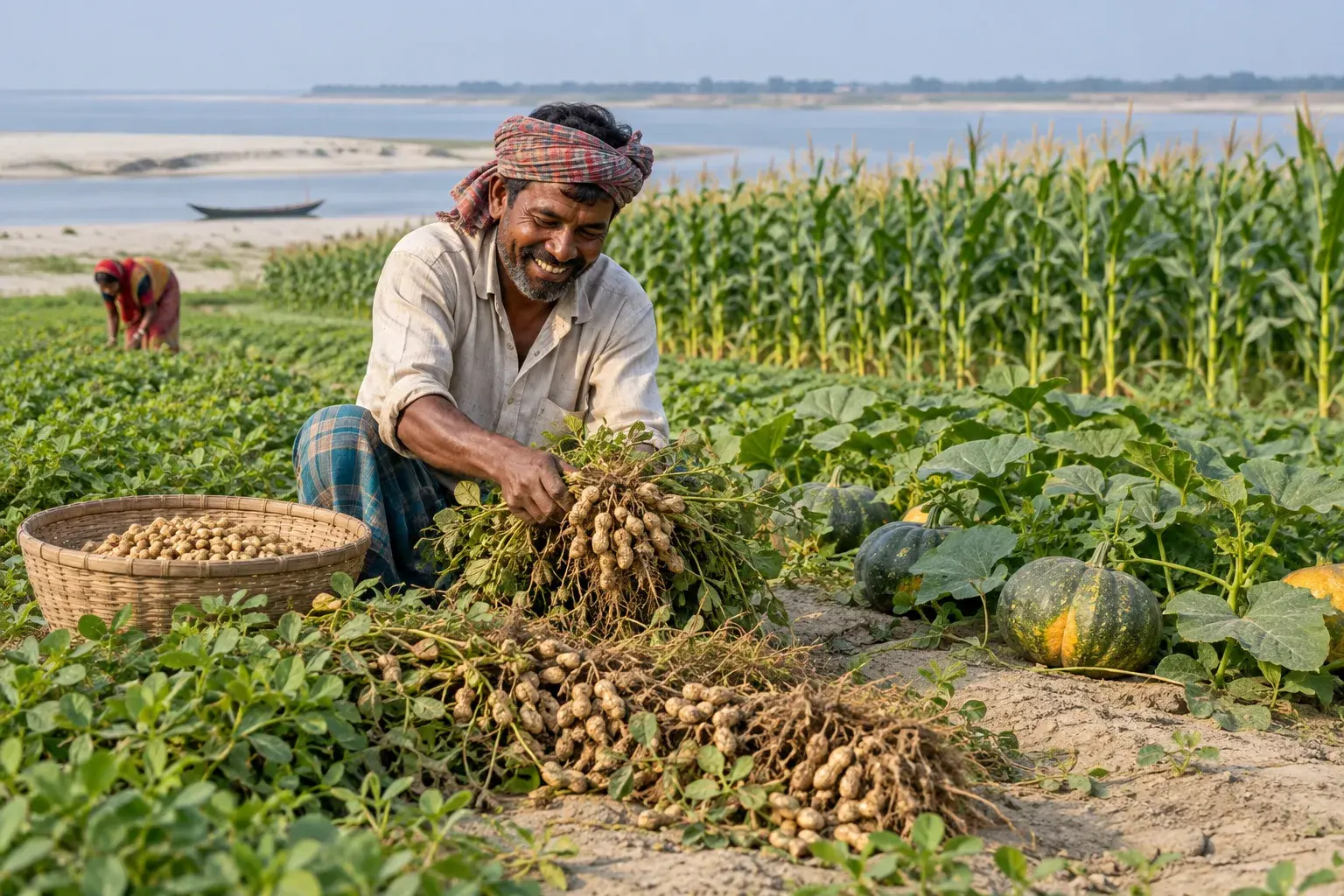
Growing groundnut, maize and pumpkin on river chars. The land is close to free: Tk 16,000 on 25 decimals returned Tk 26,400, and an acre costs Tk 65,000 to return about Tk 137,000.
- Capital
- ৳16k – ৳65k
- People
- 1 – 5
- First income
- 100 – 120 days
 Agriculture & farming
Cotton farming
Sold at the price the Cotton Development Board sets, Tk 3,900 a maund of seed cotton in 2025-26. At the national average yield of about 7.6 maunds a bigha that is roughly Tk 30,000 a bigha for six to seven months of land.
- Capital
- ৳16k – ৳1 lakh
- People
- 1 – 6
- First income
- 150 – 240 days