
Summer tomato farming
Planted in December, sold April to June. Tk 70,000-80,000 a bigha, 300-400 maunds of fruit, Tk 1,000-1,800 a maund, and Tk 3-4 crore a day changing hands at Gabura Bazar in Dinajpur.
- Last reviewed: 19 September 2026
- Version 1
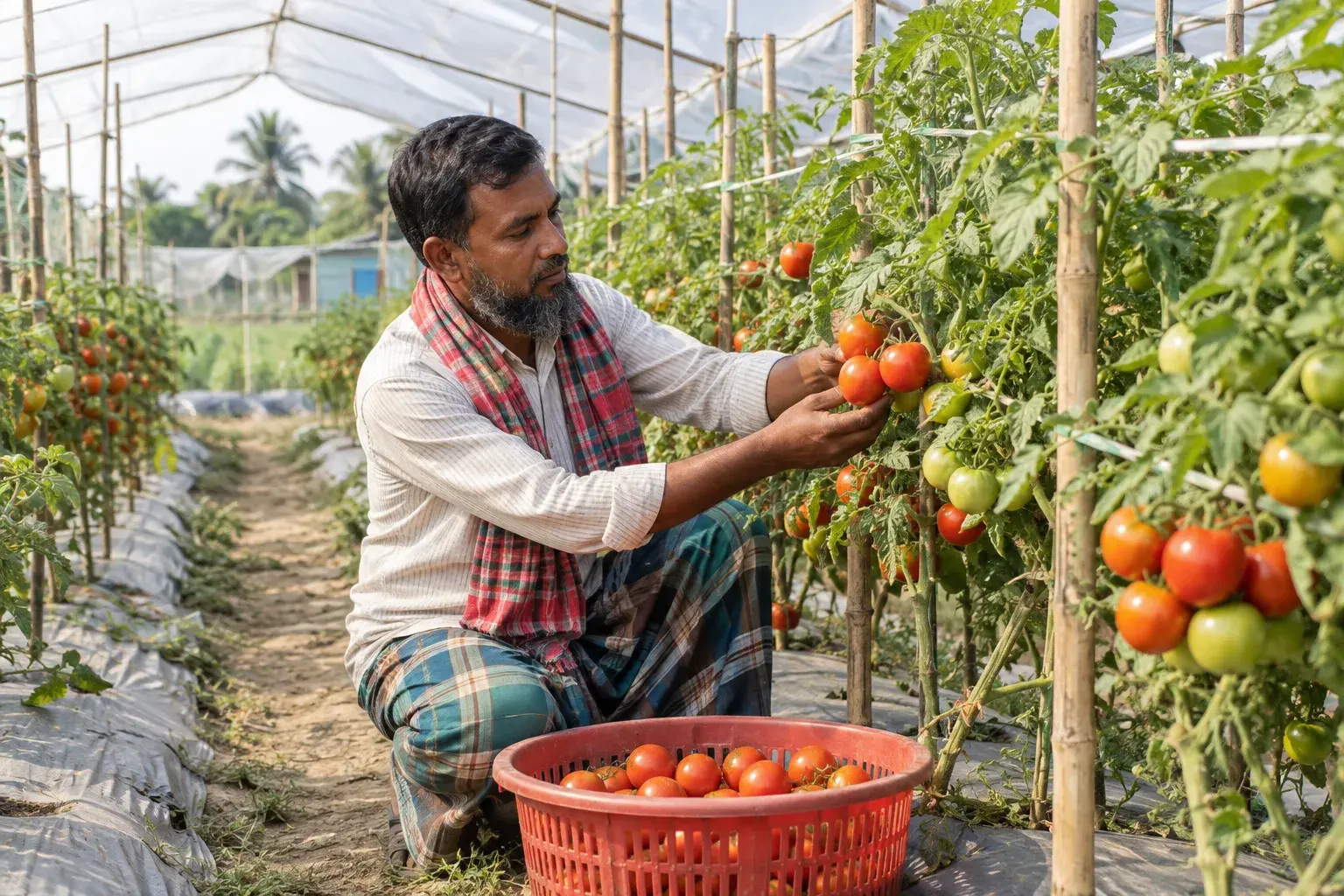
Summer tomato farming — an illustrative AI-generated picture, not a real business
- Starting capital
- ৳35,000 – ৳1,60,000 Practitioner verified
- Manpower
- 1 – 6 people
- First sale
- 90 – 120 days Practitioner verified
- Break-even
- 4 – 5 months Editorial estimate
- Kind of work
- Farm · Medium difficulty
About the business
Growing a winter crop in the heat. Seedlings go in around December, the plants fruit from March, and the tomatoes are in the market from April to June - exactly when the winter crop has finished. The country's summer tomato comes mainly from Dinajpur, Panchagarh, Thakurgaon and Jashore, and the biggest haat is Gabura Bazar in Dinajpur Sadar: more than 400 shops, over three hundred wholesalers arriving daily, 60 to 70 truckloads leaving a day and Tk 3-4 crore changing hands. The market for this crop already exists; you do not have to build it. The money works. Growers put the cost at Tk 70,000-80,000 a bigha for irrigation, fertiliser, drainage and pesticide, against 300 to 400 maunds of fruit, and at an average Tk 1,000 a maund that is Tk 3.5 lakh a bigha. Arafat Hossain of Gabura spent Tk 30,000 on half a bigha and sold Tk 1.5 lakh of tomatoes. Two things to keep in mind. First, planted area in Dinajpur went from 865 hectares to 1,108 in a single year, so supply is rising. Second, the 2026 price was good partly because rain had cut output, and with no cold storage there is no way to hold a perishable crop for a better price.
Unit economics
| Item | Range | Evidence | Suggest a correction |
|---|---|---|---|
| Monthly working capital | ৳17,500 – ৳20,000 | Editorial estimate | |
| Selling price | ৳25 – ৳45 / kg | Market quote | |
| Variable cost | ৳4 – ৳7 / kg | Practitioner verified | |
| Gross margin | 68% – 90% | Editorial estimate | |
| Time to first revenue | 90 – 120 days | Practitioner verified | |
| Break-even time | 4 – 5 months | Editorial estimate | |
| Cash cycle | 120 – 160 days | Editorial estimate | |
| Waste / loss | 10% – 20% | Editorial estimate | |
| Daily capacity | 75 – 400 | Editorial estimate |
What you need to start
- An irrigation pump and pipe, drainage channels, and crates holding 26-27 kg each.Equipment
- Seedlings, fertiliser and pesticide, all inside the Tk 70,000-80,000 a bigha. No source gives the seedling price separately.Starting stock
- Trade licence from the union parishad, municipality or city corporation: form Tk 10, licence book Tk 50, standard tax Tk 30, stamp Tk 150-300, licence fee Tk 100-60,000 by trade type. Carrying your own crop to the haat may not need it; opening an arat or trucking it yourself does.Licence
- Keeping tomato plants alive in the heat - the balance of irrigation, shade and drainage. Anyone can grow winter tomato; doing it in summer is the separate skill.Skill
- Arotdars and wholesale traders at the haat. Gabura Bazar has more than 400 shops and over three hundred wholesalers arrive daily.Supplier
- High land with drainage, measured in bighas (33 decimals). Half a bigha is enough to start: one Gabura grower got 170 maunds off half a bigha.Workspace
How the work is done
- 1Decide where the crop will be sold before anything else. The real advantage of summer tomato is a ready market: over three hundred wholesalers come to Gabura Bazar in Dinajpur Sadar every day. Check whether your area has a haat like that.
- 2Plant in December. Fruiting starts three months later in March; plant late and the crop arrives in the peak heat, when the flowers drop.
- 3Build drainage into the plot. Growers list drainage alongside irrigation and fertiliser in their costs; a summer shower that does not drain away kills the plants.
- 4Make the irrigation solid. The land dries out in summer, and a week without water ruins the crop.
- 5Get hold of crates. At Gabura Bazar a crate holds 26-27 kg, and wholesalers buy and sell by the crate.
- 6Decide whether to sell by the maund or send crates yourself. The market pays Tk 1,000-1,800 a maund by grade, and sending a crate to Dhaka costs Tk 220.
- 7Grade the fruit. On the same day the rate runs from Tk 1,000 to Tk 1,800 a maund, and the difference is grade alone. Sell unsorted and the whole lot goes at the lower rate.
- 8Work out the labour in advance. Sorting and packing at the Gabura arats pays Tk 350-400 a day, and in the peak weeks labour is hard to find at all.
- 9Do not try to hold a perishable crop. The district DAE deputy director says local cold storage would let growers hold the market from July to September, but it does not exist yet.
- 10Keep track of whether planted area near you is rising. In Dinajpur it went from 865 to 1,108 hectares in one year, and as the area grows the off-season price shrinks with it.
Seasons
- JanNormal
- FebNormal
- MarHigh
- AprHigh
- MayHigh
- JunHigh
- JulNormal
- AugNormal
- SepNormal
- OctNormal
- NovNormal
- DecNormal
Where it works well
- Strong fitDinajpur · Gabura Bazar in the sadar is the country's largest summer tomato haat: 400-plus shops, 60-70 truckloads a day, Tk 3-4 crore of trade. Planted area went from 865 to 1,108 hectares in a year.
- Strong fitJashore · The one district outside the north named as a main summer tomato centre, and the vegetable supply hub of the south-west.
- Strong fitPanchagarh · Where this crop started; Dinajpur took it up after Panchagarh. Wholesalers still collect from Panchagarh too.
- Strong fitThakurgaon · One of the main summer tomato producing centres, and close to Gabura Bazar.
- PossibleChandpur · Matlab Dakshin grows early tomato in September and October on the same principle - off-season fruit fetches more. One grower there put Tk 120,000 into 60 decimals against about Tk 7 lakh of tomatoes.
- PossibleNilphamari · Inside the Dinajpur-Thakurgaon belt, with the same soil and easy access to Gabura Bazar.
- PossibleRajshahi · One of the main tomato districts, but mostly a winter crop; summer planting here could not be verified.
- PossibleRangpur · Inside the northern vegetable belt, with both wholesale markets and trucks to Dhaka.
Risks and cautions
- HighDemand: The off-season price is the entire business case, and there is no guarantee it holds. Summer tomato in Dinajpur went from 865 hectares in 2024-25 to 1,108 hectares, 243 more in one year. Dinajpur started because Panchagarh did, and now grows more than Panchagarh. If supply keeps climbing like that, the summer price drifts down towards the winter one.
- HighSpoilage: Tomato is perishable and there is no way to hold it. The arotdars say so themselves: because it rots they have to sell on a thin margin. The district DAE deputy director says more local cold storage would get growers a better price and let them hold the market from July to September. A Dhaka retailer reckons about one kilo in every 22 kg crate is spoiled.
- MediumOther: The weather cuts the yield and lifts the price at the same time, and it cuts both ways. In 2026 rain had reduced output, which is why growers got a good price. The year whose figures you are looking at may be the exception. What the per-maund rate falls to in a good yield year was not found in any source.
- MediumDependency: A whole region leaning on one haat. Sixty to seventy truckloads leave Gabura Bazar a day; if the wholesalers stop coming or transport seizes up, the region's crop sits. There is no other summer tomato market this size in the surrounding districts, as a wholesaler of thirty years' standing says himself.
- MediumWorking capital: Four months from December to March of money going out and nothing coming in: Tk 70,000-80,000 a bigha, multiplying straight up on a larger plot. On leased land the rent falls in the same months, and that rent is not inside any cost figure on this page.
Sources
সিটি কর্পোরেশন থেকে ট্রেড লাইসেন্স প্রাপ্তির ধাপ সমূহ
Collected: 16 Sept 2026Supports: Starting capital · বাংলাদেশ
What changed
No corrections have been published yet.
Questions and answers
No questions yet. Be the first to ask.
Stories about this business
1.5-1.8 lakh a bigha to grow, over 3.5 lakh a bigha in sales
Summer tomato costs 150,000-180,000 taka a bigha, sells for over 350,000 and nets 150,000-200,000. Wholesale from the field held at 65-70 taka a kilo against 100 taka retail.
- Reasons
- Weak demand, Working capital
Similar businesses
 Agriculture & farming
Quail farming
Cage-reared quail. Laying starts in 35-45 days; an egg costs about Tk 1.20 to produce and sells wholesale at Tk 2.80-3.50. The market is narrow, and the bigger money is in selling chicks.
- Capital
- ৳35k – ৳2.5 lakh
- People
- 1 – 3
- First income
- 35 – 49 days
 Agriculture & farming
Banana cultivation
350-400 plants to a bigha, fruit in 10-13 months. Tk 150-200 a plant to grow, Tk 350-450 a bunch to sell, and the extension department puts profit at Tk 120-180 a plant.
- Capital
- ৳35k – ৳80k
- People
- 1 – 4
- First income
- 300 – 395 days
 Agriculture & farming
Watermelon farming
A three-month coastal crop. Tk 30,000-35,000 a bigha to grow, Tk 80,000 to a lakh a bigha in a good year, and a selling window only about two weeks wide.
- Capital
- ৳35k – ৳3.5 lakh
- People
- 2 – 10
- First income
- 90 – 120 days
 Agriculture & farming
Sheep rearing
Rearing sheep on open grazing in fields and chars. Before Qurbani 2026 one Joypurhat farmer sold 26 sheep for Tk 2,30,000, about Tk 8,800 each.
- Capital
- ৳30k – ৳2.5 lakh
- People
- 1 – 3
- First income
- 180 – 365 days