
Papaya farming
Fruit within six to seven months. About Tk 50,000 a bigha to grow, a wholesale rate of Tk 20-65 a kilo, and Tk 2 to 2.5 lakh of papaya possible off a bigha.
- Last reviewed: 19 September 2026
- Version 1
Papaya farming
- Starting capital
- ৳50,000 – ৳2,00,000 Practitioner verified
- Manpower
- 1 – 4 people
- First sale
- 180 – 240 days Practitioner verified
- Break-even
- 7 – 9 months Editorial estimate
- Kind of work
- Farm · Easy
About the business
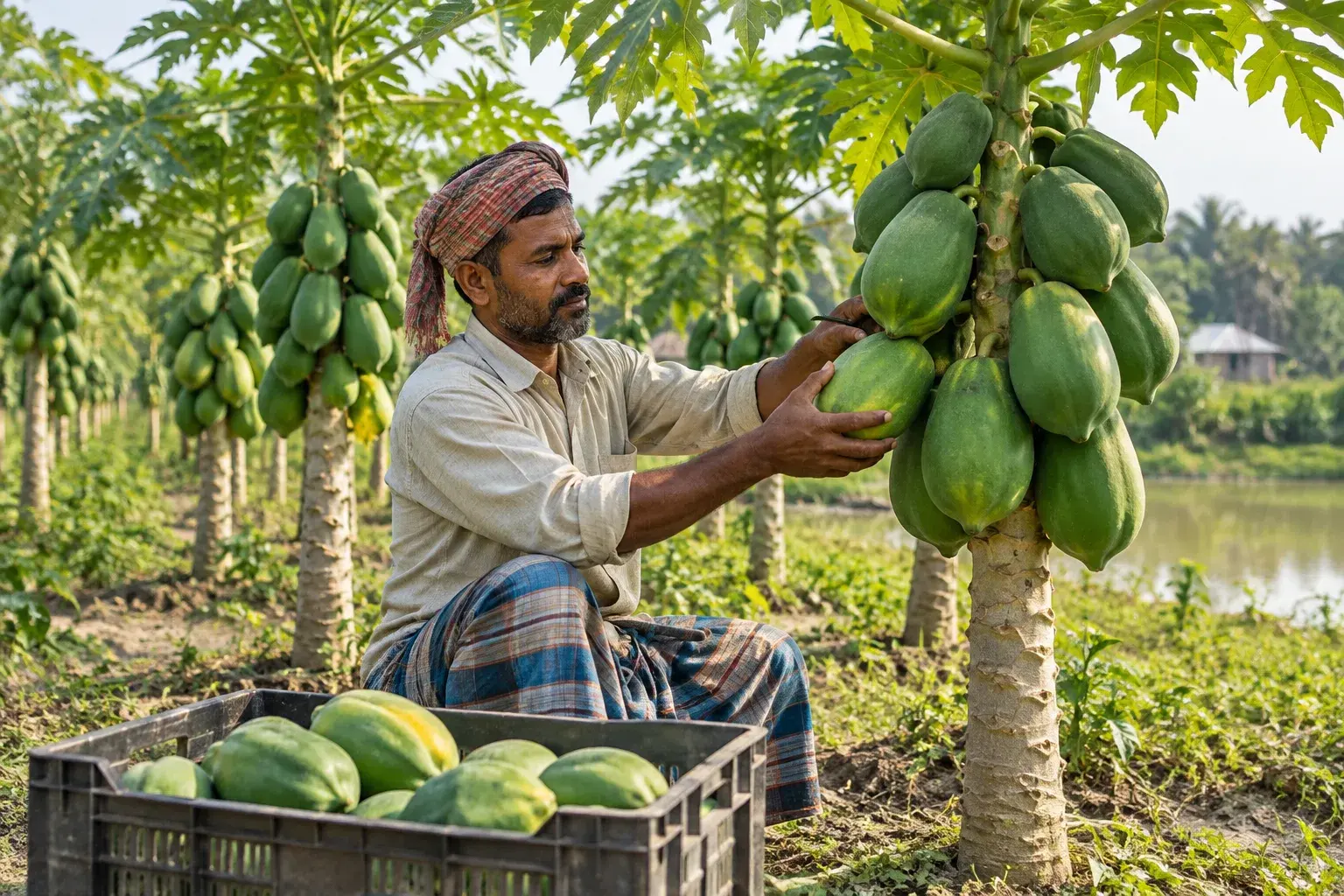
Planting papaya and selling the fruit green and ripe. Of the fruit crops this is the one that pays back fastest: plants start bearing six to seven months after planting, with none of the two or three year wait of mango or malta. Abdul Hannan of Darbeshpur in Kumarkhali, Kushtia, put 1,200 plants on three bighas and spent Tk 1.5 lakh on planting and care, about Tk 50,000 a bigha. Fruiting started in the eighth month, and in the first two months he sold 210 maunds wholesale for Tk 1.7 lakh at rates between Tk 20 and Tk 65 a kilo - a wide swing. By his own reckoning Tk 50,000 a bigha can produce Tk 2 to 2.5 lakh of papaya. One thing needs saying plainly, though. Of the Tk 10 lakh Hannan talks about, Tk 5.6 lakh is seed: 80 kg at an average Tk 7,000 a kilo. Seed production is separate work, a separate skill and a far smaller market. Fruit alone on three bighas comes to about Tk 4.5 lakh, less the Tk 1.5 lakh spent. That is still a good number, but do not take land on the strength of the ten-lakh story.
Unit economics
| Item | Range | Evidence | Suggest a correction |
|---|---|---|---|
| Monthly working capital | ৳15,000 – ৳50,000 | Editorial estimate | |
| Selling price | ৳20 – ৳65 / kg | Practitioner verified | |
| Variable cost | ৳6 – ৳9 / kg | Editorial estimate | |
| Gross margin | 55% – 85% | Editorial estimate | |
| Time to first revenue | 180 – 240 days | Practitioner verified | |
| Break-even time | 7 – 9 months | Editorial estimate | |
| Cash cycle | 120 – 210 days | Editorial estimate | |
| Waste / loss | 10% – 20% | Editorial estimate | |
| Daily capacity | 400 | Practitioner verified |
What you need to start
- An irrigation pump and pipe, plus drainage channels in the plot.Equipment
- Seed or seedlings, about 400 a bigha. The unit price of a seedling could not be verified; one source puts the cost behind each plant at Tk 150-200, without separating out the seedling itself.Starting stock
- Trade licence from the union parishad, municipality or city corporation: form Tk 10, licence book Tk 50, standard tax Tk 30, stamp Tk 150-300, licence fee Tk 100-60,000 by trade type. Selling off the field to a wholesaler may not need it; trading seed or seedlings does.Licence
- Keeping water off the base of the plant and cutting at the right time. Cut too green and the weight is low; too ripe and it spoils on the road.Skill
- A wholesaler or byapari in the local market, and a seed and seedling trader if you want to sell seed.Supplier
- High, well-drained land measured in bighas (33 decimals). Work out the area at 400 plants a bigha.Workspace
How the work is done
- 1Fix the variety. Kumarkhali grows the Manikganj Shahi local type; the upazila agriculture officer says it gets less disease and yields well.
- 2Take high land that drains. Water standing at the base rots the plant, and a rotted plant does not come back.
- 3Take seed or seedlings from somewhere you trust. Taking seed from a successful grower's orchard means you know the variety; in Kumarkhali growers take seed from each other.
- 4Plant about 400 seedlings a bigha in rows. Crowd them and the plants get less light and air, and the fruit stays small.
- 5Arrange irrigation and cut drainage channels in the plot. You need water in the dry months and a way to get it off in the rains - both.
- 6Budget no income for the first six or seven months. Keep the fertiliser, irrigation and labour money for that period aside.
- 7Sell green papaya as a vegetable and ripe papaya as fruit. Green papaya moves all year and does not spoil as fast, so the risk is lower.
- 8Do not hand everything to one wholesaler. The rate swings from Tk 20 to Tk 65 inside a month; check two or three buyers before you start cutting.
- 9Treat seed production as a separate business, not a bonus on the fruit. Seed goes at an average Tk 7,000 a kilo, but the market is small and the buyers are few. Line up the buyer first, then keep plants back for seed.
- 10Start small. Amal Kumar Biswas of Darbeshpur spent Tk 10,000 on 15 decimals and has sold Tk 30,000 of papaya so far. Learn on that scale, then take more land.
Seasons
- JanNormal
- FebNormal
- MarNormal
- AprNormal
- MayHigh
- JunHigh
- JulHigh
- AugHigh
- SepHigh
- OctHigh
- NovNormal
- DecNormal
Where it works well
- Strong fitKushtia · About 200 bighas are under papaya in Kumarkhali upazila this year; the Manikganj Shahi variety does well there and growers take seed from each other.
- Strong fitManikganj · The variety Kushtia grows is called Manikganj Shahi, so this is where it comes from and where seed and seedlings are easiest to find.
- PossibleBogura · The vegetable trading centre of the north, with easy dispatch to Dhaka along the highway.
- PossibleChuadanga · Next to Kushtia, with the same soil and the same market network.
- PossibleJashore · A major vegetable supply area with both the trucks and the arats for sending to Dhaka.
- PossibleNarsingdi · Big vegetable haats and a short run to Dhaka, which for a perishable fruit is the main advantage.
- PossibleRangpur · Plenty of high sandy-loam land, with wholesale vegetable markets close by.
- PossibleTangail · Close enough to Dhaka that ripe papaya reaches the market before it goes off.
Risks and cautions
- MediumDependency: Counting on seed income is dangerous. Of one grower's Tk 10 lakh, Tk 5.6 lakh is seed, but the buyers are a handful of seed and seedling traders. If they do not take it, 80 kg of seed sits unsold and the whole arithmetic changes.
- HighDemand: The price swings. Within the same two months Hannan sold at anything from Tk 20 to Tk 65 a kilo, a threefold spread. Green papaya is one of the cheapest things in the vegetable market, so when all vegetable prices fall papaya falls further. When the crop comes in together, the price breaks in the field.
- HighSpoilage: Ripe papaya keeps only a few days. Left on the plant the birds take it; cut, it softens fast, and a soft fruit is either refused or taken at half price. There is effectively no cold storage for this crop.
- HighOther: Waterlogging at the base or a virus kills the plant, and replacing a dead plant means another six-month wait. Lose a large share of the 400 plants on a bigha and the season is gone. No source gives a disease rate or a cost for it.
- MediumWorking capital: Money first, fruit later. Tk 50,000 a bigha goes in over six or seven months before any of it comes back. On leased land the rent falls in the same period.
Sources
সিটি কর্পোরেশন থেকে ট্রেড লাইসেন্স প্রাপ্তির ধাপ সমূহ
Collected: 16 Sept 2026Supports: Starting capital · বাংলাদেশ
What changed
No corrections have been published yet.
Questions and answers
No questions yet. Be the first to ask.
Stories about this business
1.5 lakh taka on three bighas of papaya, 1.7 lakh sold in the first two months
Alongside his school job he planted 1,200 seedlings on three bighas in 2025 at a cost of 150,000 taka. Flowering came at four months and fruit at five; the first two months of picking sold 210 maunds for 170,000 taka, covering his costs.
- Capital
- ৳1.5 lakh
- Ran for
- 5 months
- Reasons
- Working capital, Weak demand
Similar businesses
 Agriculture & farming
Poultry and duck hatchery
Setting eggs in an incubator and selling day-old chicks to farmers. Ducklings cost Tk 30-35 and sell at Tk 72-75, but chicken chick prices swing from Tk 25 to Tk 85 and back to Tk 5 within months.
- Capital
- ৳50k – ৳8 lakh
- People
- 2 – 15
- First income
- 28 – 60 days
 Agriculture & farming
Aloe vera farming
Cutting aloe leaves and selling them to companies. About Tk 50,000 a bigha to grow and Tk 1.5-2.5 lakh of leaves, but the only buyers are a few pharmaceutical and juice companies.
- Capital
- ৳50k – ৳2 lakh
- People
- 1 – 6
- First income
- 90 – 120 days
 Agriculture & farming
Milk collection and supply
Buying milk from farmers and delivering it to chilling centres and shops. Farmers get Tk 35-50 a litre and plants pay Tk 48-58; that gap is the business.
- Capital
- ৳50k – ৳4 lakh
- People
- 1 – 4
- First income
- 7 – 21 days
 Agriculture & farming
Cashew and coffee farming
Cashew and coffee orchards on hill land. Farmers get Tk 180-200 a kg for raw cashew and Tk 350-400 for raw coffee, but the first crop comes three to four years after planting for coffee and four to five for cashew.
- Capital
- ৳50k – ৳5 lakh
- People
- 1 – 6
- First income
- 1,095 – 1,825 days